A strong and resilient fighting cock can only be developed through proper and consistent training. Such training, however, can be carried out effectively only when the bird is in good health. In reality, fighting cocks are often vulnerable to various diseases that can strike at any time. Therefore, enthusiasts must remain vigilant and address these health challenges by strengthening the immune system of their fighting cocks.
Diseases in Fighting Cocks
Disease threats that constantly lurk can attack the health of fighting cocks at any time, especially during extreme weather conditions. The current period of high rainfall can cause stress in fighting cocks and weaken their immune systems. This increases their susceptibility to various diseases, making them more prone to illness. The following are some common diseases that fighting cocks are particularly vulnerable to:
Coryza (cold, nasal discharge, swollen face)
Coryza is caused by the bacterium Avibacterium paragallinarum (Av. paragallinarum), and its incidence commonly increases during seasonal transitions or the rainy season. This disease can affect fighting cocks of all ages and has significant impacts, such as difficulty in achieving target body weight, decreased performance during training and competition, and, if left untreated, potential mortality.The most characteristic symptom of coryza is acute inflammation of the upper respiratory tract, including the nasal cavity, accompanied by exudate that initially appears as thin yellowish mucus but gradually becomes thick, purulent, and foul-smelling (fishy odor). Affected birds often sneeze, experience labored breathing, and produce rattling sounds. Other symptoms include swelling of the infraorbital sinus (below the eyes), conjunctivitis, eyes stuck shut, loss of appetite, and in some cases, diarrhea.
Chronic Respiratory Disease (CRD)
CRD, or Chronic Respiratory Disease commonly known as “ngorok” in local terms—is caused by Mycoplasma gallisepticum, a bacterium that can infect chickens of all ages. This bacterium lacks a cell wall, making it sensitive to disinfectants, heat, and sunlight. However, due to the absence of a cell wall, it is resistant to antibiotics from the penicillin group, which target bacterial cell walls.Transmission of CRD can occur vertically, from infected hens to their offspring through eggs, and horizontally, either through direct contact with infected birds or indirectly via contaminated equipment, feed, or personnel. It is also important to note that chickens that recover from this disease can become carriers and act as sources of infection for other birds.Clinical symptoms may vary from subclinical to severe, depending on the degree of infection. Common signs include nasal discharge, rattling or wheezing sounds (“ngorok”), and inflammation of the conjunctiva, causing swelling and watery eyes.One critical aspect of CRD is its immunosuppressive effect, which weakens the bird’s immune system. The infection damages the cilia in the respiratory tract, making it easier for other pathogens to invade. In field conditions, CRD cases are often complicated by secondary infections such as colibacillosis, resulting in what is known as CRD complex.
Fowl cholera (greenish droppings)
Fowl cholera is caused by the bacterium Pasteurella multocida, which can survive for several months in soil or decaying organic matter but is easily destroyed by most disinfectants or direct sunlight. Outbreaks of fowl cholera can be triggered by several factors, including stress from extreme weather, excessive physical training, infections caused by immunosuppressive diseases, and poor, damp housing conditions. Chickens that recover from this disease may act as carriers, continuing to spread the infection.Cholera is highly contagious and spreads horizontally, both through direct contact with infected birds and indirectly through contaminated equipment, feed, or water. Clinical signs include lethargy, dull feathers, increased respiratory rate, and discoloration of the comb and wattles turning bluish-purple (cyanosis). Diarrhea initially appears yellow and watery, later becoming greenish and mucus-laden.In some cases, fowl cholera can also develop into a chronic form, often following an acute phase caused by a less virulent bacterial strain. In such cases, local infections may occur, characterized by swelling of the wattles, joints, footpads, or infraorbital sinuses.
Disease
Highly pathogenic avian influenza (HPAI) is characterized by a rapid disease progression and a high mortality rate. Clinical symptoms commonly observed include bluish discoloration (cyanosis) of the comb, wattles, and legs; inflammation of the conjunctiva; accumulation of mucus in the oral cavity; and respiratory distress such as coughing, sneezing, and rattling sounds. In some cases, nervous disorders like torticollis (twisted neck) may also occur, although they are not always prominent.Post-mortem examination reveals inflammation in the upper respiratory tract, including the nasal sinuses, larynx, and trachea. The lungs appear darkened, and the air sacs become cloudy. In the digestive tract, inflammation may be found in the proventriculus, intestines, cecal tonsils, and pancreas. Hemorrhages are often seen as pinpoint bleeding on the heart and body fat, dilation of brain blood vessels, and hemorrhages in thigh or breast muscles.Meanwhile, Newcastle Disease (ND)—particularly the virulent form—can present as an acute infection with a high mortality rate. Infected chickens exhibit lethargy, loss of appetite, respiratory distress (“ngorok”), and greenish-moss-colored diarrhea often mixed with white clots. Neurological symptoms, such as a twisted neck (torticollis), are also common.Upon necropsy, lesions typically include inflammation of the larynx and trachea, congestion and erosion of the proventricular papillae, and inflammation of the cecal tonsils and Peyer’s patches.
Ringworm / Fungal
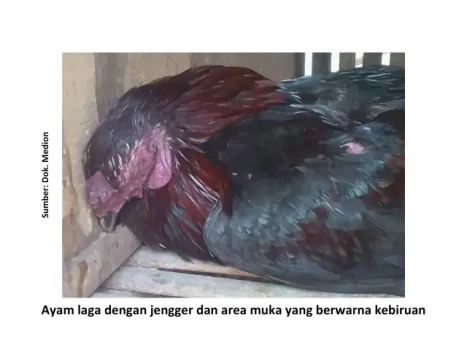
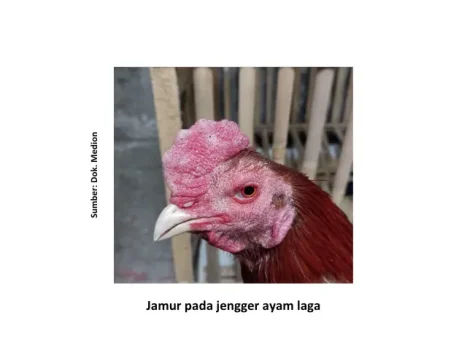
“Korep,” or ringworm, remains a common topic of concern among fighting cock enthusiasts, especially during the rainy season. Korep is a fungal skin infection that deserves special attention because it can significantly affect the bird’s performance. The most frequently identified fungal species causing this condition is Microsporum gallinae, although other fungi such as Microsporum gypseum, Trichophyton megnini, Trichophyton simii, and Epidermophyton sp. may also be involved. Clinical signs of korep typically appear as white, crusty lesions on featherless areas of the skin. These lesions can expand to nearby skin surfaces, including the base of feather follicles. In severe cases, infected birds may experience itching, feather loss, and thickened skin (hyperkeratosis). Among fighting cocks, fungal infections most often occur on the comb and facial area. If left untreated, the fungus can rapidly spread to other parts of the skin, leading to extensive feather loss. The affected skin usually appears dry, scaly, and thickened. Feather loss commonly starts on the top of the head but can spread to the neck or wings. Since feathers play a crucial role in maintaining performance and appearance, fungal infections like korep can have a serious impact on a fighting cock’s condition and competitiveness.
Worm Infestation
Just like layer and broiler chickens, fighting cocks are also at risk of worm infestation. The main factor triggering worm infection in fighting cocks is poor hygiene management. Worms that infect the digestive tract can damage the intestinal lining (intestinal villi epithelium) and cause necrosis of the intestinal mucosa, thereby disrupting the absorption of feed nutrients.In severe worm infestations, affected chickens may appear weak, lethargic, and unenthusiastic. Their appetite and body weight decrease, comb color fades (paleness), and they may suffer from diarrhea, loss of stamina, and reduced performance during fights.The risk of worm infection increases during the fly season, especially in the rainy period. High rainfall and humidity inside the cage, along with scattered feed, contribute to an increase in fly populations. Fly larvae and adult flies can act as intermediate hosts for tapeworm infections (Raillietina sp.) in chickens. When chickens accidentally ingest these larvae or flies, they can become infected with tapeworms. In addition, flies also serve as mechanical vectors for roundworms (Ascaridia galli).
The Importance of Immunity in Fighting Cocks
Endurance and overall health are crucial assets for fighting cocks to remain strong during both training and competition. A bird with a robust immune system can withstand various disease challenges, whereas a weakened immune system—such as one affected by stress—makes it more susceptible to illness.Daily care plays a vital role in strengthening the immune system of fighting cocks. Therefore, enthusiasts should maintain consistent and attentive care every day, not only when the bird is preparing for a match. The following are several practices that can be implemented as part of daily maintenance:
Provide a clean and comfortable cage
Disease-causing organisms can easily thrive in dirty environments; therefore, routinely cleaning the cage helps minimize the risk of infection. Chicken droppings should be removed regularly because, when left to accumulate, they can increase ammonia levels inside the cage. High ammonia concentration can irritate the chicken’s respiratory tract, making it easier for pathogens to enter and cause infection.After cleaning, cages should be disinfected using products such as Medisep or Antisep. Feeders and drinkers must also be cleaned and disinfected regularly. Another important step is controlling insect populations—especially flies—as they can act as disease vectors. To eliminate flies, use products such as Larvatox, Flytox, and Delatrin.Additionally, ensure that the cage has proper ventilation to maintain good air circulation and optimal air quality.
Provide high-quality feed and drinking water
High-quality feed plays a vital role in supporting and enhancing the immune system of fighting cocks. Conversely, poor-quality feed can become the entry point for disease outbreaks. Ensure that feed is provided regularly and contains complete and balanced nutrition, as it serves as the primary energy source that directly influences the bird’s performance and behavior during competition.Clean and safe drinking water must always be available. Water sanitation can be carried out using the disinfectant Desinsep to prevent bacterial contamination in the drinking water.
Maintain the cleanliness of the chicken body
Healthy chickens start with a clean and disease-free body. Bathe fighting cocks when the sun is bright, then let them dry under sunlight. Gently wash the head, face, and underwings using a sponge to avoid soaking the bird completely. Besides maintaining body hygiene, bathing also helps enhance the cock’s appearance making it look fresher, more attractive, and giving the feathers a natural shine
Provide adequate time for both training and rest
Physical and mental training are essential for fighting cocks to build strength, stamina, and resilience. Before starting a training session, provide a small amount of feed to supply energy during exercise. Training can be done every morning or adjusted according to the bird’s physical condition.Physical training helps strengthen the muscles of the wings, legs, body, and neck. Meanwhile, mental training through sparring sessions helps develop fighting instinct, emotion control, and courage. However, it is important not to overtrain, as excessive exercise can cause physical stress and weaken the immune system. Adequate rest periods are equally crucial to help the bird recover and maintain peak condition after training.
Provide supplements
The immune system of fighting cocks can weaken under certain conditions, such as stress caused by extreme weather or after training and fighting. Prolonged stress can make the bird more susceptible to various diseases. One effective way to strengthen the immune system during such conditions is by providing supplements. Supplements help reduce the effects of stress, boost immunity, and improve stamina and performance.In addition, supplements can serve as an excellent complement to training and maintenance routines, helping fighting cocks become stronger, more aggressive, and full of energy. Supertop New can be given daily as a supplement to enhance immunity or to help recovery after illness or competition. It can also be used as a performance booster before a fight. Administering Supertop New ½–1 hour before a match helps make fighting cocks stronger, more aggressive, and more energetic, with greater endurance during the fight.
Implement a health program
The health of fighting cocks can be maintained effectively when supported by a well-implemented health program. Conduct vaccinations according to schedule, taking into account the level of disease risk in the surrounding environment. Pay special attention to diseases that tend to increase during transitional seasons, such as ND, AI, and Coryza.Also, implement a regular deworming program as a preventive measure against worm infestations, which can be immunosuppressive and weaken the bird’s resistance. This can be done by administering Levamid to fighting cocks as part of their routine health management.
Proper daily maintenance, supported by the administration of supplements, helps keep fighting cocks in optimal health. This ensures that they develop a strong immune system capable of resisting various disease challenges.