
Mr./Mrs. Muditaputu – By email
Please explain whether antifungal additives in feed need to be used continuously, or only when the moisture content of the corn is high. Thank you.
Answer:
Thank you, Mr./Mrs. Muditaputu, for your question. Corn is the main energy source in poultry feed, with an inclusion rate of approximately 48–55%. As an energy source, corn contains a high level of carbohydrates with a standard metabolizable energy value of 3,300 kcal/kg (Feed Reference, 2003). The quality of corn used in feed greatly affects the nutritional value and overall performance of the birds.Good-quality corn should have a moisture content of less than 14%, an orange color, be clean and free from contamination, and contain no damaged kernels. Corn is one of the feed ingredients most susceptible to fungal growth. This is because its energy source—starch—is mainly composed of amylopectin, while the germ contains a high proportion of fats (lipids). In addition, high moisture content (>14%) is one of the predisposing factors for mold growth, along with environmental conditions and storage duration.Almost all poultry farms use corn as part of their feed formulation. Therefore, every poultry farm faces the same potential risk of fungal contamination in corn. However, the extent of fungal growth largely depends on how well feed management practices are implemented on each farm.
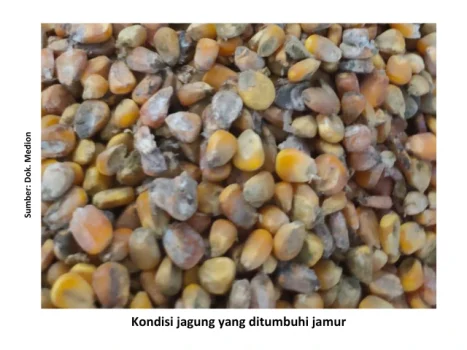
To prevent or control fungal growth in corn, the following measures should be taken:
1. Feed ingredient quality control
- Regularly inspect the quality of feed ingredients and finished feed, focusing at minimum on their moisture content. This should be done upon feed delivery and whenever there is a change of supplier. The ideal moisture content for feed ingredients and finished feed is ≤ 14%.
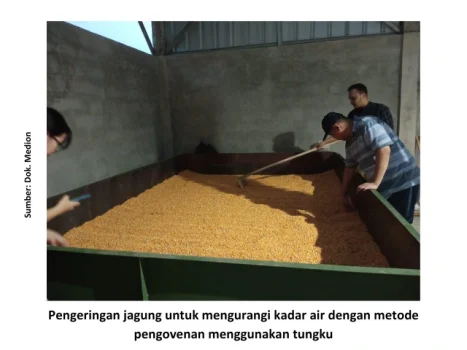
- If the feed ingredient has a moisture content greater than 14%, immediately dry it either by sun-drying or using a specialized feed dryer to reduce the moisture level.
- If the weather conditions do not allow for proper drying, adjust the storage setup and use the feed ingredient as soon as possible.
2. Feed storage management
Proper feed storage helps maintain the nutritional quality of the feed. Therefore, both the physical structure of the storage facility and its management practices must be carefully considered. Common types of feed damage during storage include mold growth, rancidity, and pest infestation. Pay attention to the following storage management practices:
- Arrange feed stacks properly in the storage area.
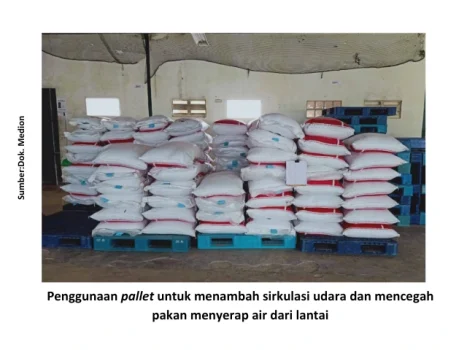
Use pallets underneath the feed stacks. Ensure that feed bags do not come into direct contact with the floor or the warehouse walls. Maintain a minimum distance of 50 cm from the walls. Adjust the pallet height to 5–15 cm with a maximum stacking height of three pallets, each containing six layers of feed bags. This arrangement helps improve air circulation and prevents the feed from absorbing moisture from the floor. - Control the temperature and humidity of the storage warehouse
A common problem found in feed warehouses is the imbalance between temperature and humidity. A well-maintained warehouse should have a temperature range of 30–34°C with a maximum humidity level of 70%. Fungal growth is significantly influenced by these two factors—temperature and humidity. Molds can easily develop when the humidity exceeds 85%. To maintain proper humidity levels within the storage area, additional ventilation should be installed to ensure optimal air circulation. - Apply the FIFO (First In, First Out) and FEFO (First Expired, First Out) systems.
Organize the use of feed ingredients and finished feed based on their storage duration. Use the feed that has been stored longer first. In addition, the FEFO system can also be implemented, meaning that feed with lower quality or shorter storage stability should be used first, even if it has arrived more recently.
3. Prevent and Inhibit Fungal Growth
One of the efforts to suppress fungal growth in feed is through the use of antifungal agents or mold inhibitors. The use of a mold inhibitor is essential when the corn has a high moisture content, as fungi can easily grow and multiply under such conditions. When the corn moisture level meets the standard, a mold inhibitor should still be used at a lower dosage as a preventive measure.In addition to fungal issues, it is also important to consider the negative effects of mycotoxins. The use of Fungitox not only acts as a mold inhibitor due to its organic acid content but also functions as a toxin binder. This is because Fungitox contains a complex silicate mineral that can bind mycotoxins in the digestive tract and facilitate their excretion through feces.The recommended dosage of Fungitox for feed with high moisture content is 2.5 kg per ton of feed, while for mold prevention, the lowest effective dosage is 0.15 kg per ton of feed.