Karunia Mentari – By email
A. Inquiry
As a chicken farmer I would like to ask how we can detect well the disease that infected the chicken? Because there are often symptoms that are almost the same between several diseases, it is difficult to conclude what disease affects chickens.
B. Answer
Thank you Mr./Mrs. Grace for the question submitted. Disease is indeed a severe challenge for chicken farms that need to be addressed. The larger the population, the more complex are also concomitant diseases (Nur et al., 2021). In addition, some diseases have almost the same symptoms. It needs good detection in cases of emerging diseases so that treatment can be done quickly and appropriately
An important key in the treatment of disease is in the accuracy of diagnosing. Diagnosing diseases of animals (including chickens) becomes the duty, responsibility, and authority of a trained field worker or veterinarian. However, farmers can also take steps “such as diagnosing " as a form of early detection. The steps in the diagnosis of the disease begins with Anamnesis, examination of clinical symptoms, necropsy or surgical carcass followed by examination of anatomical pathological changes and confirmation of diagnosis by laboratory testing.
Anamnesis is defined as the review or collection of data related to the history or life history of chickens. The Data can be obtained from the officer cage or from recording. Data that needs to be collected such as:
- Types, ages, strains of chickens
- Total population
- Clinical symptoms in which group and from when
- Health and disease history Program
- An overview of morbidity (morbidity) and mortality (mortality)
- Performance and productivity overview
- Implementation biosecurity
- Overview of the ration
- As well as the condition of the cage
The next step is the examination of clinical symptoms. Clinical symptoms are those changes that can be observed from the outside. To be able to detect the clinical symptoms that appear as early as possible, it is necessary to know the differences in the condition of healthy chickens and the changes that appear if the chicken is sick.
After the observation of the emerging clinical symptoms, it is necessary to proceed to necropsy or surgical removal of the carcass. Necropsy is important to support the Anamnesis and the observation of clinical symptoms carried out. The necropsy procedure is performed cascading and carefully. The number of chickens that dinekropsi at least 2-3 tail to get a comparison and selected chickens with mild to severe clinical symptoms. Necropsy is performed on chickens that have just died or are killed in less than 2 hours. This is to avoid organ changes due to other conditions that can confuse the diagnosis of the disease.
Some diseases do have clinical symptoms and changes in anatomical pathology that are almost the same and difficult to distinguish so it is necessary to know the characteristics (pathognomonic changes of the disease. As an example of disease Avian Influenza (AI) and New Castle Disease (ND) have similar clinical symptoms and anatomical pathologies.
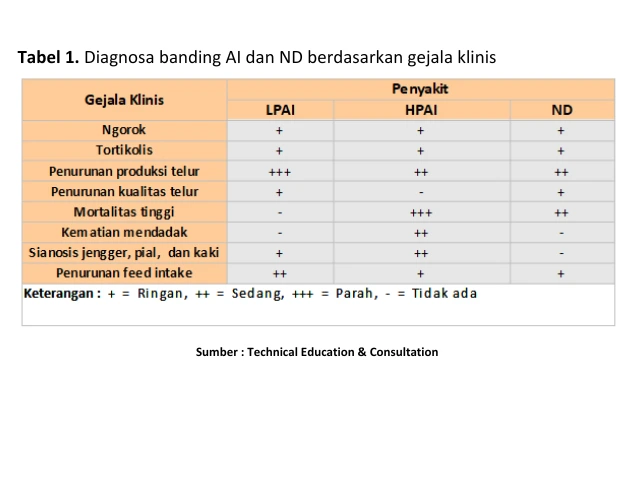
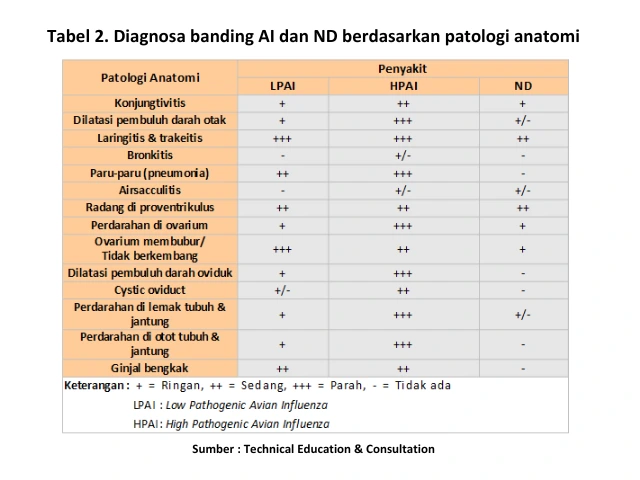
Nevertheless, AI and ND diseases with similar symptoms can simultaneously infect chickens. Clinical symptoms of AI are usually in the respiratory tract, digestion and nervous system, similar things are also found in ND (Nurmayani et al., 2023).
More and more chicken diseases with clinical symptoms and anatomical pathologies that look similar or the presence of changes that are not typical will make it difficult to diagnose the disease. In addition, not all clinical symptoms or anatomical pathological changes appear on some events in the field. In conditions like this, laboratory tests are needed as a step to confirm the diagnosis.
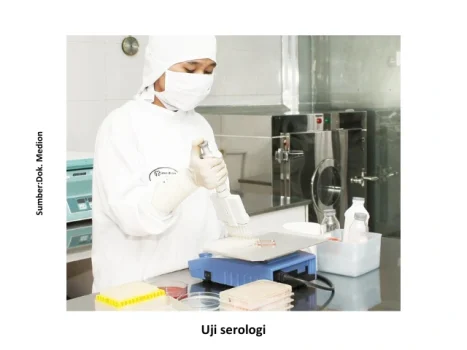
Laboratory tests in addition to confirming the diagnosis of a disease can also be used to monitor or surveillance. As in AI diseases, serological tests can be used to monitor the value of antibody titer AI and also as confirmation of diagnosis. In order to confirm the diagnosis, if the value of AI antibody titer is much higher than the standard and the titer picture is not uniform, it can be identified that the chicken is infected with the AI virus.
Medion also provides books “important diseases in chickens " and "instructions for diagnosing chicken diseases" which contain practical descriptions of diseases, instructions for diagnosing, prevention and treatment are equipped with pictures to make it more applicable. Book reservations can be made via the following email cs@medion.co.id