Livestock health is one of the factors in the livestock business that is important to note. Health problems in livestock can be caused by two factors, namely infectious factors such as bacteria, viruses, protozoa, and parasites, and non-infectious factors such as maintenance management and the environment. The emergence of various diseases in cattle in recent years is quite troubling the farmers such as hoof and mouth disease (FMD), lumpy skin disease (LSD), septicemia epizootica And other diseases.
Disease attacks will certainly cause considerable economic losses for farmers. The losses felt are production disruption or decrease in daily body weight gain, livestock reproductive disorders, medical costs and the impact of death. With the challenges of this disease, farmers need to be vigilant and try to prevent it by implementing biosecurity and health programs. It is hoped that the Prevention of disease in beef cattle fattening business can increase production and performance cows.
Challenges Of Cattle Disease
The incidence of disease almost every time found even an increase in disease attacks during the change of season or transition. The appearance of the disease in livestock on farms can be triggered by several factors, including:
- Sudden changes in weather, significant changes in temperature and humidity
- Stress conditions experienced by livestock eg post-transport
- Inconsistent application of biosecurity
- Implementation of maintenance management and cage conditions that are not ideal
- The condition of the cage is dirty, high air humidity, does not get direct sunlight, does not have air ventilation, the size of the cage is too narrow or the number of livestock exceeds capacity is a condition that can affect the comfort and health of livestock.
- Feeding that does not fit the needs of livestock
Feeding with nutrient content and amounts that do not match the needs of livestock will make immunity decrease. If the immune system of livestock decreases, then the livestock will be more susceptible to various types of diseases.
Various infectious diseases that often occur or are a challenge for farmers today can be caused by bacteria, parasites, viruses, and fungi. Such as mouth and nail disease (PMK), lumpy skin disease (LSD / skin lump disease), bovine ephemeral fever (BEF / three-day fever), anthrax (inflammation of the spleen), septicemia epizootica (SE / snoring disease), brucellosis (keluron disease / miscarriage), pink eye (inflammation of the eye), worms, scabies, myasis (maggots). While non-infectious diseases include bloating, rumen acidosis (metabolic disorders of the digestive system).
Application of biosecurity in cages
Disease Control can be done effectively with the implementation of Biosecurity, the implementation of health programs vaccination and supplementation as well as the implementation of good maintenance practices. Disease prevention measures with biosecurity need awareness and cooperation of all parties, both owners, workers, visitors, buyers, feed providers/suppliers, medical personnel and government support. The thing that can be controlled by farmers is the application of biosecurity in the cage area. These efforts include:
- 14-day quarantine of newly arrived livestock and observing their health status
- Provide a comfortable maintenance environment
Livestock needs to get good air circulation and enough sunlight, enough space, minimal stress factors by providing shade in the cage area, providing adequate drinking water. Application of biosecurity with 3 zones (dirty zone, transition zone and clean zone). As well as maintaining the cleanliness of the cage environment and equipment by not allowing cow dung to accumulate. Disinfect the cage regularly using Medisep, Antisep or Neo Antisep. - Limit guests and participate in farm biosecurity procedures
Only officers and interested persons are allowed into the maintenance area. And follow the biosecurity procedures that apply on farms. - Personal hygiene (keep yourself clean and use special cage clothes)
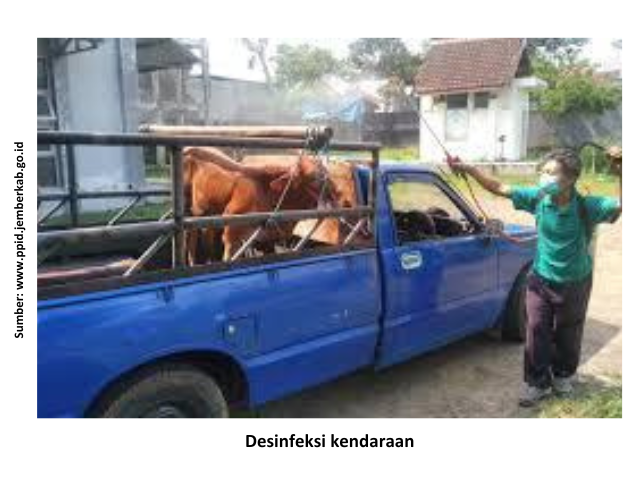
- Disinfection of vehicles and personnel who will enter the farm area by using Medisep
- Control vectors by eliminating habitats and insect elimination by Delatrin. Insects such as flies and mosquitoes can be vectors for the spread of viruses that cause LSD and BEF in cattle. Therefore, insect control must be carried out intensively using insecticides and keeping the cage clean.
- Separation of sick cattle so as not to become a source of infection and immediate treatment can be carried out
- Proper feeding
Application of nutritious feeding according to the needs of livestock. By making a balanced formulation between carbohydrate intake, protein and forage. When there is a change in feed, new feeding is done gradually so that the conditions of the rumen microbes can adapt. Avoid giving large amounts of concentrate in a short time.
Health Programs
Efforts to prevent disease in livestock in addition to biosecurity is the implementation of health programs, including:
1. Vaccine administration
Vaccination is one of the effective ways to prevent the spread of the disease in cattle. Some diseases caused by viruses can be prevented by administering appropriate vaccines to cows. Each type of disease has a different vaccine. The vaccination Program and implementation can be carried out according to the recommendation of the local animal husbandry and Animal Health Office. For example, PMK vaccination, LSD, anthrax, brucellosis and SE.
2. Supplementation
The strong resistance of the cow's body helps a lot in dealing with diseases. You can give supplements so that the cow's immune system gets stronger.
- On newly arrived cattle, give Transolite
- Deworming and repeated every 3-4 months in order to completely eradicate the worms and break the life cycle of the parasite with Wormzol Suspension or Wormzol B.
- Giving supplements to cows aims to increase stamina and power of the cow's body and maintain better productivity. Give Vita B Plex Bolus Extra Flavor once every 3-4 months. Supplements can also be given to treat muscle disorders and increase energy intake before and after transportation. For example, by giving Bioselvita.
- Feeding nutritious feed according to the needs of livestock every day. By making a balanced formulation between carbohydrate intake, protein and forage. As well as the addition of cow premix containing amino acids, minerals and vitamins such as Mix Plus Cattle Pro.