Environmental conditions are one of the factors that affect the health of livestock. One of them is the weather, especially during the transition season. Conditions of high rainfall, low temperatures with high humidity become one of the predispositions to the disease. Diseases caused by bacteria, fungi, viruses, protozoa, endoparasites and ectoparasites multiply well. Respiratory diseases being the diseases that most dominate one of them coryza. Disease coryza or the familiar known as “snot” is one of the diseases that is excellent. Especially in chicken layer because of his frequent and recurring cases.
This is certainly a concern of ours together why the case coryza it still remains difficult to control. Then how does the influence of environmental conditions, especially during the transition season?
Current Cases of Coryza on the field during the transition season
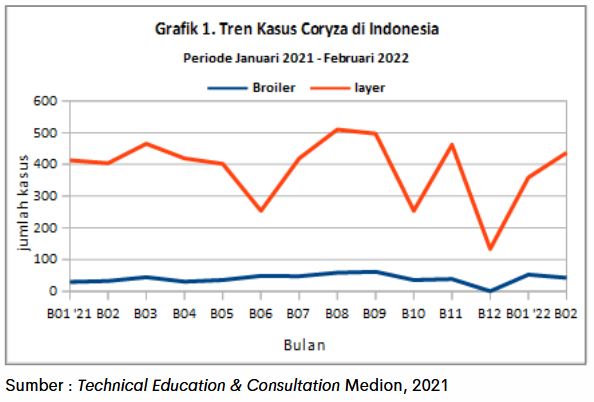
When viewed from the data in Graph 1, it is known that coryza cases increase at the beginning of the rainy season starting in August and when the weather changes (transition). Subsequent events coryza the fluctuating can be caused by erratic weather conditions, sometimes even changing extremes. Especially on the farm layer, there was a significant increase, especially at the turn of the year. So farmers need to be aware of the increase in cases coryza in wet seasons or transitions that cause chickens to experience stress so that the condition of chickens decreases. The humid conditions of the cage environment also favor bacteria coryza growing quite rapidly. Case occurrence coryza triggered predisposing factors, such as interference from the home environment, nutritional problems, vaccination treatment as well as various diseases that cause immunosuppressive.
Indonesia is a tropical country with an environmental temperature of 27-30° Celsius and humidity ranging from 70-95%. These conditions are very suitable for the development of bacteria Av. Paragallinarum causes coryza. Prevalence of cases coryza it is usually very high in the range from September to February. This is because in the transition of the weather the humidity of the cage becomes higher with a low oxygen content.
Although chicken layer or broiler both are susceptible to attack, but the number of reported cases in chickens layer higher than chicken broiler. This is because the life span of chickens layer longer, so that the risk of exposure coryza higher and aggravated by the presence of ventilation problems and poor environment.
Case occurrence coryza this will entail some losses. Among them are the number of pain/morbidity in cases coryza can reach 20-50% and mortality/mortality up to 5-20%. Morbidity and mortality will increase in the event of bacterial co-infection Mycoplasma synoviae, Mycoplasma gallisepticum, Ornithobacterium rhinotracheale, Pasteurella multocida, and viral infections IB, ILT and smallpox. In addition to chicken broiler it will be difficult to catch up with the standard weight growth delay. While the chicken layer there will be a decrease in egg production by 10-40%.
Causes and predisposing factors
Avibacterium paragalinarum (Av. Paragalinarum) is a causative bacterium coryza with its main predilection location in the infraorbital sinus located under the nose. Bacteria Av. paragallinarum causes coryza it is divided into several serovars. Based on the method page, dibagi menjadi serovar A, B, dan C. While the method kume membagi lebih detail lagi menjadi A1, A2, A3, A4, B1, C1, C2, C3 dan C4. Diantara serovar tersebut, tidak ada proteksi silang antar serovar A, B, C namun terdapat proteksi silang yang baik diantara serotipe pada serovar A (A1, A2, A3, A4) dan proteksi silang variatif diantara serotipe pada serovar C (C1, C2, C3, C4).
Teams Research and Development Medion has done mapping bacterial causes coryza in Indonesia. Based on the isolate data collected by Medion, currently the bacteria Av. paragallinarum found in Indonesia, it belongs to serotypes A1, C1 and C4. Especially the dominant serotype C4 is found and has been widely spread in several regions in Indonesia such as Bandung, Banjarmasin, Jambi, Kendal, Samarinda, Semarang, and Sukabumi.
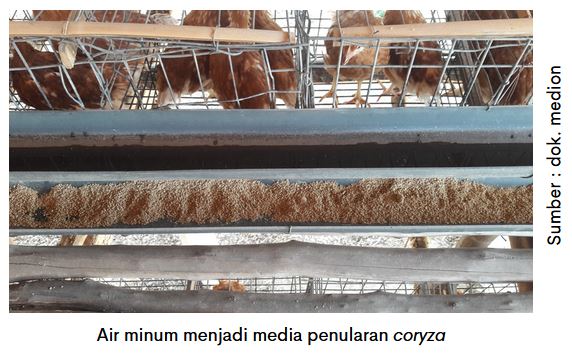
Coryza it can be transmitted horizontally either directly or indirectly. Direct transmission is from sick chickens to healthy chickens by direct contact, while indirectly from various media. For example from feed, drinking water, or air contaminated with exudate / dileran chicken nose containing bacteria Av. Paragallinarum. Exudate coming out of the nose becomes the most effective medium that transmits coryza, especially in cages with an open paralon drinking system.
Bacteria Av. Paragallinarum enter through the nose, then it will enter and multiply in the infraorbital sinus. The incubation period (the time it takes from the time the bacteria start to show symptoms) of coryza duration is 1-3 days. Outbreak coryza lasts for 4-12 weeks (in chickens layer) or 6-14 days (in chickens broiler) depends on the number of bacteria in the body of the chicken or the environment of the cage, and the presence or absence of secondary infection.
Predisposing factors provoking and aggravating the disease coryza among the factors of air, air quality and circulation are less good. This will result in a reduced intake of o₂ needed by chickens. Factor litter/ wet husk causes humidity in the cage to increase and high ammonia levels so that it will be inhaled by chickens. When it gets into the upper respiratory tract, ammonia can cause epithelial cells (mucosa) irritation and loss of cilia. Epithelial cells in these channels are the initial defense mechanism because they are able to produce mucus (mucus) while the cilia function to repel incoming infectious agents. If both structures are damaged, the bacteria causing coryza it will easily enter and stick to the infrobital sinuses of the nose then cause a more severe infection. On chicken layer, application of maintenance system multi age age (a lot of age) can also be a predisposing factor to the disease coryza. This is because when chickens are attacked coryza then already cured can act as carrier (carrier). So that the chicken is clinically cured but still carries bacteria and excretes from the respiratory system. As a result, it will transmit to other healthy chickens that are in one population, especially to younger chickens. This also causes the occurrence coryza often recurs.
Age Pattern Of Disease Attacks
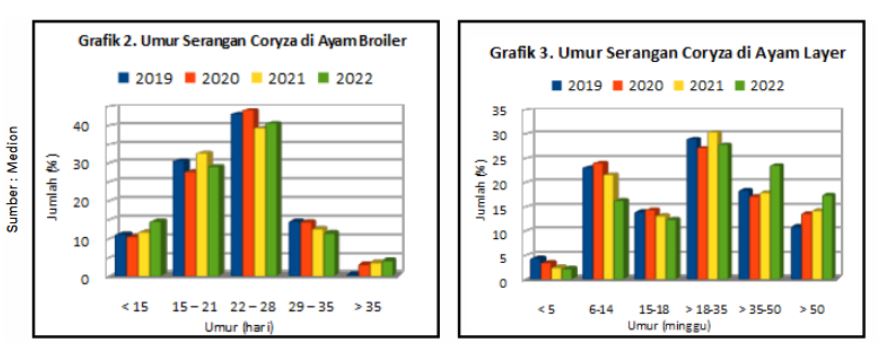
Based On Team Data Technical Education and Consultation (TEC) Medion during 2019 to 2022 it is known that cases coryza always appear throughout the year either on broiler or layer. About the age of infestation, in chickens broiler many are attacked at the age of 22-28 days. This can happen because at that age the production of feces is higher so the risk of ammonia accompanied by high density will increase the risk coryza infect. While the chicken layer the highest occurs at the age of >18-35 weeks, namely in the early to peak production. This could be because in that phase, chickens are required to pursue targets, especially egg production. If at that time the environmental conditions are not supportive and cause stress to the chicken, then this triggers the infection of the disease will easily appear no exception coryza.
Clinical symptoms and apparent Anatomical Pathology
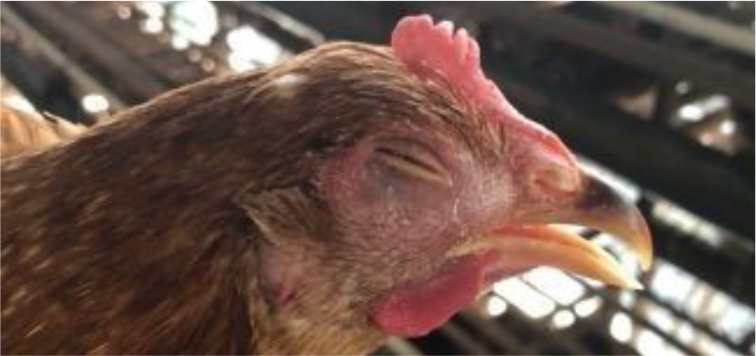
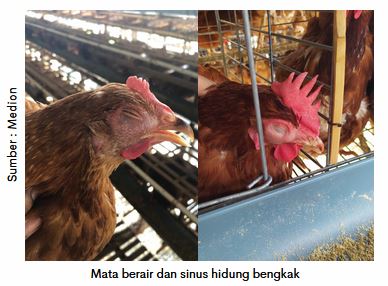
Clinical symptoms that characterize the disease coryza is an acute inflammation of the upper respiratory tract. The discharge of mucus or discharge from the nose, which at first has a watery yellow color, then gradually turns into a thick, purulent, and has a characteristic odor (foul/fishy smell). So that the chicken sneezes, has difficulty breathing and snores. The infraorbital Sinus (under the eye) will swell and if the condition is more severe the eye will close due to the accumulation of fluid. In addition, appetite is lost, and sometimes diarrhea occurs.
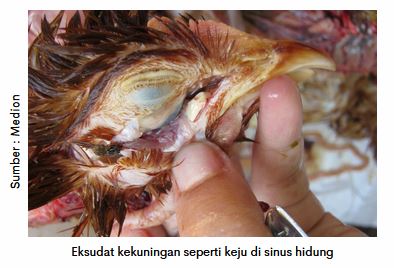
If surgery is performed to see changes in anatomical pathology, it will be found that the sinuses of the nose, larynx, and trachea are inflamed with mucus. Sometimes, in more severe conditions in the sinuses are also found persejuan. When diseases coryza in the case of colposcopy (panopthalmitis), then the eye will swell to contain yellowish solid ice. The nature of swelling in the nasal sinuses can be unilateral or bilateral. Some diseases that have clinical symptoms similar to coryza are SHS, colibacillosis (form panopthalmitis), ILT, wet smallpox (wet pox), and ORT (ornithobacterium rhinotracheale). To distinguish such cases, if necessary laboratory tests (PCR and sequencing).
Prevention Coryza
Prevention coryza it needs to be done by carrying out appropriate vaccinations, optimal maintenance management applications, and the implementation of biosecurity tight.
- Vaccination
Disease of coryza being one of the diseases that is quite difficult to cure. Therefore, alternative measures that can be taken to control coryza is prevention by vaccination. Vaccination is carried out to form immunity in the body of chickens, so the frequency of the appearance of cases can be suppressed. In addition, if coryza attack, then in chickens that have been vaccinated attack will not be severe and when treated will recover faster. Likewise with the severity of the case, if it occurs it will be milder.
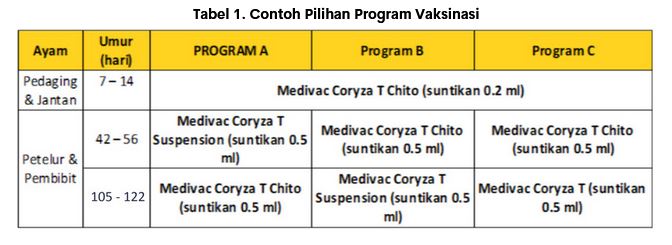
Vaccination Program in chickens layer can be given at the age of 6-8 weeks using Medivac Coryza T Suspension or Medivac Coryza T Chito then repeated at the age of 15-16 weeks using Medivac Coryza T Chito, Medivac Coryza T Suspension or Medivac Coryza T. If the farm is very prone to occur coryza, then repeat vaccination can be carried out 5-6 weeks after the first vaccination. While the chicken broiler/ males are carried out at the age of 7-14 days with Medivac Coryza T Chito.
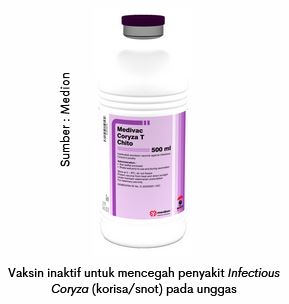
Medivac Coryza T Chito is a Medion inactivated vaccine containing bacteria Avibacterium paragallinarum strains W, Spross dan Modesto which has been dissolved in adjuvant chitosan to increase and extend the power of the vaccine.
Things to consider in the application or administration of vaccinations coryza (especially in the form of an emulsion vaccine) :
- Process thawing (raising the temperature gradually from the storage temperature to match the ambient temperature) appropriate to reduce the reaction post injection. Thawing done by removing the vaccine from the refrigerator and then left until the dew on the walls of the vaccine bottle is gone.
- The correct injection location is in adult chickens through chest intramuscularly, thigh intramuscularly, or neck subcutaneously.
- The equipment is sterile, and the needles used are disposable (cannot be blunt/bent / broken) and replaced every 500 chickens.
2. Implementation of optimal management
Management is the biggest factor that determines the performance of chickens. Therefore, there is a need for evaluation of maintenance management procedures that are applied, namely :
- Empty the cage at least 14 days after the cage is clean to break the chain of previous diseases. Cage cleaning is done thoroughly starting from the sidelines of the cage, the bottom of the stage Cage also should not be missed. Washed the cage with detergent and brushed, then sprayed high pressure water.
- Current DOC selection chick in so it is expected that chickens have a higher ability to live and are more resistant to healthy environmental changes
- Time management brooding period, and litter must be good. Where to eat and drink enough and litter it should always be dry and dust-free. Add litter dry when it is damp and wet. This prevents the risk of upper respiratory tract irritation due to high humidity and ammonia levels. Clean air in the cage needs to be considered by adjusting the opening and closing of the curtain properly and adjusting the density of the cage.
- A lot of people live in one place (one age, one site), which is paid attention to is the passage of cage traffic from young chickens to Old Ones. Place DOC/pullet in cages that are far apart from the production layer cage, and minimize stress conditions on chickens, especially during the cage moving process.
3. Tightening biosecurity
Implementation biosecurity thoroughly ranging from isolation, traffic regulation, and sanitation needs to be considered including :
- The application of 3 zones (clean, transition, dirty) so that the seeds of diseases that enter the cage environment can be minimized so that the challenges of the disease become fewer.
- Spraying the cage, washing, and sanitizing the feed and drinking place every 3-4 days and dipping the feet in the disinfectant tub before entering the cage using Medisep or Zaldes.
- Disinfection of drinking water with Desinsep to prevent the transmission of bacteria through drinking water.
- Disinfection of vehicles using Sporades or Medisep to prevent contact seedlings of the disease into the cage.
Severe Coryza
When coryza attacking the farm, here are the things that need to be done:
- Selection and isolation of sick chickens
In one group of chickens, there will be different variations in the severity of the disease, resulting in different treatment effects. There are chickens that have healed, but there will also be chickens that only look healed. When the condition of the chicken's body and the environment are inadequate, chickens that look healed will relapse. Therefore, it is necessary to carry out selection and insulation. Selection is by separating chickens that are sick and already look bad. Next, isolate by placing the chicken into a different isolation cage to be handled.
- Appropriate treatment methods
In the condition of chickens that still show mild symptoms, the application of Drug Administration can still be through drinking water. The choice of this antibiotic is the one that has good absorption in the gastrointestinal tract. This is so that the drug can be distributed to the target organ, namely the sinus infraorbitalis. The target Organ of the infraorbital sinus has a poor structure blood vessels. The choice of medicine can use Neo Meditril, Tinolin,or Remisin. In severe attack conditions where the face looks swollen, the application of Drug Administration is done by injection. This is because in the condition of swollen face, drinking water consumption will decrease. Examples of antibiotic products that can be used are Tinolin Injection, Gentamin, Vet Strep or Medoxy-LA.
In the selection of antibiotics need to pay attention to antibiotic resistance. Antibiotic resistance is a condition of increased resistance of bacteria to the action of certain antibiotics. As a result, bacteria become insensitive or resistant to one type of antibiotic. Antibiotic resistance mainly occurs as a result of inappropriate dosing, improper selection of antibiotics, and incomplete treatment. Therefore, it is necessary to carry out antibiotic rolling. Its use is to give antibiotics from different groups at intervals of 3-4 times the treatment period.
- Supplementation and supportive therapy
In sick conditions, the appetite and body condition of the chicken will decrease. Therefore, the provision of multivitamins is expected to restore the stamina of the chicken's body and stimulate the appetite of the chicken. Examples of products used are Vitamin B Complex Injection or Fortevit. In addition, immunostimulants can be administered to increase the immunity of the chicken body using Imustim.
- Evaluation of maintenance management
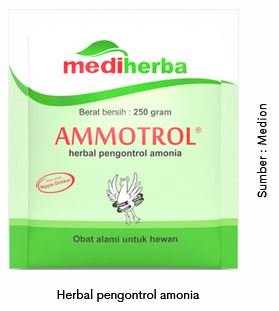
Improvements in air quality and circulation need to be considered. Control ammonia conditions in the cage to reduce irritation, especially in the respiratory tract of chickens. In addition, herbal products can be given, namely Ammotrol which serves to bind ammonia into a form that does not evaporate so that the smell of ammonia is reduced in the cage. Ammotrol it is also useful to make the feces produced by chickens drier.
Seasonal shifts and weather changes are triggers for increased incidence coryza in the field. Therefore, the need for protection by combining vaccination, increased biosecurity, and optimal maintenance management. Prevention as a first step to control cases coryza. May be useful.