Gumboro or Infectious Bursal Disease (IBD) is one of the viral diseases that like to visit cages and is an important threat to the chicken farming industry because it causes quite high losses around the world, including in Indonesia.
Disease of Infectious Bursal Disease (IBD) was originally reported by Cosgrove in 1962 in Gumboro, Delaware, United States, which is why the disease is often called Gumboro, this disease can be clinical or subclinical in chickens, so that chickens that are attacked but do not show clinical signs can also transmit the disease without being known.
Updates Gumboro in Indonesia
If you look at the ranking of diseases during 2019 to November 2021, Gumboro disease in broilers ranks first for viral diseases, followed by ND at Rank 2 (Graph 1). In laying hens before production, Gumboro still consistently ranks first in cases of viral diseases (graph 2), so this certainly needs to be our collective vigilance. We know that Gumboro has immunosuppressive properties which means it can suppress the chicken's immune system. When Gumboro infects chickens, it becomes a gateway for other diseases to infect. Some viral diseases such as ND and IBH that are currently prevalent in young chickens can appear along with Gumboro infection.

Based on the data that has been collected by the field team, displayed Gumboro attack age charts in broilers and layers, it appears that Gumboro attacks most often appear at the age of 22-28 days. This is related to bursa Fabricius which is the main organ attacked by Gumboro virus. Bursa Fabricius developing actively at the age of 3-4 weeks so that at that age is the most risky time Gumboro attack, but need to be aware that Gumboro can also attack chickens aged 15-21 days and cause considerable loss of mortality (mortality) and morbidity (morbidity) is high. Gumboro attacks in chickens under 3 weeks of age are usually subclinical (without clinical symptoms) and have a greater immunosuppressive effect that can thwart the vaccination program. However, at that age, Gumboro attacks can also be clinical with visible symptoms.

Get To Know Gumboro Virus
Gumboro is a disease caused by the Avibirnavirus virus which is a virus double stranded RNA and non-amplified. The structure of this non-amplified virus makes it insensitive to disinfectants from the group ammonium quartener, therefore, the selection of disinfectants is very important to eradicate the virus that causes Gumboro in the cage. Avibirnaviruses are stable and long-lived in the environment for more than 3 months. Therefore, it is very important to pay attention to the process of cleaning and resting the cage to minimize the virus population in the cage environment. The incubation period of the disease is 2 – 3 days and is transmitted horizontally, that is, from sick chickens to healthy chickens. There is no vertical or parent-to-child transmission of Gumboro disease. The disease is transmitted from sick chickens through the melting of the body or feces of infected chickens either directly or indirectly. Indirect transmission can be through media such as litter, where drinking water and feed, livestock equipment, transportation equipment or workers contaminated with feces contain Gumboro virus.

Based on patotype or the level of malignancy, Gumboro virus is classified into three groups, namely classical, variant and vvIBD (very virulent IBD). Currently Gumboro virus found in Indonesia is from patotype classical and vvIBD. Throughout 2018 to 2021, it was known that the Gumboro virus of the strain vvIBD being the dominant or most commonly found strain attacking chickens. Please note that vvIBD it can cause high mortality of up to 20% in broilers and up to 80% in laying hens, and can penetrate high maternal antibodies. Whereas we all know that maternal antibodies are antibodies that come from the mother to provide protection to chicks from the Gumboro virus. If maternal antibody numbers are high but can be penetrated by vvIBD, then the virus will not be neutralized by maternal antibodies so that the chicks will get sick. Therefore, we cannot rely only on maternal antibodies as protection against Gumboro virus, chickens also need to be provided with vaccinations. The Giving of vaccinations homologous or in accordance with the virus in the field is one of the efforts to prevent Gumboro infection.
Properties Immunosuppressive Gumboro
Gumboro disease is one of the diseases that are immunosuppressive. This is because the Gumboro virus attacks the immune system of chickens, especially bursa Fabricius which is located at the top of the anal hole (cloaca) chicken. Normally, the body bursa Fabricius experiencing regression (shrinkage) in early sexually mature at 16 – 18 weeks. The process of disappearance of this organ is influenced by reproductive hormones. As an antibody-producing plant, it is actually an organ bursa Fabricius it has been working actively to produce B lymphocyte cells since chickens in the embryonic phase, namely in the 14-day egg incubation period. Bursa Fabricius is where B lymphocyte cells are produced. Initially immature B lymphocytes (immature) then undergoes maturation. This process will occur when B lymphocytes are exposed to antigens derived from field viruses or vaccine viruses. B lymphocytes will be activated and produce antibodies as the body's response to exposure to these antigens. When Gumboro virus enters the organs bursa Fabricius, then this virus will attack immature B lymphocyte cells, causing a decrease in the number of mature B lymphocytes. This has an impact on reducing the number of antibodies formed so that this is the reason Gumboro is immunosuppressive.
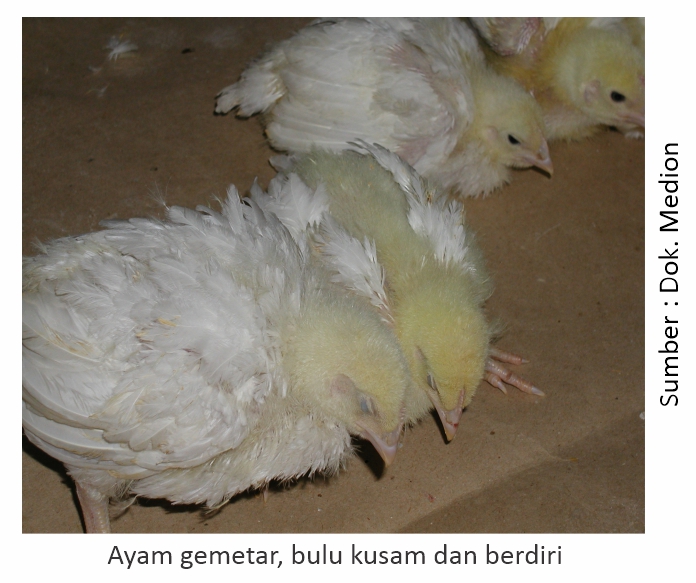
Chickens infected with Gumboro disease will experience several clinical symptoms that appear, namely trembling, dehydration, dull feathers and standing. In addition, we can make observations on the anal hole (cloaca) will be found feces or feces that stick, accompanied by feces that are thin and white. In the case of subclinical Gumboro, this symptom does not appear significantly so we need to observe not only from the symptoms but also from changes in the organs in the chicken's body.
We have known that bursa Fabricius become the main organ of Gumboro attack. If we do surgery, it will be found bursa Fabricius who have inflammation accompanied by swelling. In addition, changes were found in the urinary organs, namely in the kidneys experiencing swelling. In the muscles will be found bleeding with a typical type of shape striae (lines) in the muscles of the chest and thighs. Meanwhile, the organs of the digestive tract, namely precisely in the proventriculus, inflammation will be found at the lower limit, namely between the proventriculus and the ventricle or gizzard.
Reasons why Gumboro still attacks and how to control it
Some factors that cause Gumboro still often attack livestock in cages include:
1. Immunosuppressant factors against vaccination success
Vaccination is one of the preventive measures, the time of Gumboro vaccination using conventional active Gumboro vaccine is at the end of the first week or entering the second week. This age is a critical time for the growth of chickens, especially those affected by management. Maintenance management error is the delay in widening the cage so that it affects the density of the cage. The opening of the cage curtain as ventilation and air circulation or the addition of material litter the late will cause the air quality in the cage is not fresh followed by the smell of ammonia began to appear. This becomes one of the predispositions of the onset of respiratory diseases such as CRD or gastrointestinal diseases (coccidiosis). These two diseases are immunosuppressive this will affect the success of the vaccination. Therefore it is very important to arrange the management especially the widening time of the cage, the density of the cage, the opening time of the curtain, and the addition litter according to the conditions in the cage. It is necessary to ensure smooth air circulation so that ammonia can be minimized and reduce the risk of CRD and coccidiosis as a factor immunosuppressive.
In addition, the age period of one to two weeks, especially in laying hens, is a solid period of vaccination using active and inactivated vaccines. Not only Gumboro vaccine, chickens also need to be equipped with ND, IB, and AI vaccines. Chickens will experience stress due to improper treatment during vaccination and coupled with inadequate maintenance management and environmental conditions of the cage. This also poses a risk of vaccination failure because stress is also immunosuppressive. Handling proper nutrition is also necessary to ensure that the chickens do not experience stress. Vitamins such as Vita Stress and herbal products as immunostimulant namely Imustim can be done to support and maintain the body condition of chickens
2. The presence of vectors, especially Franky beetles
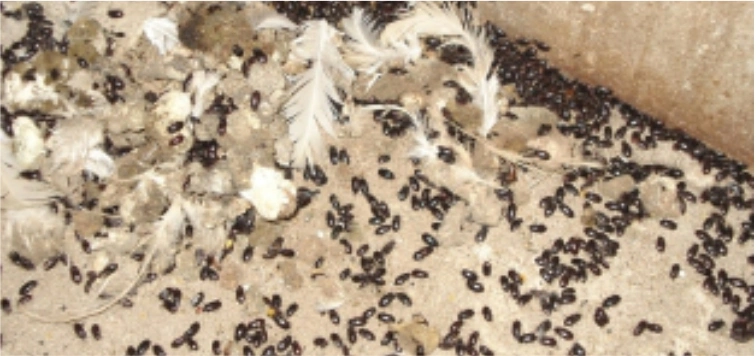
Franky beetle also known by the name Alphitobius diaperinus is an insect that plays a role in transmitting several viruses including Gumboro, ND, and also AI. This vector often hides in damp places in cage areas with groups and large numbers. The preferred location of Franky beetles is in litter or chicken droppings including those attached to chicken feed. In addition, these insects also often hide on the floor of a hollow cage or on a cage pole that has experienced loss. Frankie usually goes out at night. Eradication of Franky beetles in cages is one of the supporting measures to prevent the spread of Gumboro virus. One of them is by giving Delatrin and supported by cleaning, especially during the empty period of the cage so that there is no place for the vector to hide
3. Lack of sanitation and disinfection of the cage and the cage empty period is less than optimal
The spread of Gumboro virus is often due to lack of sanitation and disinfection in cages. The selection of the type of disinfectant also needs to be considered considering that this virus is not amplified. Viruses that are not amplified are sensitive to class disinfectants oxidizing agent (iodine complex) and aldehyde (formalin). Products that can be used are Antisep, Neo Antisep or Formades. Washing the cage when the cage is empty also pays attention to the rest of the organic matter that sticks mainly in hard - to-reach places such as between the cage and the bottom of the cage. Because organic matter such as feces is the preferred medium for Disease agents including Gumboro virus to hide. Gumboro Virus in the stool is still infective up to 122 days after being excreted (excreted). That is why Gumboro virus can survive even more than three months in a cage.

Avoid the remains of feces / piles of sacks containing feces around the location of the cage. What is sometimes missed and often overlooked is the length of cage rest after the cage washing and disinfection process that is not suitable or less than 14 days. Long periods of cage rest that are not optimal cause infectious agents to still appear and potentially infect livestock again. The recommended cage rest period is 14 days counting from the moment the cage is clean to break the life cycle of the infectious agent.
4. Management brooding period, less than optimal
Time brooding period, is the critical period of the chicken keeping period where from DOC to 14 or 21 days chickens are kept with the help of heaters. This maintenance period also determines whether or not the performance of chickens in the future because at this time there is a rapid development of chicken immune organs.

At the age of one week the development of lymphoid organs already reaches 70%. Optimal development of these lymphoid organs plays a role in the formation of active immunity that replaces passive immunity passed from mother to Chick or called maternal antibodies. When the main needs at the time brooding period, such as temperature, air, water, and feed are not met properly, then the growth of body organs including immune organs will not be optimal. Therefore, it is necessary to monitor the management in the future brooding period, to ensure that the main needs of the chicken are met. Signs of the development of chicken organs can be seen from the body weight of chickens that can be evaluated by weighing every week.
5. Inappropriate vaccination programs and applications
Conventional active Gumboro vaccine given when maternal antibodies are still high may result in the vaccine virus being neutralized by maternal antibodies. So that the vaccine given is not able to provide optimal protection. Accuracy of vaccination schedule and accuracy of vaccine type selection vaccination is a critical point that affects the success of vaccination. Serum sampling at the age of 1-3 days can be done to check maternal antibodies and help estimate the age of the first Gumboro vaccination using a conventional active vaccine. In addition, the timing of vaccination can take into account the history of Gumboro cases in the previous period with a distance of 14 days before the age of attack.
The application of the active Gumboro vaccine is carried out orally either mouth drops / chews or drinking water. The thing to note is that the dose received by each individual chicken is uniform, that is, each one gets 1 full dose. Based on the selection of applications, the method of mouth drops/ cekok is more recommended because it is more accurate in administering 1 dose to each chicken. Although this method takes longer than the application of drinking water which is known to be more efficient and practical in the field.
The number of viruses in 1 dose of active Gumboro vaccine is only a minimum of 100 viruses, much smaller than the ND vaccine which 1 dose of vaccine contains a minimum of 10 million viruses. When handling and Gumboro vaccination application is not appropriate then the amount of virus that reaches the target organ is no longer in accordance with the minimum dose. As a result, the formation of antibodies is not optimal and cannot be protective. This is because the dose of vaccine received by chickens depends on the amount of drinking water consumption and is constrained by the vaccination time limit where 2 hours must be consumed. In addition, if the vaccine is given via drinking water, the quality needs to be considered, especially the content of heavy metals, hardness, pH, and chemical contamination such as disinfectants/ chlorine. Avoid vaccines from exposure to ultraviolet rays from sunlight and too close to brooder because it can cause vaccine damage.

Proper Steps Gumboro Vaccination
Prevention is better than cure, as well as Gumboro disease. Vaccination is a preventive measure that is carried out from inside the chicken's body. The principle of vaccination is to give an artificial infection to stimulate the formation of immunity in the body. Some things to consider when vaccinating Gumboro include:
1. On time
Gumboro vaccination programs using active vaccines are generally carried out once in broilers and twice in laying hens. Determination of the age of the first Gumboro vaccination can be done based on maternal antibody status by sampling serum age 0-4 days or taking into account the history of Gumboro disease in the previous period.
2. The right vaccine
The selection of Gumboro vaccine must be adjusted to the cases that occur in the field. Use Medivac Gumboro A jika kasus Gumboro muncul pada ayam umur <21 hari atau >21 hari dengan tingkat kematian tinggi (>5%) atau gunakan Medivac Gumboro B jika kasus Gumboro muncul pada ayam umur >21 hari dengan tingkat kematian rendah (<5%). Berikan juga Imustim 3 days before and after vaccination to help the formation of antibodies is more optimal. While the administration of inactivated vaccines using Medivac ND T Gumboro L Emulsion at the age of 4 days can be given. Tujuaanya to provide more optimal protection given that the vaccine contains vvibd virus local isolates so that homologous with airy virus

3. Proper application
Gumboro vaccination application is orally by mouth / mouth drops or drinking water. Application through the method of cekok or mouth drops can be given at the age of 10 days. Whereas if through drinking water can be given at the age of > 10 days. Before giving drinking water containing the vaccine, chickens should first drink fasting for 2-3 hours, depending on the weather. If the conditions of the cage environment is very hot, fasting drink enough for 1 hour. In order for the vaccination result through drinking water to be optimal, the vaccination should be carried out in the morning. This is because the time is the peak time for chickens to move and consume drinking water and environmental weather conditions are still relatively comfortable and the ambient temperature is not high
Vaccination is one of the preventive measures that needs to be balanced with other measures. Tightening biosecurity it is the right combination that supports the success of vaccination. Biosecurity has an important role as the main protective fence before the disease enters and infects into the farm. We know that Gumboro attacks chickens especially when bursa Fabricius is actively working to produce immunity. Gumboro attacks appear at the age of 22-28 days or 3-4 weeks, but can also appear at the age of 14-21 days. While the first active vaccine given at the age of 1 Week requires time to form immunity at the protective level at 2-3 weeks post vaccination. It should be noted that there is still a risk for chickens to be attacked by Gumboro if the amount of maternal antibodies in the chicken's body is low or not uniform so that individual chickens have varying levels of immunity. The most important thing is to make sure challenge Gumboro virus in the field can be suppressed. This is certainly not separated by the role biosecurity. We know 3 basic concepts in biosecurity. The first concept is biosecurity conceptual includes the selection of appropriate farm locations such as away from settlements and do not mix with other types of livestock. Next is biosecurity structural includes the appropriate form of cage building such as a good Cage direction that is longitudinal from West to East. The last concept is biosecurity operational includes routine activities carried out in livestock rearing management. Spray the cage regularly, management litter, transportation disinfection before entering the cage area, and disinfection of operators or visitors who will enter the cage needs to be done. These things are to prevent the entry and development of Gumboro virus into the farm.
A combination of vaccines and biosecurity it is precisely a preventive measure from disease attacks including Gumboro. It is hoped that by doing both strategies, Gumboro cases can be avoided so that the chickens survive. May be useful