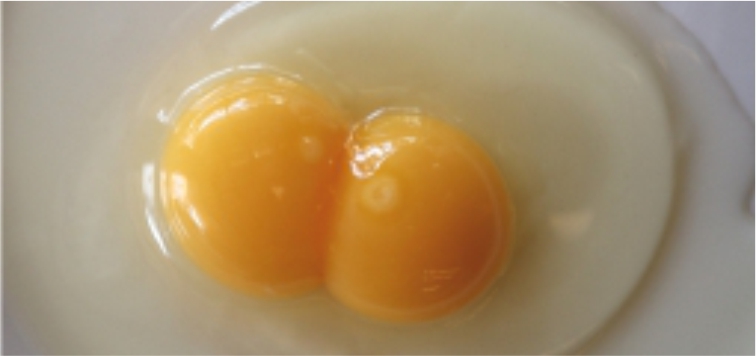
Eggs are a nutrient-dense food and easy to obtain. Various types of nutrients contained in eggs ranging from protein, fat, vitamins to minerals. Even eggs contain protein with a complete content of ten essential amino acids in sufficient quantities for optimal growth and development of the body.
In the whole egg component, the yolk (yolk) becomes an interesting part to review. In addition to the highest fat content among other egg components, color yolk also become the basis of consumer considerations in choosing eggs.
Consumers prefer eggs with yolk dark or reddish-orange in color. In addition to more interesting, yolk orange considered more qualified although the actual content of protein and fat remains the same as yolk the usual yellow color.
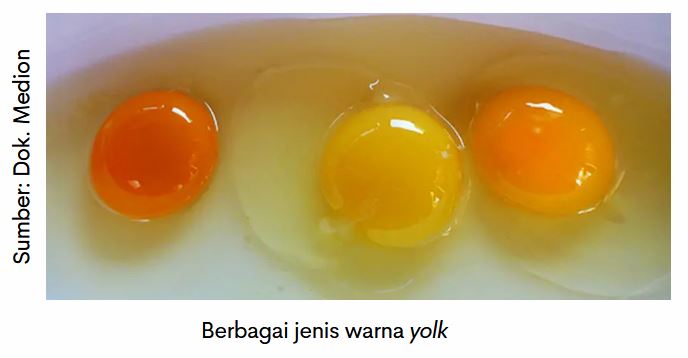
Carotenoids, Egg Yolk Pigments
Compounds or chemicals that cause yolk yellow in color are carotenoids. Menurut Bovskova et al. (2014), carotenoids are fat-soluble yellow, orange and red color pigments.
Carotenoids are divided into two main groups, namely carotene and xanthophyll. The difference between them lies in the presence or absence of oxygen atoms in their chemical structure. Xanthophyll contains oxygen atoms in the form hydroxy, carbonyl, aldehyde, while carotene is not. Xanthophyllit is he who plays a big role in coloring yolk, while carotene is found only in small amounts in yolk.
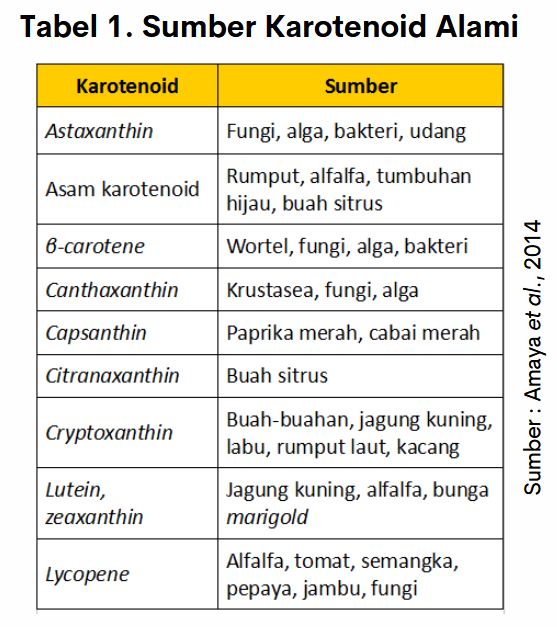
There are more than 600 types of carotenoids found in nature. Naturally, carotenoids are found in plants, animals, algae, fungi and photosynthetic bacteria or Photosyntetic Bacteri (PSB). Carotenoids can be synthesized de novo (synthesis of complex molecules from simple molecules), except in animals. Animals can not synthesize carotenoids, so the color pigments that are in their body come from the feed consumed. Here are some types of carotenoids and their natural sources listed in Table 1.
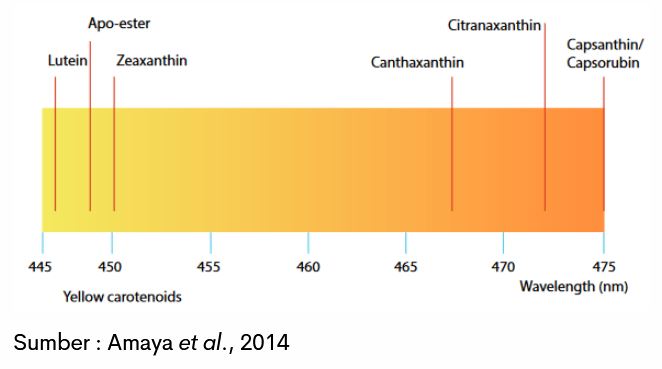
Each of the above color pigments exerts a different color effect depending on the chemical structure and wavelength. Here are the wavelengths of several types of carotenoids. To the human eye, these color waves appear as yellow to red.
Carotenoid deposition in the body of poultry
The absorption of carotenoids in the poultry body consists of four stages, namely :
- Consumption of carotenoids through ration
- Formation of complexes between fatty micelles and carotenoids. Carotenoids are not absorbed alone, but together with fats.
- Absorption of the fat-carotenoid complex through the surface cells of the small intestine.
- Transport of the fat-carotenoid complex by lipoproteins in the blood plasma to be subsequently deposited (deposited) into target tissues, namely yolk in poultry production.
In the body of poultry, carotenoids are also spread to several other body tissues, including skin, abdominal fat, beak and shank (Frame, 2009).
Factors affecting color Yolk
The concentration of carotenoids in the blood plasma of poultry can vary, depending on the type and concentration in the feed, while secondary factors are influenced by the chicken itself. These two factors ultimately have an impact on the amount of pigment deposition in the target tissue, especially yolk. Several factors affecting the color yolk namely:
1. Concentration of carotenoids in the ration
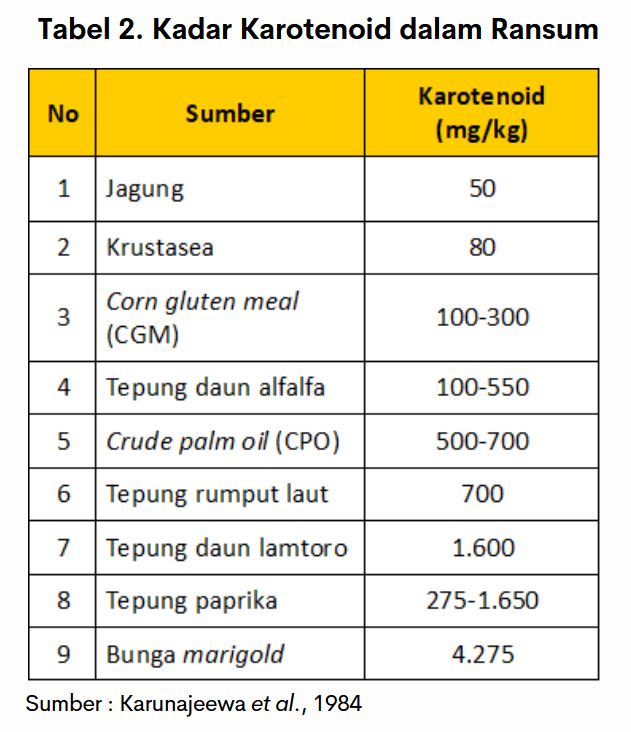
Color yolk influenced by the concentration and rate of deposition of each carotenoid in the ration. The higher the content and deposition rate of carotenoids, the darker the color yolk produced. The content of carotenoids in the ingredients of the ration varies from one to another (Table 2).
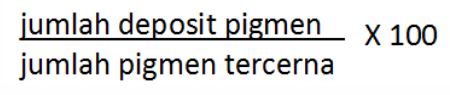
The rate of carotenoid deposition also varies. The higher the carotenoid deposition rate, the more pigment is deposited into the yolk. The rate of carotenoid deposition is obtained from the calculation :
2. Genetics
Karunajeewa et al. (1984), color yolk affected by the characteristics of poultry strains. This is related to the ability of each strains to deposit carotenoids from the ration towards yolk. Differences can be found between individuals in one strains, but the incidence is quite low. About 0.05-0.15% or 5-15% of individual differences of chickens in terms of color yolk caused by genetic differences.
3. Nutritional content of the ration
Carotenoid pigments are dissolved in fat and their absorption in the body of poultry is parallel to the absorption of fat. Various studies have shown that the addition of fats or oils (both vegetable and animal) together with natural/artificial pigments is able to improve the color yolk significantly. However, carotenoids can lose their ability to give color yolk if subjected to oxidation.
The high temperature and humidity of the ration storage environment can accelerate oxidation and damage fats and carotenoids. Therefore, some studies indicate the addition of antioxidants in the ration, such as vitamin E, can prevent the breakdown of carotenoids and help improve color yolk.
4. Perkandangan
Different cage systems can affect the quantity and quality of eggs produced. Philippe et al. (2020) in his research compared the quality of eggs of Lohmann's chickens reared with conventional battery systems, enriched batteries and aviary.
Conventional battery systems are composed of a series of multilevel battery enclosures. Enriched battery systems are similar to conventional batteries, but are equipped with nest-laying facilities, perches and boreholes litter in it. While the system aviary, chickens are free to move on the floor litter without batteries and already equipped with facilities such as in battery cages enriched. All three systems were fed the same feed without the addition of synthetic pigments.
Results show color yolk system aviary better (darker) than the other two systems. This is because in the system aviary, chickens have the potential to consume material litter (wood shavings) which may contain carotenoids. In addition, lower egg production in the system aviary making colors yolk darker because the higher the egg production, color yolk tends to get paler.
5. Disease
Diseases that can interfere with the functioning of the gastrointestinal tract, for example mycotoxicosis and coccidiosis, can decrease the absorption of pigments in the intestine and decrease color yolk. Maintain gastrointestinal health, for example by giving Optigrin, being one of the key. The content of herbal extracts inside Optigrin able to kill pathogenic microbes and coat the intestinal villi to block sporozoites Eimeria sp. infects the cells of the small intestine. Finally, the digestive tract of chickens is healthy and the absorption of feed nutrients (including pigments in it) is more optimal.
How To Improve Color Yolk
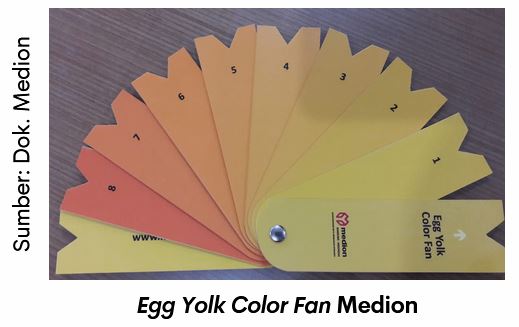
Basically, color assessment yolk it is subjective and varies for each person and different regions. However, in general, consumers like color the most yolk minimum scale of 5 on Egg Yolk Color Fan Medion.
The requirements that must be met in order to coloring yolk can be optimal, namely :
- Consumed in sufficient quantities.
- Digested by a healthy intestine.
- Not used as an antioxidant (low immunosuppressive challenge).
- Not used as a precursor of vitamin formation (poultry does not develop vitamin deficiency).
This is because carotenoids have other functions as vitamin A-forming precursors and antioxidants in the poultry body. If poultry is immunosuppressed and vitamin A deficiency, then carotenoids in the body will be used first to increase immunity and the formation of vitamin A.
To get the color yolk older and preferred by consumers, it is required to add pigment to the ration. There are 2 kinds of pigments that can be used, namely :
1. Pure pigment (synthetic)
Factory-made pure pigments are many types, such as cantaxanthin (carophill red), xantophyll, lutein and so on. The use of pure pigments need to pay attention to economic efficiency because the price is quite expensive.
2. Natural pigment
Another alternative is to use raw materials ration source karotenoidalami available in the environment. Some of them are :
a) Crude palm oil (CPO)
Areerob et al. (2019) in his research proved that the addition of CPO as much as 2-4% to the ration of laying hens can improve the color yolk significantly. The CPO contains a high concentration of carotenoids that is 500-700 mg / l with a composition of 36% ③ - carotenes, 54% ③ -carotenes 10% of the combined-carotenes also xantophyll.
b) extract of peppers and marigold flowers
Lokaewmanee et al. (2010) in his research compared three ration treatments, namely control group a (basal Ration based on corn), Group B addition of 0.1% paprika extract and Group C addition of 0.1% paprika extract + 0.1% marigold flower extract. Results show improved color yolk significantly between the treatment group and the control group.
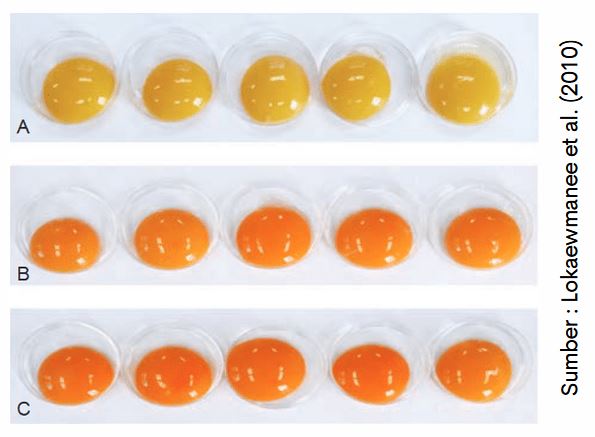
Such color enhancement is due to peppers and marigold flowers containing total carotenoids and xanthophyll higher than yellow corn.
Thus, information about carotenoids, color-determining color pigments, at a glance yolk. Hopefully useful and add to our insight.