Father Roro
Palembang-South Sumatra
What are the steps for applying biosecurity to incoming vehicles (transportation) and water as a medium that can become a disease transmitter?
Answer:
Dear. Mr. Roro, thank you for the question. Biosecurity plays an important role for the development of the livestock industry in the future. If the livestock industry wants to progress and prosper, even though there are vaccines and antibiotics in the medical program, efforts are still needed to prevent and eliminate disease through biosecurity programs. The basic understanding of how a disease enters, survives and spreads in a farm location must be understood thoroughly, so that disease control measures can be carried out correctly and effectively. In general, biosecurity means a series of measures to reduce the risk of transmission of disease seeds and prevent the entry of disease seeds into an area (Martindah et al. 2014).
When biosecurity is viewed in terms of hierarchy, it consists of three components, namely conceptual, structural, and operational biosecurity. Conceptual biosecurity is the first level of biosecurity and is the basis of all disease prevention programs, including choosing the right cage location, separating the age of birds, limiting contact with other birds or wild animals. Structural biosecurity is the second level of biosecurity, covering matters related to the layout and structure of cages, the correct manufacture of fences, the manufacture of sewers, the provision of decontamination equipment, the installation of feed storage rooms and dressing rooms. While operational biosecurity is the third level of biosecurity which consists of management procedures to prevent the occurrence and spread of disease infection in a farm. Operational biosecurity consists of three main things, namely isolation, traffic management, and sanitation (cleaning and disinfection). Disease agents can enter or be transmitted through the media, including means of transportation and water. Here's the review:
Transportation
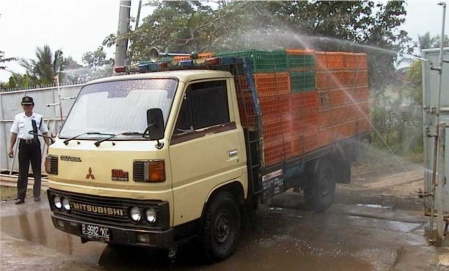
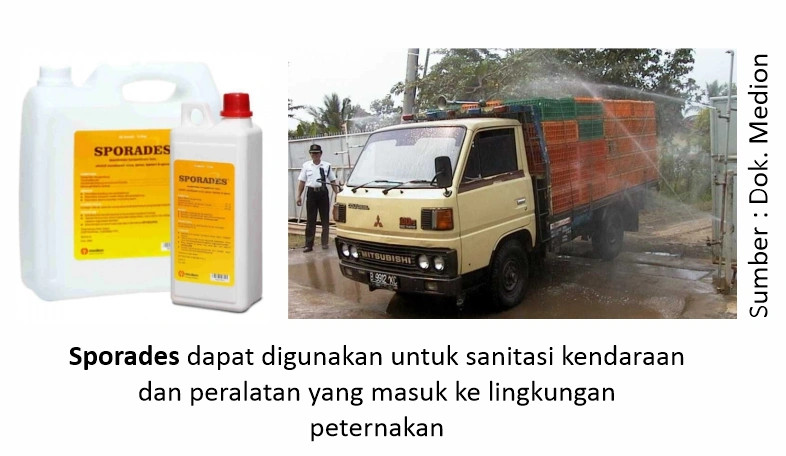
Vehicles are one of the factors that can spread the disease between farms. Various types of vehicles that enter the farm area ranging from vehicles carrying chicken seeds, feed, to vehicles of technical officers are at risk of carrying and transmitting diseases. If the division of 3 zones is applied, namely the red zone or dirty area, yellow zone or transition area from dirty area to clean area, and green zone or clean area, then vehicles carrying really necessary goods are allowed to enter the yellow zone without entering the green zone and must be decontaminated first. For example, using Sporades as a disinfectant that can be used to sanitize vehicles and equipment that enter the farm area by dipping (vehicle tire dyeing) or spray. Internal farm vehicles are not allowed to go out, while personal vehicles of workers and guests are only allowed to enter or be parked in the red zone.
Drinking Water
Water is one of the media that can transmit disease seeds to chickens. From data Technical Education and Consultation Medion that the last 3 years( 2017-2019) it is known that 63.82% of the total water samples in the farm contain Coliform above the standard and 44.84% positive contaminated with bacteria Eschericia coli (E. bra). Contamination E. Coli infection this most likely comes from chicken feces that heavily contaminate surface water. Therefore, the water on the farm must be disinfected through the administration of antiseptics. For example, using Antisep, Neo Antisep, Desinsep, Medisep, or Zaldes (select one). Some things to consider include:
- The dosage of antiseptics used must follow the rules of their use.
- Antisep and Neo Antisep should not be used to dissolve the drug/vitamin because it is a strong oxidizer that could damage the potency of the drug/vitamin. If disinfected drinking water will be used to dissolve drugs/ vitamins, it can use Desinsep, Medisep, or Zaldes. But special drinking water mixed with Desinsep, it needs to be precipitated in advance for at least 8 hours if it will be used to dissolve drugs/vitamins. While in the case of vaccination (vaccination through drinking water), do not give water containing antiseptics for 48 hours before and 24 hours after vaccination because the vaccine virus will be damaged or die if it comes into contact with antiseptics. When used for vaccine administration should add water stabilizers such as Medimilk or Netrabil. The purpose of administering these stabilizers is to neutralize the active substances in antiseptics that can reduce the workability of the vaccine.
- In an effort to prevent contamination of disease seeds and so that good microbes in the chicken intestine are not disturbed, the drinking water disinfection program can be done with a 3-2-3 system. This means 3 days of antiseptic Administration, 2 days of regular drinking water and 3 days of antiseptic administration again, and so on intermittently.
To ensure that the water we give to the chicken is qualified clean water and handling of water quality problems can be done properly, you should do the first water sample testing in the laboratory Medion (MediLab). Do periodic testing, especially when there is a change of season or at least once every 1 year.
Sometimes we also often find a layer of mucus (biofilm) and Moss attached to the surface of drinking places, reservoirs/tubs, and water pipes that become a place of growth and development of pathogenic microbes such as bacteria E. Coli infection (causes colibacillosis). Therefore, it is also necessary program and management flushing namely by cleaning drinking water pipes using high pressure water (about 1.5-3 bar) or with a water spraying rate of 1 minute every 30 meters of paralon pipe. Flushing can be done routinely, especially after giving antibiotics, vitamins, and vaccines through drinking water. Before it is done flushing we recommend that the water pipe be emptied first until there is no remaining water. Action flushing it will be optimal if previously the inside of the pipe is soaked with lifting material biofilm such as hydrogen peroxide (H₂O₂) agar biofilm can be lifted / detached. To make an H₂O₂ solution, 20-30 ml of pure h₂o₂ liquid is mixed with 1 liter of water. The h₂o₂ solution is then dissolved into a reservoir / reservoir of water and flowed to the end of the pipes leading to the place of drinking or nipple drinker. After that, it is allowed to stand for at least 2-3 hours, and then rinsed with pressurized water or in-flushing. In addition to H₂O₂, can also use other materials such as citric acid at a dose of 3 grams/liter or vinegar acid at a dose of 8 ml/liter which was allowed to stand for 1 hour.
When will be done flushing by using chemicals, while water pipelines can not be used to drain drinking water to chickens nipple drinker, so that the chicken is not thirsty, you should prepare a manual drinking place at night when the consumption of chicken drinking is small, or the method flushing this is done when the cage is empty. However, if flushing using water with high pressure or tools Harsonic which utilizes high frequency sound waves to prevent and eliminate biofilm then it does not need to be done.