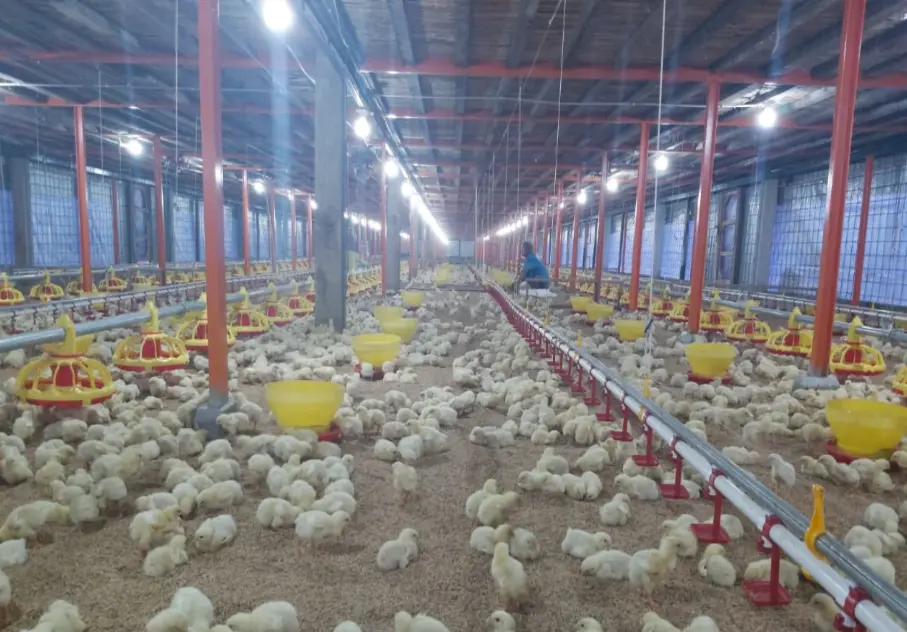
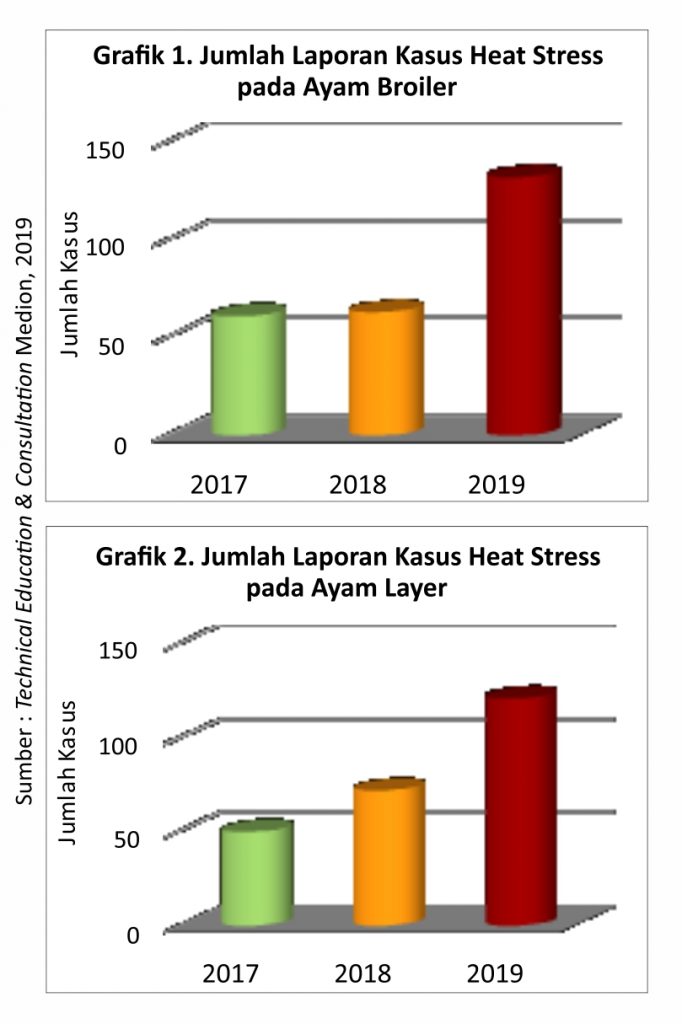
The temperature of the hot water (heat stress) being one of the biggest fears that can cause serious losses in poultry farming. This can also be compounded if the chicken farm has not implemented an automatic temperature and humidity control system that can condition the chicken in a comfortable atmosphere (closed house). Case incidence Data heat stress the team gathered Technical Education & Consultation (TEC) Medion as seen in graphs 1 and 2 there is an increase in each year.
Have been observed daily temperatures in the tropics during the rearing of chickens broiler can exceed 30°C. While the need for temperature conditions for chickens broiler will tend to decrease with age. This condition causes the chicken broiler experiencing heat conditions that are higher than the heat limit that can be tolerated.
The Meteorology, Climatology and geophysics agency (BMKG) reported that climate change caused an increase in the last average air temperature in April 2020 by 0.64 °C. This is not good for livestock because in the future it will have difficulty adapting to hot environments. Heat stressit can threaten the productivity of chickens, so it needs to be anticipated.
What Heat Stress?
Heat stressheat stress) is a disorder experienced by chickens due to environmental air temperature conditions exceeding normal temperature (>28oC) in the comfort zone. This results in the chicken is unable to balance between the production and disposal of body heat. Please note that the comfort zone (comfort zone) chickens are in the temperature range of 25-28oC with a humidity of 60-70%. At a temperature of 33°C for several hours can even cause death in poultry.
Symptoms Heat Stress
In principle, when the chicken is in condition heat stress, the chicken will try to lower its body temperature through the release of body heat. However, because chickens do not have sweat glands, the response seen from the behavior of chickens when experiencing heat stress among others:
- Chickens stretch, hang, or spread their wings. However, this effort is less than optimal because the temperature of the cage environment is not significantly different from the heat of his body.
- Chickens attach the body to the walls of a cooler cage or immerse the body inside litter. Sometimes chickens also do “bathing " in drinkers.
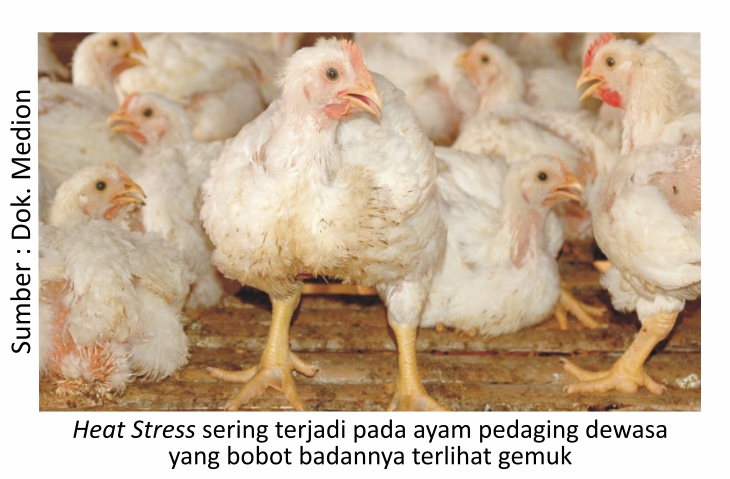
- Do peripheral vasodilatation or increase peripheral blood flow (edges), especially in the combs, Wattles, and feet so that the color becomes more red and hot.
- Chicken do panting, that is, breathing through the throat or increasing evaporation (evaporation). The cock will open its mouth and move its throat as a place for air to enter and exit. The release of heat through evaporation allows the chicken to lower its body heat. Nevertheless, panting requires higher muscle activity and can lead to increased heat energy requirements associated with heat stress. The chicken that did panting but the body temperature does not decrease, it will become weak, faint, then it can die suddenly. Death from heat stress this will especially begin to happen when the chicken's body temperature reaches 42oC or more.
- Water consumption will increase if the ambient temperature increases which will cause stool and litter become wetter.
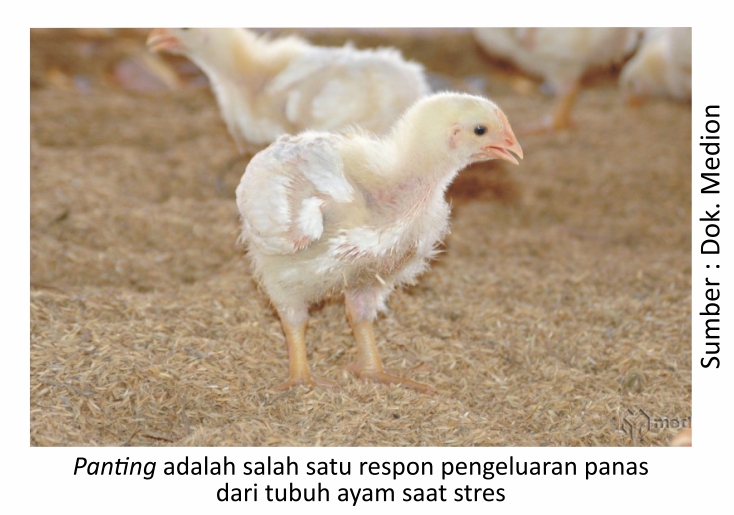
Provoking Factors Heat Stress
Current Cases of heat stress itself is more susceptible to adult chickens because it has perfect feathers that make it difficult to dissipate body heat. In addition, from the large body size in adult chickens can also be produced more body heat.
In general, several provoking factors (predisposing) to its occurrence heat stress in chickens, among other things:
- High genetic potential
Chicken breeds broiler and layer commercial that is widely maintained today has the potential to grow very fast and large body weight. This is due to the results of genetic engineering with a high level of productivity. The potential is good, but the risk of body weight that is too large without the development of internal organs such as the lungs and heart, will lead to increased cases of sudden death caused by heat stress.
- Chicken body temperature regulation system
Heat stress relatively easy to find in chickens because the chicken's body temperature is not influenced by ambient temperature (homeothermic). In addition, the chicken's body is not equipped with the sweat glands necessary to give off its body heat.
- Climate in Indonesia
Indonesia has a tropical climate with 2 seasons, namely the rainy and dry seasons. During the dry season, in tropical climates, during the day the ambient temperature will reach its highest point and the humidity of the air will be at its lowest point (the air is dry). This condition will be perceived by chickens as an uncomfortable condition until the chickens experience heat stress. In this condition during the day is needed appropriate management cage, for example by adding a fan or blower.
- Poor cage management
For example, the selection of cage materials and cage construction that is not appropriate to air ventilation that is not regulated properly. In addition, most chicken coops in Indonesia are made with a system open house (open cage), where the atmosphere in the cage is easily influenced by environmental conditions.
- Excessive cage density
The area of the cage is less / too narrow or chicken population per m2 too much will result in competition in obtaining oxygen chickens higher. In addition, the condition of the cage will become increasingly hot because normally chickens also produce body heat.
- Nutritional content that is not as needed
Giving rations with nutritional content, especially excess crude protein can aggravate the case heat stress. Excess crude protein will be broken down by the chicken's body to be removed with feces. The breakdown of crude protein will produce body heat that is much greater than the digestion of carbohydrates or fats. In addition, the crude protein that is wasted with feces will be broken down by bacteria in the feces into ammonia and heat.
Mechanism Heat Stress and its impact
When the chicken faces heat conditions from various sources, the chicken will respond by lowering its body temperature through the expenditure of excess heat energy from the body.
The body heat expenditure mechanism will function normally (optimal), when chickens are kept in the comfort zone (comfort zone), with a cage ambient temperature of 25-28oC and humidity 60-70%. Outside of these conditions, with temperatures exceeding the comfort zone, the chicken's response to release body heat will change.
Current Cases of heat stress it is divided into 2 forms, namely acute and chronic forms. The acute form appears when there is a drastic (sudden) increase in temperature, red), while the chronic form occurs if the temperature rises slowly over a long time.
When heat stress occurs in chronic chicken, then the chicken will immediately give a physiological response. The symptoms shown are changes in behavior in an attempt to increase the release of excess body heat (energy) through the 4 ways as previously described.
When the uncomfortable condition continues, the chicken will respond through hormonal mechanisms, where the levels of the hormone ACTH (adeno-cortico-tropic hormone) will be a sharp increase in blood circulation. Aftermath feed intake (ration consumption) decreases and drinking water consumption increases.
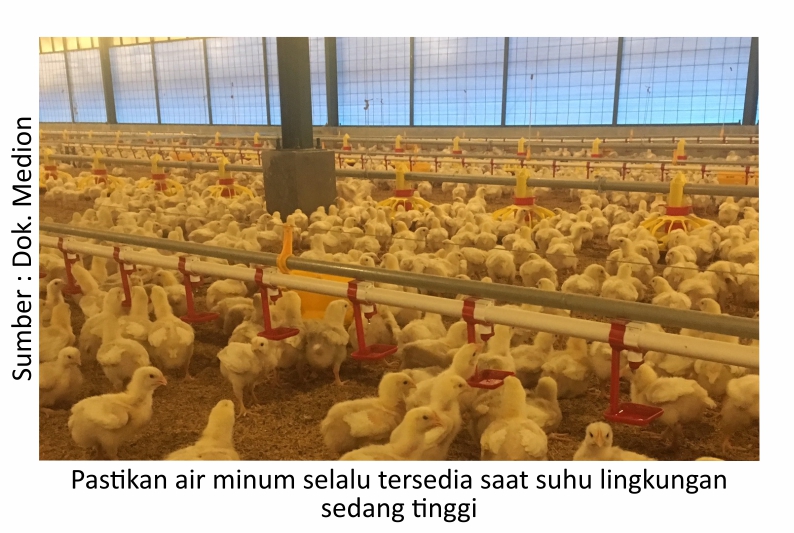
In such a situation, growth disorders, poor uniformity of chickens, swelling of ration conversion values (FCR), and the appearance of nutritional deficiency symptoms will occur in the field. The worst consequences even lead to death. Small loss due to heat stress this is influenced by the age, breed and weight of chickens as well as the period and level heat stress experienced by chickens (the maximum temperature received by chickens, the duration of the stress and the speed of change in air temperature).
Increased consumption of drinking water when chickens experience heat stress also bring its own impact, one of which is the decrease in the quality of dirt (become wetter). As a result, handling feces becomes more difficult and fecal contamination of eggs and chicken feathers increases so that the quality of eggs and chicken crusts can decrease. In addition, wetter stool conditions will cause flies to develop more easily and quickly. Increased ammonia levels can also result from wet stools, as a result of which cases of respiratory diseases, such as snoring or CRD, are easier to occur.
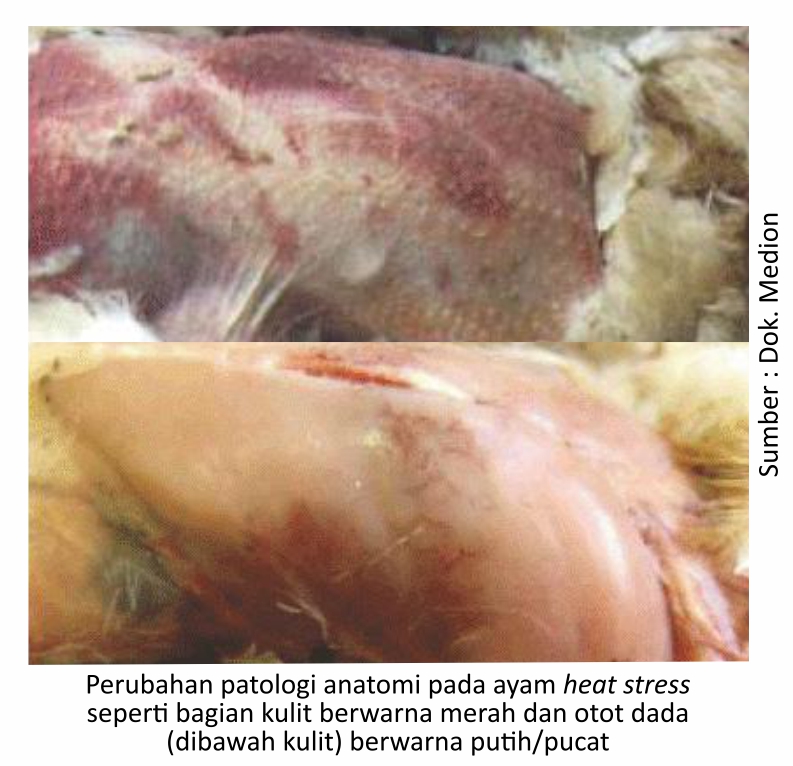
High temperature conditions also affect the stability of the content of nutrients in the chicken ration, especially vitamins. Vitamins are essential micronutrients needed in the metabolic process in the body of chicken. A decrease in the level of this vitamin will affect the productivity of chickens.
Not only causes a decrease in chicken productivity, heat stress also result in a weakened immune system (immunosuppressive). Total white blood cell count and antibody production decreased significantly in chickens layer who experienced heat stress. Sin addition, the activity of lymphocytes will also decrease. High levels of ACTH in the blood circulation will also trigger the cortex acrenalis to increase the production of the hormone coltisol resulting in a decrease in the number and changes in the type of leukocytes, namely eosinophil cells, basophils and lymphocytes.
Furthermore, Tony Unandar (2012) states that the increase in the degree of severity heat stress caused by increased activity panting, in the next stage will result in respiratory alkalosis. In the end, there will be an imbalance of microflora in the intestine. In such a situation, the process of absorption of nutrients will be disrupted. As a result, of course, will further aggravate the disruption of chicken productivity. Cases of infectious diseases in the gastrointestinal tract will also appear.
How To Cope Heat Stress
It is important to know that in the handling of heat stress need to pay attention to two things, namely, efforts to reduce the heat felt in the chicken and reduce the heat generated from the chicken itself. Starting from overcoming high temperatures in the environment then support the condition of chickens is declining because heat stress here. This is certainly supported by improved environmental management and feeding as needed to keep chickens from producing excess heat from their bodies. Ways that can be done as an effort to overcome heat stress in order not to happen protracted and detrimental to farmers are among others:
- Arrangement of ventilation by opening all the curtains during hot weather, so that the circulation of hot air to be quickly replaced with cold air. Ventilation arrangement can also be carried out by providing additional blower, or “artificial rain".
- Do chicken thinning. Thinning in one cage aims to reduce the density so that the chicken feels more comfortable, not too hot, dense, and can freely radiate heat from the body to the environment. An example of heat emission with radiation is a chicken stretching or spreading its wings. In chickens aged heat stress the density of the cage can be reduced by 10%.
- Notice litter, cause litter which is not feasible to be a source of heat without us knowing, through the fermentation system that is on litter itself. Add litter only if the condition is already very moist by wet feces.
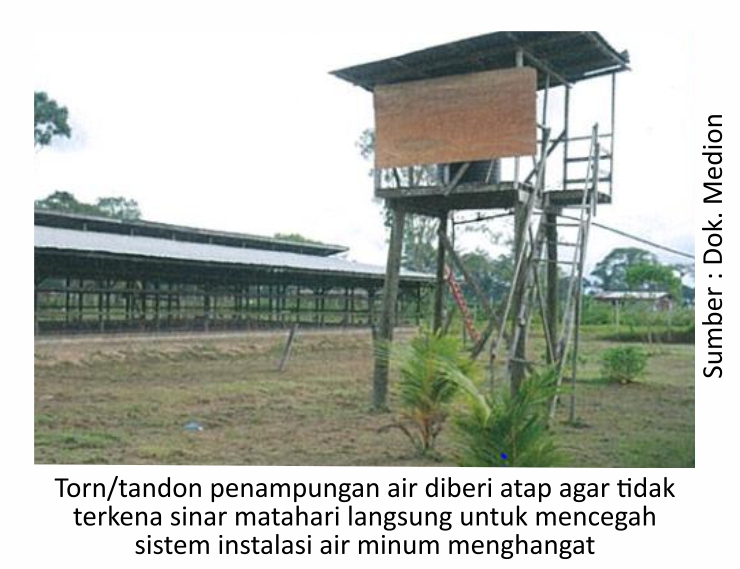
- Provide good quality cold water. A good drinking water temperature is 20-24oC. Cold water can be used to help chickens stabilize their body temperature when the ambient air is high. When the temperature is high the appetite of chickens increases dramatically, even if the temperature reaches 32oC drinking water consumption can be increased by 50%. The drinking water supply (TMA) and control the availability of water at regular intervals (especially if using TMA manual). If you need to increase the amount TMA so that it does not make it difficult for chickens to access it.
- Adjust the treatment to environmental conditions, for example, do not vaccinate, cut the beak (debeaking) or other treatment when the ambient temperature is high, as this can further aggravate the condition heat stress. Activities like the above can be done during cold weather or at night.
- You should not give rations during the day when the temperature conditions are high, because it can cause death due to the high activity of digestive metabolism and the generation of a lot of body heat. For that, the management that can be done is to give 1/3 ration in the morning, then 2/3 ration in the late afternoon, and provide additional rations containing calcium supplements or other minerals needed by chickens at night.
- Give vitamins and electrolytes. The most important Vitamin is vitamin C.
Giving vitamin C can be used to help chickens cope heat stres. Research shows that giving vitamin C can help improve egg weight, shellfish thickness, and egg production when it occurs heat stress. This is due to the increased consumption of rations by chickens. Pardue and Thaxton (1986) stated that vitamin C is known as a good antistress and is widely given to poultry because it is needed in hydroxylation reactions in the adrenal glands to reduce the production of the hormone ACTH.
Meanwhile, according to Piliang (2001), the provision of vitamin C in stressful conditions or when environmental stress is high, is able to maintain normal vitamin C concentrations in blood plasma, because when stressed chickens do not have the ability to synthesize vitamin C in sufficient quantities.
In addition to vitamin C, the provision of electrolytes is also needed. According to Ahmad and Sarwar (2006), the condition of acid-base imbalance in the blood during stress can be corrected through electrolyte supplementation through drinking water. Examples of Medion multivitamin products that can be used in dealing with stress in chickens are Vita Stress or Kumavit both contain vitamin C and electrolytes. Give also Imustim as an immunostimulant capable of enhancing the immune system in immunosuppressed conditions (eg stress conditions)
- Increase bisecurity. When the temperature is high, the development of disease in paralon drinking water becomes faster. Therefore, the schedule of cleaning and disinfection of drinking water channels should be increased. So is the disinfection of the cage. When there are chickens choose safe disinfectants, such as Antisep, Neo Antisep or Medisep. If in the drinking water channel has formed a layer or crust (called biofilm which is a good place for the development of disease seeds) should be done flushing (flowing pressurized water) by dissolving hydrogen peroxide (H2O2) 15-20 ppm, citric acid 1.5-2 g/l or vinegar acid 8 ml/l, because in conditions where there are many biofilms, disinfectant compounds cannot work optimally.
Prevention for Heat Stress
In tropical regions such as Indonesia, the incidence of cases heat stress inevitably, it must happen to chickens, especially in dry farming areas. In an effort to make the atmosphere in the cage feels comfortable, it is recommended to use a closed system cage (closed house). However, suggestions for the use of open-air cages are still recommended to have an adequate ventilation system, a monitor-shaped roof, built lengthwise in an east-west direction, and equipped with protective plants around the cage. Here's the explanation :
- Create a comfortable atmosphere (comfort zonethe chicken, through :
- Cages are built with a good air circulation system in mind. Choose a roofing material that is able to reduce (reduce) heat. If necessary use a roof monitor system. There are also some farms that have added artificial rain systems on the roof that are used during hot temperature conditions.
- Enclosure system slat (stage) with a height of 1.5-2 meters will help facilitate air circulation. Additions blower or the fan further improves the air quality in the cage, it's just worth noting that the best wind speed is no more than 2.5 meters/second. In addition, the direction of the wind flow must also be unidirectional
- Note the distance between the cage, the distance between the cage and the cliff and the height of the trees around the cage. The distance between the cages is at least 1 x the width of the cage (the width of the cage should be no more than 7 m)
- Set the density of the cage, for example 1 m2 for 15 kg or 6-8 chickens broiler, as well as 8 tails/m2 for chicken layer age 6-16 weeks.
- Implement good maintenance management
- Provide quality drinking water in sufficient quantities.
- Provide rations with the appropriate nutrient content and organize the distribution of the ration places.
- Set the cage curtain opening and closing system, adjust to weather conditions.
Knowing the various causes heat stress and implement appropriate preventive management is expected to be able to reduce losses that could arise due to the case heat stress such. Happy work and success always. Greetings.