Goat livestock or often called small ruminants are popular livestock in Indonesia, especially for farmers domiciled in agricultural/ plantation areas. Besides being easier to maintain, fast to breed, and can utilize waste and agricultural follow-up, goats are always available in the market. Raising goats requires relatively little capital when compared to raising cows / buffaloes.
If the management of goat farming is carried out optimally, it will provide tangible benefits in increasing income and welfare for farmers and breeders. But at the moment, intestinal worms are one of the threats to breeders of these small ruminants. Among the many livestock diseases in Indonesia, worm disease is still less attention from farmers.
Although worm disease does not directly cause death, but the economic losses caused are quite large. The infiltration of parasitic organisms, especially worms into the body of livestock to breed (infestation) in large quantities often causes farmers to lose because it suppresses productivity, among others, in the form of weight loss, decreased milk production in dairy cattle and an increase in the number of rejected livestock organs such as meat, skin, and offal. In addition, worm infestations in large quantities can lower the immune level of livestock (Nurcahyo et al., 2008). This facilitates the infection of a wide variety of other diseases.
Causative agents and symptoms of worms in goats
Helminthiasis or commonly known as worm disease is a disease caused by the infestation of worms in the animal's body, both in the digestive tract, respiratory, liver, and other parts of the body. Cases of worms in goat livestock generally run chronically (for a long time), so that at the beginning of the attack the symptoms are difficult to observe. In general, goats affected by Worms experience symptoms of pale face, thin body, lethargy, dull and standing fur, diarrhea or even difficulty defecating, and decreased appetite.
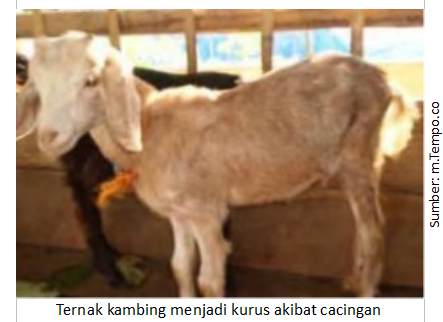
In general, the worms that attack many goats in Indonesia are gilig worms (Haemonchus contorcus) and heartworms (Fasciola hepatica). Worm Haemonchus contorcus it usually lives with other worms and is attached to the intestinal membranes until it sucks the juice of food, body fluids and blood, and secretes toxins. Therefore, goats with these worms cannot get fat despite the high feed consumption. This resulted in the growth of livestock to be hampered. In addition, 3-4-month-old goats affected by this disease can die.
Symptoms that appear are usually difficult for goats to pass feces because of its hard texture, then it becomes soft and eventually experiences diarrhea. As a result, the hair in the area around the anus becomes dirty. In addition, the goat's belly looks enlarged, the hair feels rough and dull, and lethargic. The influence caused by the worm infection also resulted in organ damage and reduce the body weight of goats (Marlina, 1990).
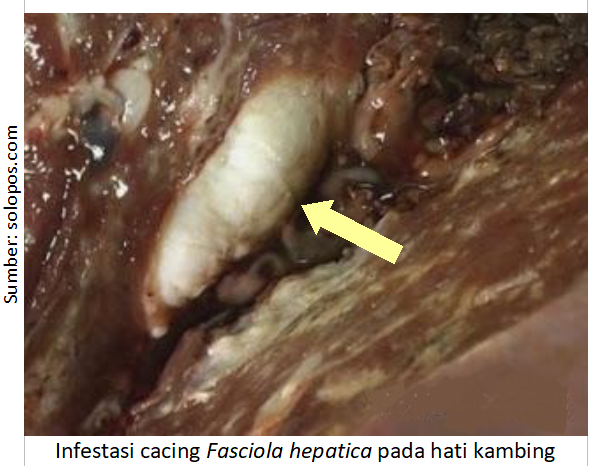
In the case of an attack Fasciola hepatica, it is often reported that goats have digestive disorders in the form of difficulty defecating with dry feces. In severe cases, goats often show symptoms of diarrhea, stunted growth and even a decrease in productivity. When goats are cut, it will be found that there are changes in anatomical pathology, especially in the liver. In acute cases there will be damming and swelling of the liver, the surface of the liver will usually experience point bleeding (ptechiae). The gallbladder and intestines contain blood. While in chronic cases, there is usually a thickening of the bile duct wall and hardening of the liver tissue (liver cirrhosis). In the bile ducts, helminth parasites can usually be found and gallstones are often present.
Cases of worms in goats are influenced by several predisposing factors (triggers) of the disease, including:
- Age. When viewed from the age of the attack, cases of worms in goats can attack all ages. However, based on the number of cases that occur in the field, goat or lamb children tend to have a higher level of vulnerability to these cases because they have not optimal body resistance.
- Weather and environmental conditions. Watery land conditions such as in rice fields are a suitable place for the development of worms because larvae and adult worms can grow optimally in dirty and humid conditions.
- Sanitation and hygiene are less than optimal. Cases of worms in goats will be more difficult to eradicate if not supported by good Cage and environmental sanitation. Leftover feed and feces that are not cleaned will accumulate and become damp, making it easy for larvae and worms to breed.
- The host population is between. One of the intermediate animals of worms that attack goats is snails Lymnaea rubiginosa. Wet environmental conditions or during the rainy season can trigger an infestation Fasciola sp. because during the rainy season is the right situation for the spread of worm eggs through these freshwater snails, which become intermediate hosts. Inside the snail's body, larvae multiply which then come out in large numbers and spread on wet grass and foliage.
- Drug Administration is not routine. Deworming is still not routinely done by farmers, which is only once a year. This situation will allow livestock to be susceptible to worms.
Control and handling of worms
Control and treatment of cases of worms in goats can be done in a simple way, which is to break the life cycle of these helminth parasites. Some things that must be considered regarding the control and handling of cases of worms in goats include:
- The program of administration of anthelmintics (anthelmintic). Anthelmintic administration is the main step in the control and treatment of worms in both calves and adult goats. The program of anthelmintic administration should be carried out from a young age (age 7 days) and repeated periodically every 2-3 months in order to completely eradicate the worms and break the life cycle of the parasite.One of the Medion anthelmintic products that can be used to eradicate gilig worms and liver worms in goats is Wormzol-K. Products Wormzol-K in addition to being effective for all stages of gilig worms, it can also be used to eradicate tapeworms and adult liverworms in goats. However, it should be noted that this drug should not be used in the first 1/3 month of pregnancy because it can cause miscarriage (abortion).
- Sanitation of the cage and the environment is optimal. Efforts that can be made to maintain the cleanliness of the cage include cleaning feces and leftover feed regularly, maintaining the drainage of the cage and the environment around it so that it is not damp and muddy, and avoiding waterlogging of the soil. In addition, plants and weeds around the cage cleaned and disinfected the cage regularly using Antisep, Neo Antisep, or Formades for an empty cage.
- Grazing system and grass feeding. Goats should not be grazed too early because at that time the worm larvae are usually dominant on the surface of the grass is still wet. In order to break the life cycle of worms, the grazing system should be carried out in turns. This means that goats are not constantly grazed in the same place. On grazing fields can also be sown copper sulphate to prevent the development of helminth larvae.Giving fresh forage grass is not recommended for intensively reared goats. It is better to dry the grass first before giving it to the goats to avoid the ingestion of worm larvae attached to the grass. The forage can be chopped in the afternoon so that the larvae and adult worms die and the forage can be given the next day.
- Selection and feeding of quality feed. The quality of the feed affects the incidence rate of worms in goat livestock. The quality of feed, both grass and concentrate, which can help improve the endurance of goats because the necessary nutrients are fulfilled.
- The host population is between. The population of freshwater snails as hosts for breeding worms can be reduced by keeping ducks or ducks that act as natural predators of these intermediate hosts. The cage environment must also be kept moist and not wet to prevent the survival of these freshwater snails around the cage.
- Monitoring eggs and larvae of worms. It is necessary to make efforts monitor routinely (once every 2-3 months) against worm eggs through stool tests. This stool test aims to find worm eggs both qualitatively (types of worm eggs) and quantitatively (number of worm eggs per 1 gram of feces). Currently Medion has a laboratory that can serve the test, namely MediLab which has spread in several regions in Indonesia.
In order to overcome the cases of worms that continue to recur, control and handling needs to be applied by breaking the life cycle of worms that are sustainable and supported by the commitment and awareness of all farmers. Greetings.