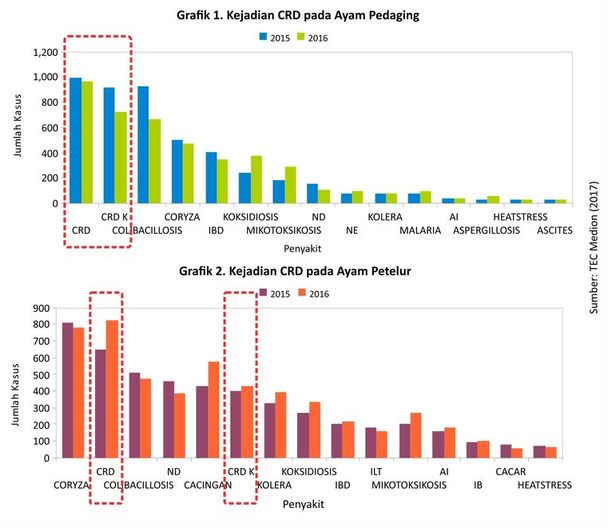
Grunt or cool language CRD (Chronic Respiratory Disease) for humans it can be only limited to mild health problems. However, it's a different story for poultry. CRD is a disease that affects the respiratory tract of chickens and is chronic. It is called "chronic" because the disease lasts continuously for a long period of time and is difficult to cure. From Team data Technical Education and Consultation (TEC) Medion reported that in 2016 snoring disease ranked first and second out of 10 diseases that often affect broilers (broilerthe chicken (layer) (Graphs 1 and 2). We already know that CRD is immunosuppressive or able to suppress the immune system of chickens. In the field, the occurrence of pure CRD is rare and generally has been accompanied by complications with other diseases especially E. Bra, so called complex CRD. Based on field data, the complex CRD ranked 2nd in broilers and 6th in laying hens.
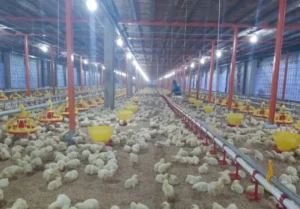
Long drought, heat stress, dusty environment, smoke pollution, plus declining water quality due to drought, all that triggers the incidence of CRD disease in chickens, both broilers (broilerthe chicken (layer). The climate picture is very relevant to the current situation in almost all regions of the country.
Causes of snoring disease in chickens
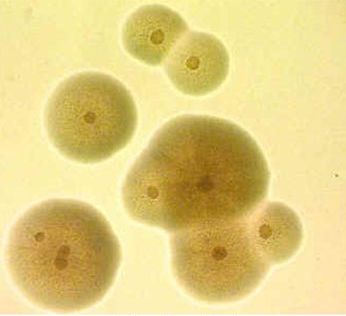
CRD in chickens is caused by bacteria Mycoplasma gallisepticum Bacteria, such as bacteria (bacteria-like organism). The chicken that has been cured will act as a carrier of the seeds of the disease (carrier) and as a source of transmission to other healthy chickens. CRD can affect chickens of all ages, with high morbidity but low mortality.
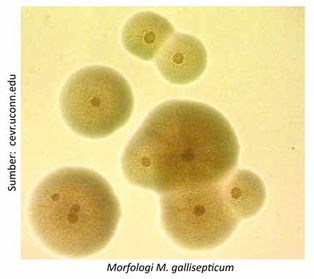
M. gallisepticum sensitif terhadap sinar matahari dan berbagai golongan desinfektan, misalnya Iodine, Benzalkonium chloride (BKC), atau Formaldehyde. This microorganism has a distinctive character that does not have a cell wall, then M. gallisepticum resistant to antibiotics of the penicillin group. M. gallisepticum can live in feces for 1-3 days at a temperature of 20 °C, in the yolk for 18 weeks at a temperature of 37 °C or for 6 weeks at a temperature of 20 °C. In allantois fluid, these microorganisms remain infective for 4 days in an incubator, 6 days at room temperature and 32-60 days in a refrigerator.
Impact of CRD disease
Transmission of CRD disease occurs horizontally and vertically. Horizontal transmission occurs through direct contact with sick chickens or chickens carrier. Transmission can also occur indirectly through air contaminated by chicken nasal discharge containing M. gallisepticum, rations, drinking water, cage equipment, transport or workers contaminated by these bacteria. While vertical transmission occurs transovarially from parents with CRD to chicks through eggs.
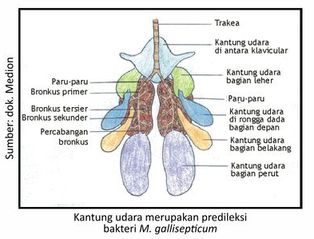
CRD attacks are closely related to the respiratory system of chickens. The respiratory tract of chickens is naturally equipped with mechanical defenses. The surface is lined with mucosa and there are Cilia (vibrating hairs) and mucus that serves to filter incoming air. M. gallisepticum often present in the respiratory tract of these chickens, it enters together with the air flow that has previously been contaminated. When it enters the respiratory tract of chickens, the agent of this disease settles on the mucosa of the respiratory tract and damages its cells. The presence of these bacteria will trigger inflammation and blood flow in the area becomes increased. Bacteria will join the bloodstream and go to the air sac, where the air sac is a suitable place (predilection) for M. gallisepticum live and multiply.
As a single disease, CRD in adult chickens rarely leads to death, although the incidence is quite high. Complex CRDS can incur considerable economic losses. The onset of complex CRD in farm when the weather is volatile it can cause up to 30% mortality. While mortality in small chickens ranges from 5-10%. In addition, the losses incurred by farmers are a decrease in egg production and ration conversion, which increases by 10-20%. The impact is stunted body weight growth, decreased carcass quality, decreased egg production, not achieving uniformity of body weight and the number of chickens that must be diafkir. The presence of disturbances in the respiratory system due to complex CRD infection, will cause reduced oxygen intake and the body's metabolic processes will be disrupted so that the growth of chicken was hampered and the efficiency of the ration becomes ugly.
Complex CRDS can also cause vaccination failure because they are immunosuppressive (suppress immunity). The respiratory system is the gateway to the body's primary defense because it contains ciliated mucosal tissue that serves to capture foreign particles that enter through the respiratory tract. The malfunction of the primary defense system, especially respiratory, is the main trigger for the entry of other disease agents such as viruses that cause IB and ND. The Virus that attacks before vaccination will inhibit the immune system in producing antibodies so that the possibility of the results of the next vaccination will fail because the condition of the chicken has decreased.
Clinical symptoms and Anatomical Pathology
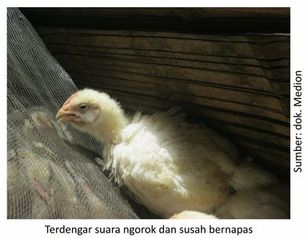
Clinical symptoms that appear can vary, from subclinical to difficulty breathing, depending on the severity of the disease. The incubation period ranges from 6-21 days. Visible clinical symptoms include mucus discharge from the nose and snoring. Other symptoms that appear are inflammation of the conjunctiva of the eye so that it is swollen and watery. A decrease in ration consumption also occurs followed by the development of body weight that is below the standard. Chickens suffering from impaired growth or decreased egg production. However, if it is complicated by colibacillosis, the clinical symptoms that appear in young chickens include chicken chills, loss of appetite, weight loss, and increased conversion ratio of rations. Chicks are more often seen in flocks near heaters.
Visible anatomical pathological changes include cavities and sinuses of the slimy nose. If these changes occur for a long time, the mucus will be yellow with a cheesy consistency. The air sacs become cloudy or contain mucus. In the later stages, the mucus becomes yellow and of a cheesy consistency. Such exudate can also be found in the heart and pericardium.
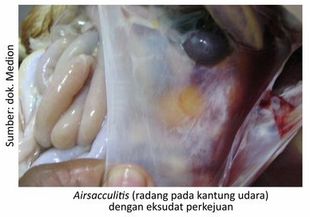
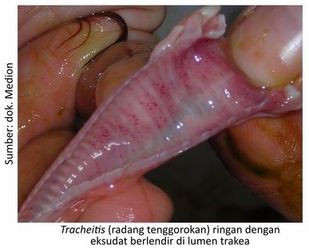
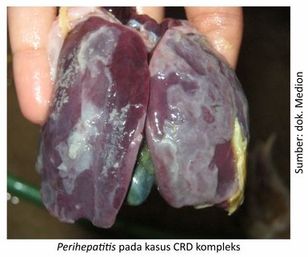
In chickens suffering from complications can be found inflammation of pericardium, the liver capsule and on the air sacs. Inflammation of the oviduct is also often found. Other changes that can be found include the mucous membrane of the trachea covered with mucous fluid, swollen and yellowish-red in color.
In the nurseryhatchery) when going to hatch, chicks from eggs infected with CRD do not have the energy to peck eggshells, so they can not hatch. It is also often found that chickens have diarrhea of green, whitish-yellow color. Chickens that show these clinical symptoms will die in a short time. CRD if it attacks young chickens, symptoms that appear in the form of a weak body, drooping wings and feces colored like soil.
The presence of disorders of the respiratory system and inflammation of the trachea are symptoms similar to IB or ILT diseases. In the case of CRD, there will be inflammation of the trachea along with cloudy air sacs. While in the case of ILT, tracheal bleeding is more specifically accompanied by the presence of thick red mucus from the flaking tracheal cells. In the case of IB, inflammation of the trachea is accompanied by swelling of the kidneys and accumulation of uric acid.
CRD triggering factors and complex CRD
CRD trigger factors can be divided into 2 kinds, namely from the anatomy of the chicken body (respiratory system) and maintenance management factors in the cage. From the anatomical factor, it is known that chickens have a different respiratory system than mammals, since there are air sacs, which are the location of the predilection of also Mycoplasma. The airbag has the disadvantage that it consists of only a few layers of cells and few blood vessels. In this part there are also very few phagocytic cells, while the infectious agents in the environment are numerous. This will facilitate such infectious agents as also Mycoplasma to colonize and damage epithelial cells.
While from the factors of maintenance management, cages with high density and short cage rest periods are the causes of CRD often attack and occur repeatedly. In addition, litter (chaff floor mats) that are too much dust or very damp in the rainy season also contribute significantly to triggering CRD. Age 3 weeks and above is a critical period for CRD attacks because at that age feces and ammonia begin to accumulate. Ammonia with high levels is known to damage the membrane of the respiratory tract so that the seeds of the disease freely enter and attack chickens, including also Mycoplasma and the plague of his followers.
Prevention to do
In order for CRD disease and its followers to be prevented, we need to make improvements to the comprehensive maintenance management system, namely by doing some of the following:
1. Litter Management
Condition litter it should always be kept in dry conditions, especially during the rainy season. Litter wet and dirty will trigger the onset of respiratory and digestive tract disorders, because in litter many develop bacteria, viruses, and parasites. It is necessary to do the handling strategy litter in order not to cause problems, it is primarily a source of disease transmission. Use litter with an initial thickness of about 8-12 cm for postal cages and 5-8 cm for stage cages.Need to do back and forth management litter to prevent litter wet. Flip-flops litter performed regularly every 3-4 days from the age of 4 days to the age of 17 days.
During the rainy season litter it will be easy to get wet and clump. If the amount litter a small lump, then it can be sorted and removed from the cage. However, if the number litter that clumps or wet already a lot, better stack with litter the new to the lumpy does not appear. Litter previously used substitutes should first be sprayed using disinfectants such as Medisep or Zaldes.
During the rainy season, it is necessary to repair the damaged structure of the cage. For example, repairs to a leaking roof, roof repairs so as to prevent rainwater tampias. Examination of the condition of the curtain, whether there is a hole or not and how to open the curtain from below that causes the chicken to be exposed to rainwater tampias. Save litter in a place that is protected from rainwater tampias.
2. Cage Density
The ideal chicken density standard is 15 kg/m2 or the equivalent of 6-8 adult broilers and 12-14 laying hens grower (pullet) per m2- his. If the density of the cage exceeds the capacity of the cage then the amount of chicken manure is also more and more and this is certainly not proportional to the amount litter who is in the cage as a result litter not able to fully absorb the feces. Feces will accumulate and cause ammonia levels in the cage to be high so that the chicken's respiratory tract will be irritated and trigger respiratory disease infections.
3. Maintain Cage Ventilation
A good air ventilation system will keep the air quality optimal for chickens. Dirty air mixed with ammonia and CO2 will be wasted out of the cage replaced with oxygen. Setting open and close the curtain, the height of the stage floor and the width and distance between the cages is very influential on the air ventilation system. During the rainy season, the curtain opening and closing system must be considered so that the chicken is not cold and not exposed to rainwater or airflow tampias that are too strong. A good ventilation system will produce good air quality. In addition, good ventilation will reduce the level of humidity in the cage and indirectly affect the quality litter.
4. Keeping chickens healthy
The main thing that is tried to keep chickens healthy is to avoid stress factors. Stress factors include disease agents, uncomfortable environments and poor maintenance practices. Take a multivitamin (Strong n Fit, Vita Strong, Vita Stress or Fortevit) and Imustim to increase stamina and endurance of the chicken. Do it anyway cleaning program by giving antibiotics such as Therapy, or Neo Meditril in accordance with the dosage and rules of use to eradicate the seeds of the disease in the incubation period or before the symptoms of the disease appear.
5. Strictly implement Biosecurity
Generally farmers who run the program biosecurity well has the ability and sensitivity to detect early the emergence of CRD infection in the cage. So that the rapid pace of anticipation can suppress the spread of the disease.
The application of biosecurity these include by improving the management of the cage, sanitation and disinfection in the area of the cage environment using Formades or Sporades, carry out cleaning and disinfection of cage equipment (ration places, drinkers, etc.) using Medisep routinely, perform drinking water sanitation using Desinsep to kill E.bra contained in drinking water with the 3-2-3 program, empty cages must be applied at least 14 days after the cage is cleaned and traffic control by controlling vehicles and guests in and out of the farm location.
Treatment and management of CRD
One of the principles of treatment is that the drug must be in accordance with the type of disease that attacks. However good the method of Drug Administration, but if we are wrong in choosing the type of drug, it will not be obtained the desired treatment effect. In carrying out complex treatment of CRD using antibiotics, it is necessary to know that M. gallisepticum it cannot be killed with antibiotics that work by damaging or inhibiting the formation of bacterial cell walls.
Handling for M. gallisepticum that is, by administering antibiotics that act on cell membranes and nuclei, especially those that actively inhibit the formation of folic acid and bacterial proteins M. gallisepticum and have a high concentration in the place where the bacteria are located (respiratory tract), not a high concentration in the blood. While bacteria E. Coli infection it is a Gram (-) bacterium that can be fought by almost all classes of antibiotics except the macrolide group. Examples of products that can be used to eradicate CRD and CRD complexes include Doctril, Neo Meditril, Therapy, Doxytin, or Trimezyn.
Choose one of these drugs and administer it according to the dosage and rules of Use indicated on the product etiquette or leaflet. Do it rolling or replacement of the selected antibiotic every 3-4 maintenance periods to prevent the occurrence of drug resistance.
In addition to giving antibiotics, some actions that must be taken in dealing with CRD cases include:
- Administration of high doses of multivitamins Fortevit at night to cope with stress and increase the stamina of the chicken body. Or can also be given Egg Stimulant or Neobro to improve production.
- Time period brooding period,, leave a gap of ③ 20 cm at the top of the cage for air circulation holes. Although at the beginning of time brooding period,, each side of the cage must be closed with a curtain, but still a gap must be left to facilitate air circulation in the cage.
- Pay attention to the density of the cage, whether it is really dense or just pseudo-density. When it turns out to be dense, carry out thinning (selection). Meanwhile, pseudo-density occurs when chickens gather in a certain place on the side of the cage to avoid uncomfortable conditions, for example, excessive sunlight or strong wind. For this condition, then set the curtain open and close well.
- If you need to install a plug or blower to help the circulation of air.
- Partial dredge litter which clumps or add with litter new to suppress ammonia production. When replacing or removing litter, do it gradually so that the chicken is not stressed. At the same time can be added a sprinkling of lime to absorb moisture in litter. Reduce ammonia levels in cages by spraying Ammotrol on feces.
- Carry out spraying in cages with disinfectants Antisep or Neo Antisep to eradicate bacteria also Mycoplasma causes of CRD.
By implementing some of the steps above, farmers are expected to be enlightened on how to prevent CRD. May be useful. Greetings.