The importance of knowing the baseline antibody Titer Layer
“When is the ND vaccination schedule in chickens layer production ?”
“When should the ND vaccine be given during chicken production?”
“I have the ND-IB vaccine every 3 months, is that enough or do I need to add more?”
“Chickens at the peak of production can they be vaccinated?”
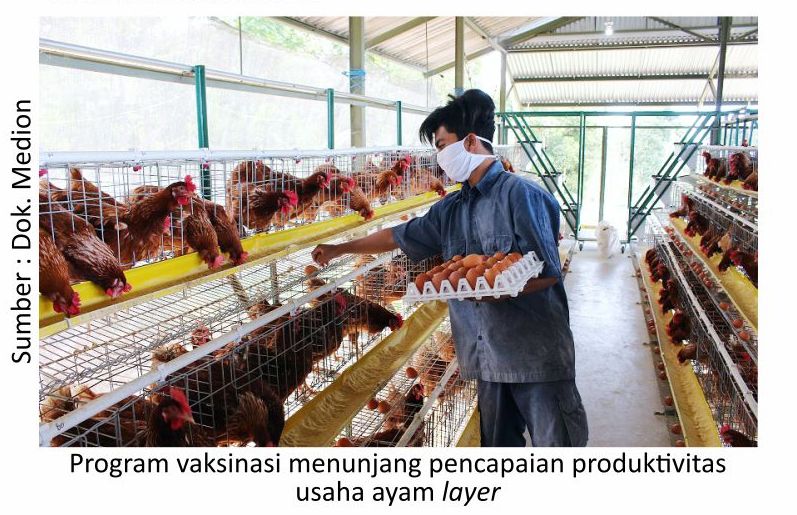
Definition Of Revaccination
These questions often arise when discussing the issue of the right vaccination schedule. In order to be able to answer these questions, we need to understand the purpose of repeating vaccinations or terms commonly used in the field, namely revaccination or booster. Booster derived from the word boost which in Indonesian can be called encouragement or addition that has the intention of helping or encouraging something to improve or improve. Booster or revaccination in poultry has the purpose of increasing or increasing the antibody titer from previous vaccinations that have begun to fall in the hope that the antibody titer in the chicken's body is always in a protective level so that it can be protected from disease attacks.
After knowing the meaning and importance of revaccination, the next question that arises is when is the right time to revaccinate. The right time to revaccinate is when the antibody titer has started to fall or is close to the minimum titer standard in providing protection. For example, if the standard titer Haemagglutination inhibition test (HI test) AI is 4 log2 or GMT 16 we should revaccinate when the antibody titer is close to 16 but there is no need to wait for the titer to be below 16 because it is already a bit late considering that the vaccine needs time to work so that the antibody titer is at a protective level. To be at the protective level of the active vaccine it takes 2-3 weeks and the inactivated vaccine 3-4 weeks post vaccination. These questions often arise when discussing the issue of the right vaccination schedule. In order to be able to answer these questions, we need to understand the purpose of repeating vaccinations or terms commonly used in the field, namely revaccination or booster. Booster derived from the word boost which in Indonesian can be called encouragement or addition that has the intention of helping or encouraging something to improve or improve. Booster or revaccination in poultry has the purpose of increasing or increasing the antibody titer from previous vaccinations that have begun to fall in the hope that the antibody titer in the chicken's body is always in a protective level so that it can be protected from disease attacks.
After knowing the meaning and importance of revaccination, the next question that arises is when is the right time to revaccinate. The right time to revaccinate is when the antibody titer has started to fall or is close to the minimum titer standard in providing protection. For example, if the standard titer Haemagglutination inhibition test (HI test) AI is 4 log2 or GMT 16 we should revaccinate when the antibody titer is close to 16 but there is no need to wait for the titer to be below 16 because it is already a bit late considering that the vaccine needs time to work so that the antibody titer is at a protective level. To be at the protective level of the active vaccine it takes 2-3 weeks and the inactivated vaccine 3-4 weeks post vaccination.
Get Baseline Titer
To determine the condition of chicken antibody titer has started to fall or is still at the protective level by routinely performing serological tests. The need for routine serology tests to get a complete picture of how the condition of chicken antibody titers so that the health status of the chicken can be known and also as a preventive measure or called early warning system.
Baseline titer is the minimum level of antibody titer so that the farm is safe from infection with certain diseases in the farm environment itself. Baseline titer this is obtained by doing monitor antibody titers are routinely in certain intervals and are carried out on healthy chickens for 2-3 rearing periods. On chicken layer can be done in the critical phase and the production phase. The critical phase is when the chicken begins to lay eggs, before the peak and peak production of 18, 25 and 30 weeks. Then after that, blood samples can be taken every 1-2 months. Types of diseases that need to be made baseline titernya is important diseases in chickens layer especially those that can attack to egg production such as AI, ND, IB and EDS.
Monitoring Titer for determining revaccination
For example in Graph 1. which is baseline nd titer on one farm layer.
In the graph at the beginning of production to peak production of ND titer in good condition but at the age of 32 weeks antibody titer decreased so that revaccination with active ND nd. It can be seen at 37 weeks that the antibody titer ND already rises again. Revaccination is done when the antibody titer has started to decrease or it is easier if a graph is made like the one above, making it easier for us to see the antibody titer pattern.
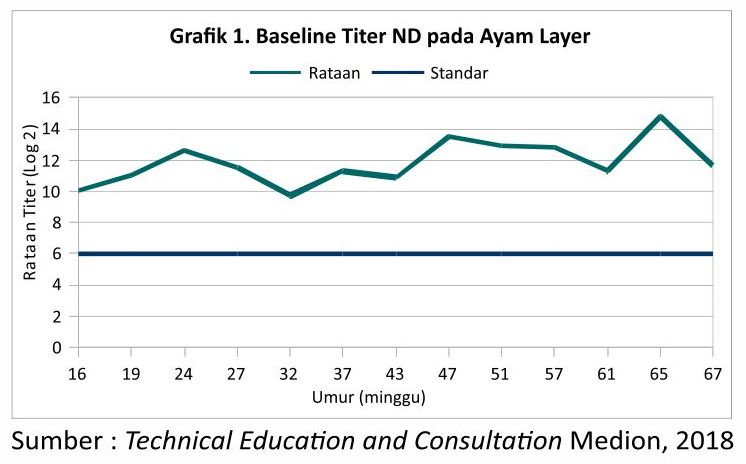
Minimum standard of HI nd titer in chicken layer that is 6 log2 or GMT 64. But given the current conditions in Indonesia, which is an endemic region of ND, when using only the standard is feared to be less protective, especially for farm in regions with ND challenge conditions are quite high. Quoting one of the journals from the website poultrymed.com (2017) entitled “The Titer Needed to Protect Commercial Layers” or the titer needed to protect chickens layer the commercial explains that the group of chickens with low hi nd titer (5 log2-8 log2) and medium HI titer Group (9 log2 – 11 log2) have uncharacteristic symptoms, abnormal egg production and still exist shedding virus (cemaran virus). While in the high titer HI group > 12 log2, chickens are fully protected in the absence of clinical symptoms or abnormal egg production shedding virus.
Monitoring Titer as Early Warning System
Early warning system is an early warning system in chicken farming. The test results will be compared with baseline titers on the farm. Signal of the problem is shown from the picture of the current titer deviated (eg lower titer) of baseline titer.
One of the chicken farmers layer testing nd titer at the age of 55 weeks with the results of its HI titer 9 log2, whereas around that age baseline the titer is at the HI 12 log2 titer. Medion field personnel also suggest checking the condition of the chickens in the cage. After checking, it was found that there was a decrease in egg production of about 2-3% and was supported in 1 week after checking the ND antibody titer again which resulted in a titer spike to 15 log2. This indicates a challenge ND on the farm. Farmers were immediately taking action with the provision of supportive therapy, increased biosecurity and revaccination of ND with accompanying monitoring of antibody titers.
Serological Test Sample
Ideally, the number of blood samples that can be taken each time the test is 0.5% of the total population or at least at least 15-20 samples per cage and sampling is done randomly throughout the cage. Blood collection is carried out in the veins on the wings in adult chickens in an amount of at least 1 ml per tail. After that, give space to the syringe or syringe and let stand at room temperature for about 2 hours so that blood serum is easily formed. After the serum is formed with the marked presence of a separate clear liquid with blood clots, immediately separate the serum to be packaged and sent to the nearest laboratory. If testing is not done immediately serum can be stored in the refrigerator. Keep the temperature in the serum delivery package maintained cold by giving additional ice cubes or ice pack.
The quality of a good serum sample is clear yellowish serum color, not cloudy, odorless and not lysis (blood cells are not broken or damaged). Serum lysis is characterized by its reddish color, such a condition will certainly make it difficult for the laboratory when concluding the results that cause the test results to be biased (distorted).
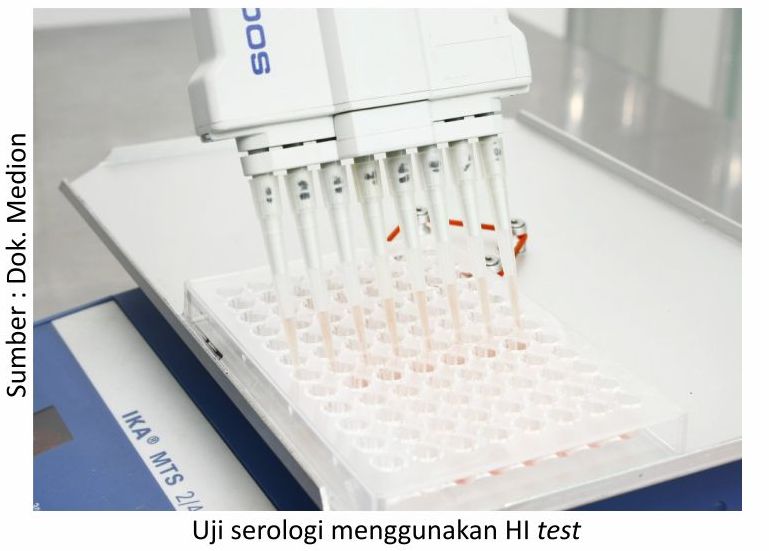
Laboratory tests are an effective means of monitor health status of livestock. Monitoring antibody titers routinely can make farmers more aware of the condition of the chickens they maintain and can also be used as a tool to make decisions in farm management. Current conditions with the growing technology, especially in the world of animal husbandry make farmers today can not rely only on instinct in making decisions but must be based on clear and accurate data.
Therefore Medion presents MediLab which provides serology testing services and has branches spread almost throughout Indonesia. Serological test methods in MediLab performed in accordance Standard Operational Procedures (SOP), referring to the Indonesian national standard (SNI), Office Internationale Epizooticae (OIE) and others. Testing in MediLab it has also implemented ISO 17025: 2008 (testing and Calibration Laboratory Accreditation standard). The testing tools used are always calibrated regularly and also skilled laboratories make the test results given accurate. In addition, the type of complete testing and also test results issued by MediLab equipped with interpretation of test results making it easier for farmers to understand the results of laboratory tests and what steps should be taken to handle it.
By maximizing the existing tools and utilizing them properly would help keep the performance of the chicken in its best condition. Greetings.