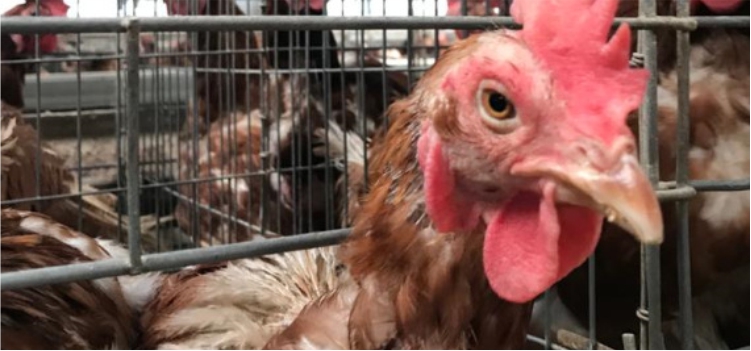
One of the common parasitic diseases found in both laying and male chicken farms is intestinal worms. The risk of chicken contracting worms can occur in various conditions, especially in cages with poorly maintained cleanliness.
Of course, this worm disease harms many farmers because it can cause a decrease in chicken body weight, reduce chicken productivity and make chicken health continue to decline. But it is not uncommon for farmers who have not paid attention to this disease because the symptoms are less specific or the mortality rate is not high.
There are various types of worms that often attack the health of chickens. Broadly speaking, when grouped there are convex worms (nematodes) such as Ascaridia galii and tapeworms (Cestodes) such as Raillietina sp.. But lately there have also been cases of worms that do not belong to the group of gilig worms or tapeworms, that is, worms Acanthocephala.
Cases Of Worms Acanthocephala in poultry
In Indonesia, early reported cases of worms Acanthocephala the chicken occurred in Yogyakarta. Furthermore, there are also areas of Central Java, namely Magelang, Klaten and Solo.
Results of species identification Acanthocephala found in Yogyakarta and Central Java are Mediorhynchus gallinarum.
In recent years, the Medion team has also found cases of worms Acanthocephala on chicken farms in East Java, namely Blitar and Mojokerto.
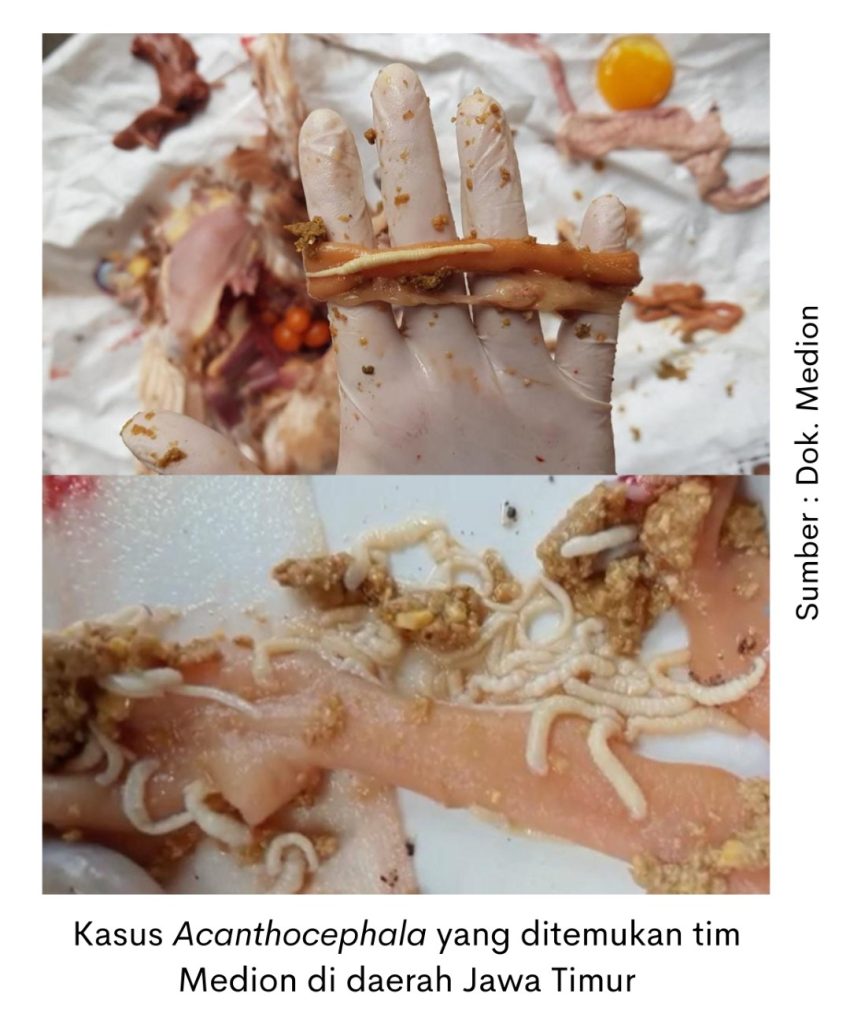
Worm Acanthocephala it has a body shape that is bilaterally symmetrical like a caterpillar. The body of an adult worm can be divided into three parts, namely the probosis, neck, and body. The proboscis located in the anterior part of the worm is used as a hook to attach itself to a part of the intestinal mucosal wall of the host.
These worms have similarities with tapeworms in their digestion, which absorb nutrients from the intestinal tract of chickens through pores that are found throughout the worm's body.
Life cycle of worms Acanthocephala occurs indirectly and requires two hosts, an intermediate host and a definitive host. The larvae feed on the eggs of the larvae (acanthor) in conjunction with feces.
The eggs of worms that are in the environment will be eaten by an intermediate host in the form of animals crustaceans and insects like cockroaches and flies. In the body of the intermediate host there will be the development of the life cycle of the young/larval stage of the worm Acanthocephala.
Acanthor will come out of the egg membrane in the digestive tract of the intermediate host and migrate into the body space. After migrating acanthor will develop into the next larval phase, namely acanthella and continues to evolve into cystacanth.
Furthermore, the larval stage will develop into the adult worm stage when ingested by the definitive host. The adult stage of this worm lives in the digestive tract of the definitive host of vertebrate animals such as poultry.
The impact of worms on the health of chickens
Generally, intestinal worms do not show specific symptoms and rarely cause death. As a result, this disease is not rarely ignored, but actually this disease can cause economic losses. Although it does not show specific symptoms, worms can cause several symptoms that are distinguished by their severity.
In the case of worms of mild severity, helminthic infestations in the digestive tract of chickens are still in small quantities. The clinical symptoms can look like a decrease in production but the chickens still appear to be relatively active and healthy.
Whereas in severe severity there will be a decrease in appetite, stunted growth, a significant decrease in production, and diarrhea. This can occur due to impaired intestinal health. In severe cases of infestation, adult worms can also be found that come out together with feces. The condition of the chicken's body can look pale, thin with coarse feathers.
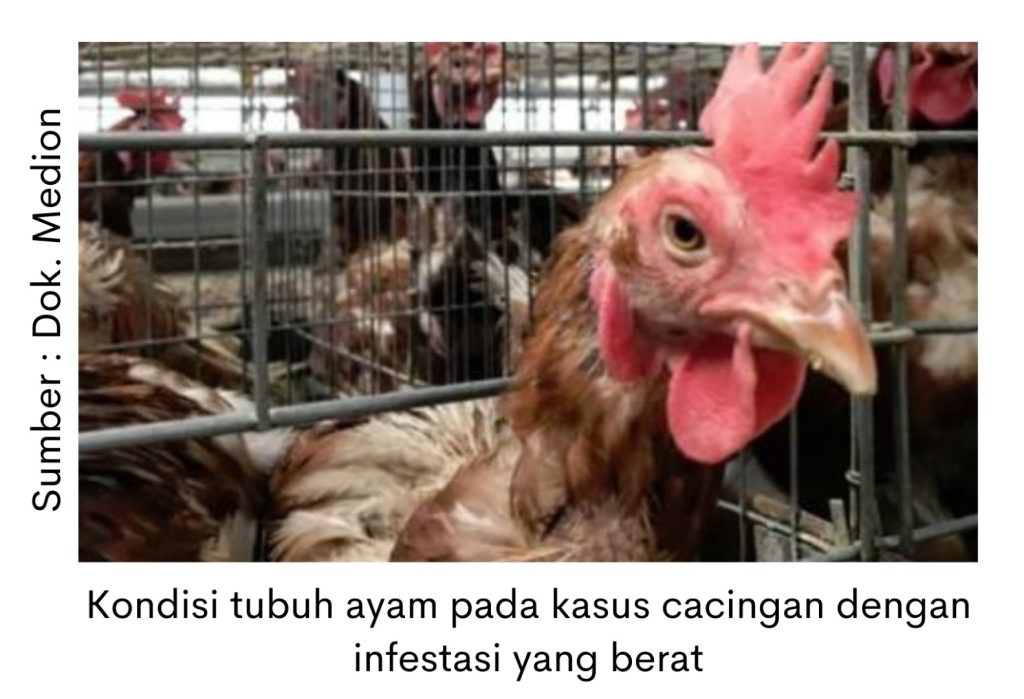
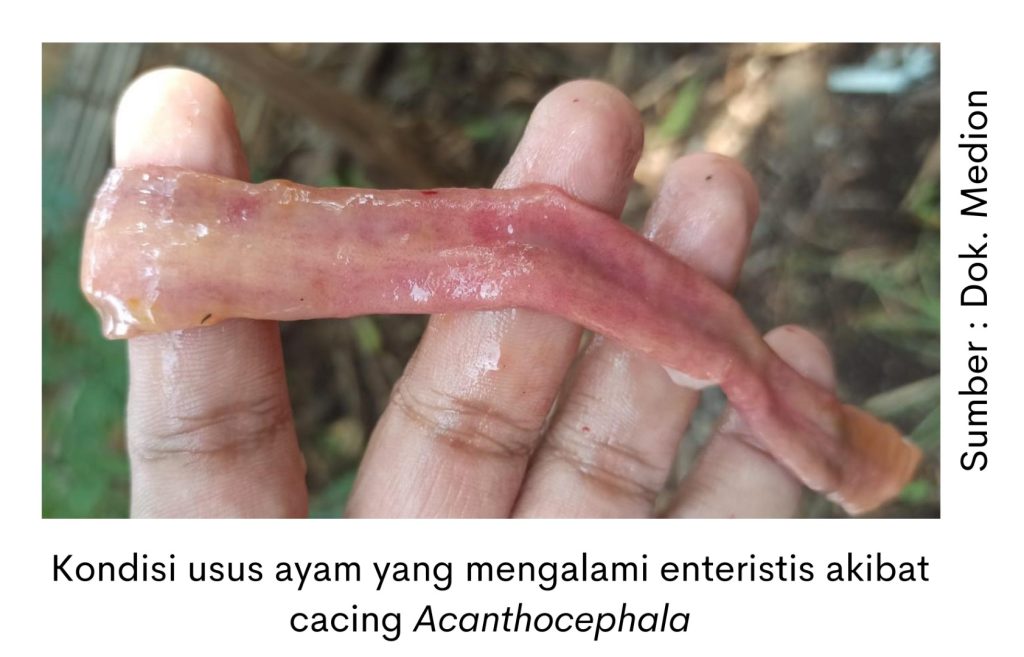
Pathological changes can also be seen in cases of worm infestation Acanthocephala heavy ones. In the case of an intestinal infection (enteritis), there is a thickening of the intestinal wall, the presence of nodules on the intestinal wall and accompanied by bleeding (haemoragi).
Pengendalian Cacing Acanthocephala
Efforts to control cases of worms must be carried out comprehensively in preventive measures and handling. Here are things that can be done to prevent cases of worms:
- Pay attention to the sanitation of the cage by not allowing feces in the cage to accumulate too much.
- Minimize the population of intermediate hosts such as flies around the cage because they can act as intermediate hosts. Use Larvatox which is mixed with feed to minimize fly larvae. As for the extermination of adult flies use Flytox by way of sprinkled on a base that has been moistened and placed in an area that is infested with flies.
- Give deworming periodically every 1-2 months. Worm medicine needs to be given regularly to break the life cycle of worms in the chicken's body so that intestinal health can be maintained.
- Do monitor worm eggs with regular stool examination that can be done in MediLab. Examination of worm eggs is carried out by microscopic examination. Stool samples should be taken directly from the chicken's cloaca or freshly removed fresh feces and if not directly examined need to be preserved in advance in 10% formalin.
Furthermore, stool samples can be examined using a microscope.This Monitoring is necessary to determine the presence or absence of helminth eggs in the body of chickens qualitatively (type of helminth eggs) and quantitatively (number of helminth eggs). The results of this monitoring can be used as an evaluation of the prevention or treatment of worms that have been carried out.
Handling of cases of worms can be done by administering deworming. Things that need to be considered in the administration of anthelmintic is the active substance contained in it because it will affect the spectrum of its work.
The selection of worm medicine is said to be appropriate if it has a spectrum of action in accordance with the type of worm that attacks so that the treatment will be effective. On the handling of cases Acanthocephala not all anthelmintic drugs show effective results. Several active substances that effectively eradicate Acanthocephala adalah albendazole dan levamisole. Examples of products that can be used are Wormzol Suspension and Levamid.
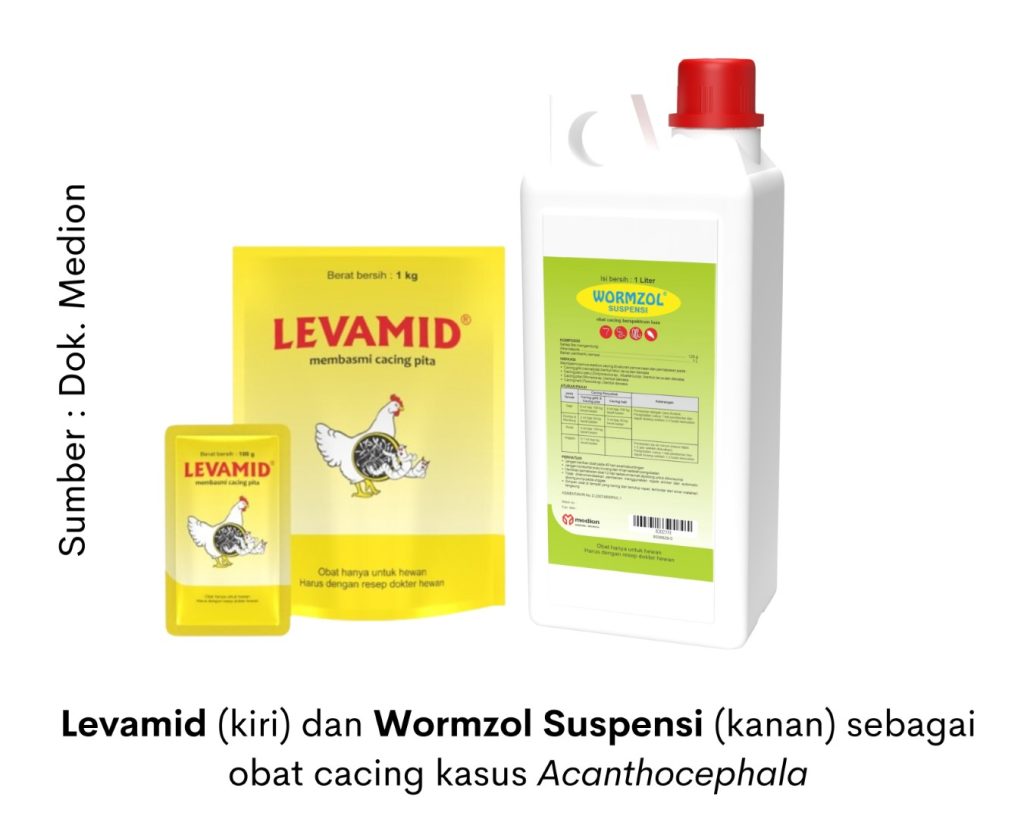
Wormzol Suspension is an anthelmintic with albendazole content that has a broad spectrum. In addition to being able to overcome Acanthocephala, this anthelmintic is able to eliminate other types of worms such as tapeworms and gilig worms.
Administration of Wormzol Suspension done through a mix of drinking water at a dose of 0.1 ml / kg of chicken weight. Drinking water that has been mixed Wormzol Suspension must be discharged within 2 hours, so the drinking water provided needs to be adjusted to the needs of drinking within that time.
Things to consider in giving Wormzol Suspension it is not recommended to use nipple drinker or automatic dosing pump.
Levamid it is an anthelmintic that contains a combination of levamisole and niclosamide. The combination of the two active substances produces anthelmintic drugs that have the same broad spectrum as Wormzol Suspension. Administration of Levamid done through mixed rations at a dose of 0.2 grams / kg of chicken weight.
Mixing way Levamid into the ration needs to be done gradually so that it can be sure to be mixed evenly. First mix Levamid into the ration with a small amount (approximately 25% of the total ration) and stir until smooth.
Furthermore, the ration already contains Levamid mix into the overall ration (75% of the remaining ration) and then stir again using a shovel or mixer horizontal until homogeneous. When given to chickens, the ration already contains Levamid should be discharged within 2-4 hours. Therefore, the amount of ration given needs to be adjusted to the needs of chicken feed during this time.
Worms are parasitic diseases that are often considered trivial but slowly but surely cause various kinds of harm. Therefore, a comprehensive strategy is needed in controlling cases of worms. Good management, strict sanitation and biosecurity, eradication of disease vectors and routine deworming are important to break the life cycle of worms.