Many have already proven that by using closed house able to improve livestock performance. Cage broiler closed house equipped with various equipment components that aim to provide optimal comfort, can overcome weather problems, increase cage capacity, and protect from chicken health problems.
Heating
On time brooding period,, chickens need warmth temperature in the range of 30-34°C (Cobb Management Guide, 2018). Future needs brooding period, this can be achieved using a heater. The selection of heating can use LPG gas fuel. There are two types of LPG heaters that can be used, namely spot heater and central heater.
Spot heater only heat certain points or areas in the cage. Working principle spot heater similar to the rays of the sun. Since it only heats a certain area, fuel consumption spot heater more efficient.
Spot heater effective for heating the husk base or litter that'S the foot of the DOC. Generally, one spot heater it has a capacity for 750-1000 Doc. One example spot heater can use Infrared Gas Brooder Medion (IGM).
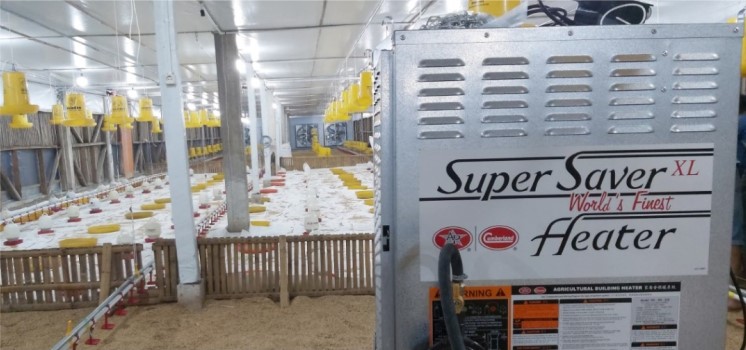
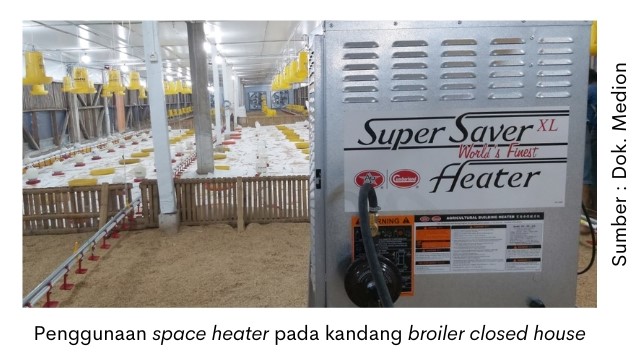
Central heater or space heater (Super Saver) will heat the air throughout the cage room. Space heater it is usually placed in the center of the cage or in an area with fairly slow air movement to create more optimal air heating.
One space heater it generally has a capacity of 10,000 DOC so it offers practicality for cages with more populations.
Ventilation System
The ventilation system provides comfortable air conditions with the support of equipment such as the following:
1. Fanfan)
Fan on closed house is a kind of fan exhaust mounted on the back of the cage (system tunnel) which creates air movement by sucking air from the front of the cage to the back of the cage.
While on the system cross, the fan is mounted on one side of the enclosure wall, and the fan will draw air from inlet mounted on the opposite wall. In general, used 2 kinds exhaust fan namely box faN and cone fan.
Things to consider in the operation of the fan is the number of fans on and the length of time the fan is on. The fan capacity that matches the air volume in the enclosure is the key to obtaining suitable air conditions. The selection of the fan also needs to consider the fan efficiency factor, namely the ratio of the air capacity produced with the electrical power requirements.
Fan maintenance is important to do regularly. Simple maintenance such as cleaning dust or dirt attached to the fan can be done every week or month. While more complicated maintenance such as replacement of worn or damaged parts is usually done in a matter of years or when the cage is not in operation.
2. Cooling pad
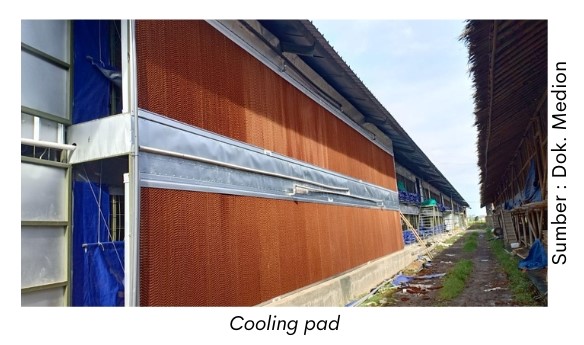
In addition to the fan, of course, the cage closed house also equipped with cooling pad. The fan is where the air out of the cage, while cooling pad is where air enters the cage or opening inlet. Cooling pad made from an arrangement of corrugated paper that forms a certain pattern to direct the flow of air entering the cage.
Deep network cooling pad this includes also with a water circulation system that is useful for wetting cooling pad. Determination of aperture inlet at the colling pad this is guided by the number of fans running and the desired target wind speed.
Cooling pad using the principle of evaporation or evaporation of water to lower the temperature of the air from the outside that is inserted into the cage. Some of the heat energy from the outside air will be used to evaporate the water in cooling pad so that the air temperature will be cooler brought into the cage and produce wind chill effect give me the chicken.
Evaporative cooling pad also serves as a filter for air entering the cage. Block-block cooling the pad prevents large air impurities from entering the cage, so the air becomes cleaner.
Cooling pad also need to be treated by routinely cleaning. Over time, the use of cooling pad it can be overgrown with Moss and mold, or there is a buildup of minerals such as calcium.
The mineral deposits are closely related to the source of the water used and can be prevented by providing special treatment (treatment) on water. Cleaning of mold and mildew can be using appropriate chemicals. Cooling pad those that have been damaged (usually torn or weathered) need to be replaced.
3. Curtain cage
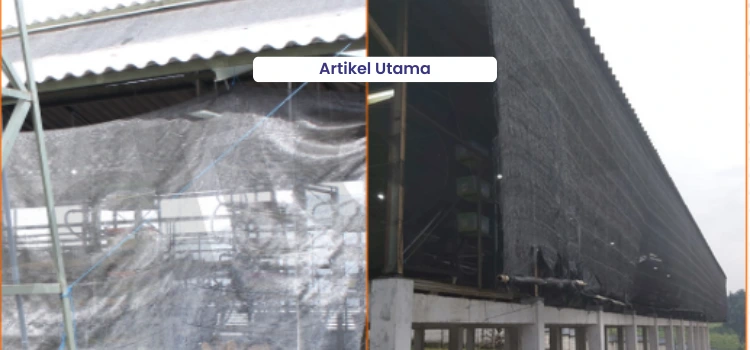
The cage curtain is the side cover of the cage so that the chickens are protected from outside interference. Curtains are installed next to the cage and are usually made of plastic material. In addition, cage curtains are also useful for :
- Helps maintain air temperature in the cage
- Prevent direct wind exposure to the chicken's body
- Generate static pressure in the cage
- Controller
Controller or climate controller is a device for automatically controlling the temperature and air velocity in an enclosure environment closed house. This tool is often referred to as the” brain " of the system closed house. Controller will regulate the work of the equipment by reading the sensors and following the inputted settings.
As for if the temperature in the cage still has not reached set point the desired result of the ambient temperature is too high, climate controller can adjust the cooling system. For example first increase the airspeed by the addition fan, then with the operation cooling pad. Climate controller connected to the sensor device is a temperature sensor and humidity sensor.
The sensor serves to measure the actual temperature and humidity conditions in the cage. At this stage the humidity sensor is mounted on controller role to maintain conditions in the cage does not experience over humidity.
With good accuracy of sensor readings and optimal setting of the number of fans by climate controller, electricity consumption for the needs of the cage can be kept efficient and efficient. Conversely, when the air temperature is too cold, controller will reduce the number of rotating fans, fan rotation speed and prevent water from flowing in cooling pad.
Climate controller it also plays a role in the period brooding period, in regulating the flame of the heater in order to maintain the temperature in the cage in accordance with the requirements of future maintenance brooding period,.
Types controller very diverse, ranging from the simplest to the technologically advanced that can be controlled remotely and collect data for production analysis. Controller currently it can not only read data from sensors and control equipment in the local enclosure only, but also can send information to the outside to be read by the user through the internet-connected system (IoT).
Feeding Equipment
On time brooding period, still in use partly manual chicken rations. At the age of 6 days and older, automatic equipment is already being used.
Feeding equipment in the cage closed house divided into 2 systems, namely main feeding system (source of food supply) and feeding line system (feed pipe line). Cage operators simply fill the feed into the hopper at the main feeding system and feed will be distributed automatically to each hopper feeding line. The electric Motor will drive auger inside the pipe (feeding lineso that the feed back from the hopper feeding line will be distributed to each pan feeder.
Pan feeder last (conveniently located close to the electric motor) is equipped with a feed sensor, so that when pan feeder the far end is full, then the sensor will work and make the electric motor become “off”. Height of feed pipe line (feeding line) set to chicken reach or chicken breast height). Height feeding line can be set using winch- pulleys.
Automatic Chicken Drinking System
Automatic chicken drinking system is divided into two parts, namely main water supply and water line drinker. Main water supply (source of water supply) comes from torn as a source of drinking water reservoir for chickens. Water is pumped and flowed according to the pressure set by pressure meter.
There are also medicator such as Dosatron as a tool to insert antibiotics, vitamins, or vaccines automatically into the water pipeline.
Water line drinker consists of a water pipeline equipped with nipple drinker which can remove and retain water (self locking) so that the water does not drip easily. Nipple drinker also equipped with cup which is attached under the point nipple.
Installation cup to ensure that no water falls into the husk when chickens drink so that the husk is kept dry and high ammonia gas formation can be avoided.
Thus the description of equipment closed house at the broiler. May be useful.