Question by Mr. Yudi – by email
How can flies be effectively controlled in livestock areas, particularly when their population tends to increase during the rainy season? If insecticides are to be applied, what factors should be taken into consideration? After administering Larvatox at the recommended dosage, can the dose be reduced for subsequent applications? Thank you.
Answer
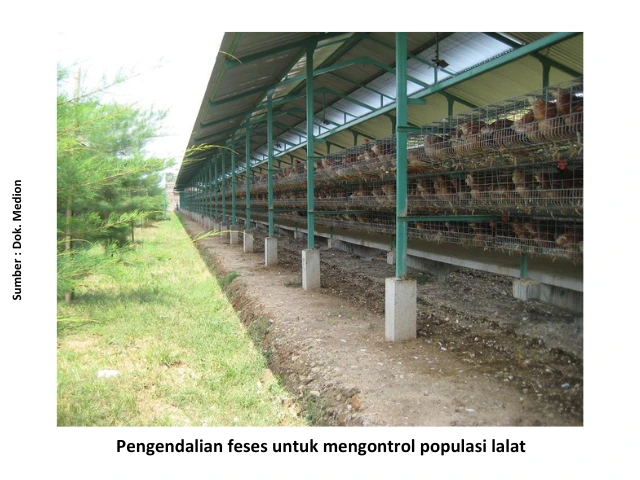
Thank you, Mr. Yudi, for your question. During the rainy season, ambient humidity tends to increase, causing the feces to become wetter than usual. It is important to note that moist manure provides an ideal breeding environment for flies as well as for various pathogenic microorganisms.
This condition contributes to the rapid increase in fly populations. Approximately 0.45 kilograms of moist and wet feces can serve as a breeding site supporting the complete life cycle, of up to 1,000 flies.
Freshly excreted chicken feces contain approximately 75–80% moisture. Therefore, it is essential to promptly reduce the moisture content to 30% or lower to prevent excessive fly breeding.
A commonly applied technique for fly control is the use of mechanical control methods. Various types of fly elimination devices, commonly referred to as fly traps—are widely available on the market.
These traps operate electrically by using a current flow and are equipped with attractant materials designed to lure flies toward the device. Fly traps are commonly installed in the center area of the poultry house. It is also advisable to place such traps in the egg-storage area to maintain hygiene and reduce fly infestation.
Flies are unable to move or fly effectively against air currents or wind direction. Therefore, it is advisable to install fans with airflow directed outward from the poultry house or toward the entrance, helping to reduce fly activity inside the facility.
Another approach to fly control focuses on preventive measures by creating environmental conditions within the housing that are unfavorable for fly breeding. These include the following practices:
- Provide a feed ration with balanced nutrient composition, particularly with appropriate levels of crude protein and salt. Diets containing excessive crude protein or salt may increase water intake in chickens, resulting in watery (wet) feces that create favorable conditions for fly breeding.
- Remove manure at least once a week. This cleaning frequency aligns with the typical life cycle of flies, as adult flies lay eggs approximately every seven days.
- Wet waste and organic materials, such as carcasses of dead chickens found on the farm, must be properly managed. Such waste should be incinerated, buried, or otherwise disposed of appropriately—for example, promptly removing or burying broken eggshell waste accumulated beneath the cages.
- Clean the poultry house and its equipment regularly, then disinfect using products such as Antisep, Neo Antisep, or Medisep. Before applying the disinfectant, ensure that no fecal residues remain trapped beneath the elevated cages.
- If necessary, add limestone or ash to the litter to help restore the litter (bedding) material’s moisture-absorbing capacity.
- Be cautious when replacing or refilling drinkers. Avoid spilling drinking water. In addition, regularly check the condition of drinkers or water pipes, and promptly repair any leaking roof tiles to prevent excess moisture inside the poultry house.
- Immediately clean up any spilled feed or manure, especially if it is wet, to prevent odor buildup and reduce the potential for fly breeding.
- If manure is to be stored, dry it first until the moisture content is below 30% by sun-drying whenever possible. Storing manure in a moist condition can accelerate the development of fly larvae.
- Pay attention to the ventilation system. Proper air circulation within the poultry house facilitates faster drying of manure and helps maintain a hygienic environment.
- Also ensure that the drainage system around the poultry house functions properly, allowing wastewater from inside the house to flow smoothly. Stagnant water can accumulate, produce unpleasant odors, and ultimately attract flies.
Medications that can be used to control flies include Flytox for killing adult flies, Larvatox for eliminating fly larvae, and Bamaktin, which can also be applied to target larval stages. However, the use of insecticides must be carried out with caution to ensure safety and prevent resistance development.
Pay attention to wind direction and avoid direct contact with chickens as it can be very dangerous to their health. Therefore, insecticide spraying should be carried out during the house resting period.
If spraying is intended to kill fly larvae on manure piles, for example using Bamaktin, the application must be carried out carefully to prevent chickens from being exposed to the insecticide. This can be done by drenching or pouring (using a watering can, perforated bottle, or sprayer tank with larger droplets) while avoiding strong wind flow.
Another product that can be used to break the fly life cycle is Larvatox (100 grams per 1 ton of feed). This product maintains the larval form of flies and prevents maturation into pupae and adult stages, thereby stopping the development into mature flies.
In addition, Larvatox also helps to keep the manure drier, thus eliminating the breeding medium for flies. Mix 100 grams of Larvatox with 5 kilograms of feed gradually, then blend the mixture with 1 ton of feed until homogeneous. Larvatox should be administered continuously for 4–6 weeks, then discontinued for 4–8 weeks, and reapplied when fly populations begin to increase again.
The administration technique of Larvatox is intended to completely break the fly life cycle. It is important not to discontinue the use of Larvatox before 4–6 weeks, even if the fly population has decreased, because we know the iceberg phenomenon in flies (the visible flies represent only about 20% of the actual population).
Reducing the dosage of Larvatox is not recommended, as it may result in suboptimal efficacy and could lead to the development of resistance. Larvatox contains the active ingredient cyromazine, which acts on manure and is not absorbed by the intestinal tract, making it very safe for chickens.
Manure mixed with cyromazine will dry more quickly, thereby preventing fly larvae from developing into more mature stages.
The active ingredient cyromazine contained in Larvatox has a wide dosage range, with the toxic dose for chickens reaching 641 mg/kg feed per bird, equivalent to 6,410 grams per 10 tons of feed. Therefore, its toxicity level is very low and does not cause side effects even when used at higher doses.
However, we still recommend using it according to the prescribed dosage (100 grams per ton of feed) and the recommended directions for use, as its effectiveness may decrease if not applied properly at the standard dose. The following factors may reduce the effectiveness of Larvatox:
- Mixing of Larvatox with feed is not homogeneous. It is recommended to first mix Larvatox with a small portion of feed before blending it with the larger quantity. For example, 100 grams of Larvatox should be mixed with 5 kg of feed (taken from 1 ton of feed) first, then thoroughly combined with the remaining 1 ton of feed.
- For optimal results, Larvatox should be administered continuously for 4–6 weeks, even if the fly population appears to have decreased. After that, the use of Larvatox should be discontinued for 4–8 weeks and then reapplied when flies begin to breed again.
- The dosage of Larvatox must be accurately maintained, as reducing the dose below the label recommendation may trigger resistance. If this occurs, an alternative product with a different active ingredient should be used, provided it is equally effective in eliminating fly larvae.