Bapak Gunawan
Malang-East Java
I am a breeder of laying Ducks. At the beginning of arrival until the first 2 weeks, my ducks died a lot. I do not know if my ducks are not good seedlings or management is wrong. What is certain is that there are no visible symptoms of the disease. Based on this, I want to ask, how to assess the quality of good DOD? What kind of management should I apply in order to suppress the death of ducks in the first 2 weeks?
Answer:
Dear. Mr. Gunawan, thank you for the question. The death of ducks in the first 2 weeks can be caused by infectious factors in the form of disease and non-infectious genetic and management. If the father duck does not show symptoms of infection, then the cause can be traced to non-infectious.
Genetic or breeding ducks affect the success of maintenance as much as 30% while management 70%. Based on this, if you get less good seeds with proper management, then the shortage of seeds will be covered and most likely the maintenance of ducks will be successful. However, if genetically not good coupled with improper management, it will certainly cause problems during maintenance, one of which is death.
To assess a good DOD and quality can be seen from the following parameters:
- DOD weight more than 40 grams
- Fur bright, not dull and dry
- Clean and bright eyes
- There are no strings attached (omphalitis)
- The legs are not dry and there are no wounds
The success of keeping ducks will be much influenced in the first 2 weeks. If these first 2 weeks can be optimally passed, then subsequently the Ducks are stronger with maximum productivity. The management and handling of ducks at the beginning of arrival until the age of 2 weeks is :
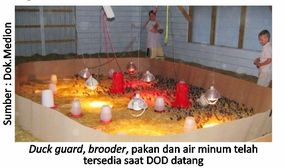
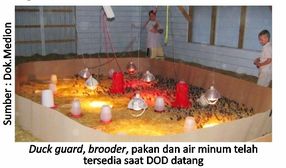
- When DOD comes in the cage, immediately unload DOD, weigh, selection and stocking in duck guard which has been prepared.
- DOD that is not suitable such as dry feet or dull fur should be separated. For DOD experienced omphalitisabdominal pain, weakness, the presence of feces around the cloaca and an abnormal beak should be directly in culling.
- Artificial heating (brooder) have been turned on 1-2 hours prior to DOD arrival. The recommended heating temperature ranges from 29-32°C. Control the DOD so that the spread under the heater is even and remains active.
- Provide feed and sugar water when the DOD arrives. This sugar water serves to replace the energy lost during the trip. Although the newly hatched DOD can survive not to drink for 2 days, but you should still give sugar water or Gingertol as a source of energy and maintain a warm body DOD. Feed should be given little by little with frequent frequency. This is so that the DOD is stimulated to eat and the feed remains fresh.
- The number of ration places and drinking places should be sufficient. Ducks tend to drink 2 times more than chickens, so drinking water should always be available in sufficient quantities.
- The density of the cage should be regulated so that it is not crowded. The recommended density is 35-40 heads/m2 for laying ducks and 50-60 heads / m2 for broiler ducks and then thinning every 3-4 days.
- Control air circulation, temperature and humidity regularly.
- Pay attention to the health program at the age of 1-3 days. Give Vita Chick to anticipate DoD stress, or can be given Neo Meditril if the DOT is not correct. In addition, do the ND vaccination at the age of 4 days or at the same time using the ND-AI vaccine. Or you can also use a separate AI vaccine at the age of 14 days.
In addition, keeping in one cage should be carried out with the same age and strain or breed of ducks. It aims to facilitate monitor DOD health and minimize the possibility of disease transmission.