Email : aleedjangkar@gmail.com
Laying hens saya sudah berumur 22 minggu tapi jengger masih kecil dan belum bertelur. Mohon solusinya, terima kasih.
Answer :
Thanks for the question Brother. The solution to overcome the laying hens late adult sex (small comb) and have not laid eggs is to check on :
1. Quality Pullet
Delay in egg production can be caused by quality pullet the less good. Its characteristics are that the reproductive organs are immature (it can be observed from secondary sex characteristics), the body weight does not reach the standard and the uniformity is low.
Pullet the adult genitals and ready to lay eggs have the characteristics of a large comb and red, long leg bones (shank) at least 100 mm and the width of the pubic bone is the width of three fingers of an adult. Low body weight (10-15% below the standard) causes chickens to reach genital maturity late in time, so egg production will regress. Meanwhile, the uniformity of low body weight causes the initial unevenness of laying between chickens and the size of the eggs will vary.
Ideally, the body weight of the laying hens should have reached the standard when entering the beginning of production (age 18 weeks, body weight 1.5 kg). Check the body weight of your chickens at the age of 22 weeks and compare it with the standards issued by the breeder.
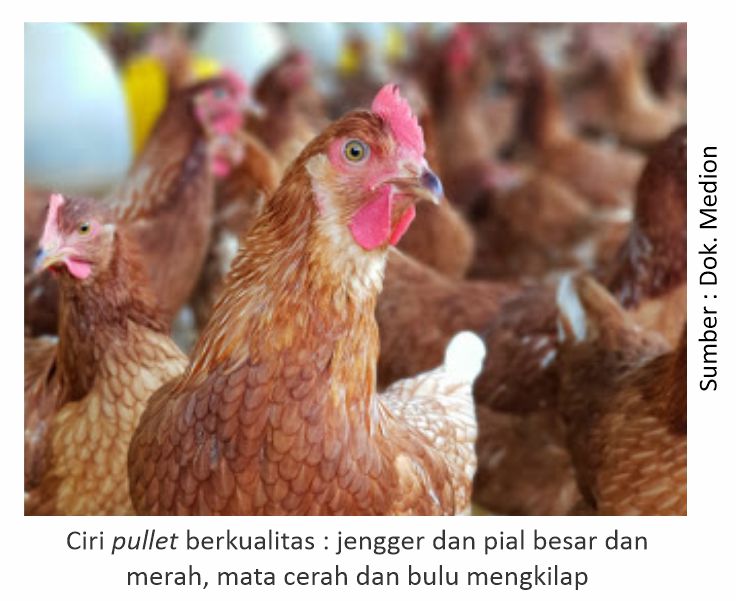
Sampling chickens as much as 2-5% of the population per cage. If the body weight is less than the standard, increase the consumption of the ration by increasing the frequency of ration administration, reducing stress factors and adding premixes to the ration.
For chickens that have not shown mature sex (small comb), can be given Vitesel Inj to optimize the function and maturity of the reproductive tract. If in the next two to three weeks there are no changes, make a selection and culling chickens whose comb condition is still small.
2. Consumption and nutrition of the ration
Egg production is strongly influenced by the nutrients contained in the ration, for example, proteins, energy, fats, fiber, vitamins and minerals. If one of these nutritional needs is not met through rations, egg production will be disrupted.
Ensure ration nutrition according to chicken needs and ration consumption increases every week from 18 to 25 weeks of age. Starting from 84 grams / head/day at the age of 18 weeks to 112 grams/head / day at the age of 25 weeks (ISA Brown Product Guide, 2020). To increase the consumption of the ration, can add Kumavit as much as 1 gram per 2 liters of drinking water.
3. Lighting Program
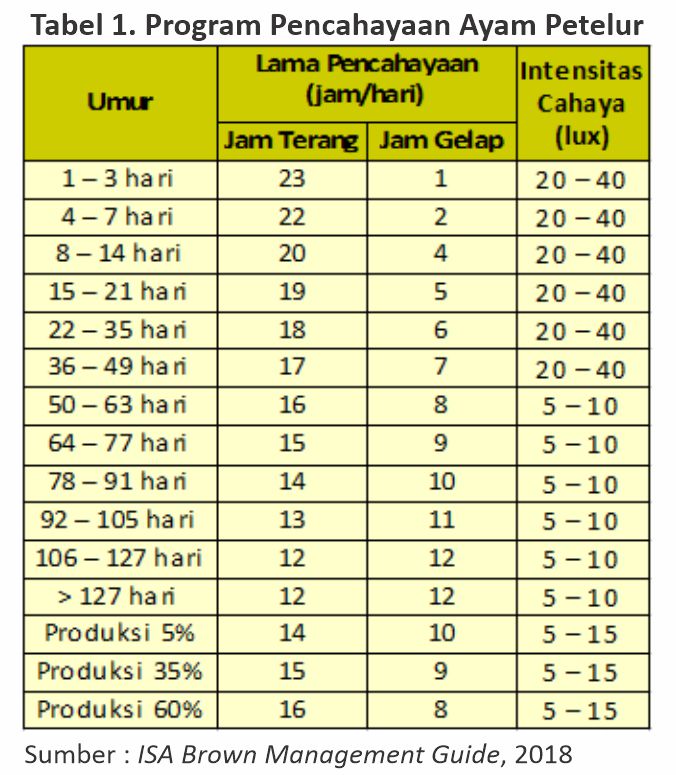
Provide the right lighting according to the needs of chickens per age. Lighting is essential to stimulate the maturity of the reproductive organs to produce eggs.
Lighting of the right intensity and duration will stimulate the consumption of rations and the maturity of the reproductive system. Conversely, poor lighting results in late achievement of ideal body weight and mature sex at the right age, so that the beginning of production will retreat.
4. Infectious Diseases
Check the health status of chickens. There are several specific diseases that can affect the reproductive organs of laying hens, making them incapable of production. These diseases include ND, IB and AI.
Jika ayam menunjukkan gejala sakit, lakukan pemeriksaan bedah bangkai dan jika perlu uji titer antibodi untuk membantu meneguhkan diagnosa penyakit. Sehingga penanganan yang tepat dapat segera dilakukan.
Do monitor titer antibodi secara rutin satu bulan sekali terutama untuk ND, AI dan IB. Hal ini bertujuan untuk mengetahui status kesehatan tubuh ayam dan membantu penentuan jadwal vaksinasi ulang yang tepat.