The rainy season is one of the predisposing factors for the occurrence of diseases in chickens. Changes in temperature and humidity during the rainy season can affect both the resistance of the chicken's body, and the proliferation of disease agents in the farm environment.
It is important to be vigilant and tighten up biosecurity as an effort to prevent the occurrence of disease disorders in our livestock. Some things that can be done to tighten biosecurity are as follows:
1. Increase the frequency of disinfection in cages and equipment sanitation
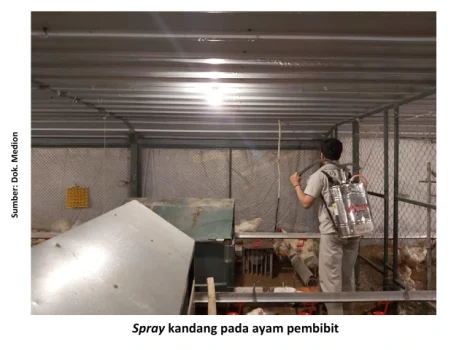
To prevent the seeds of the disease from spreading in the cage, regular disinfection can be carried out with , the cage uses a suitable disinfectant. At the time of the cage contents, choose a disinfectant that is safe if inhaled or on the chicken's body, such as Desinsep, Antisep, Neo Antisep or Medisep. When the cage is empty, disinfectants such as Formades and Sporades can be used.
But one of the things to consider during the rainy season is the potential for increased humidity in the cage. Do not let , the cage aggravates the humidity in the cage. Important things to consider when doing spray, among them :
- Do , disinfect when there is still a slight gust of wind
- Avoid , disinfect during the peak of humidity in the cage, usually at night or in the morning
- Do , disinfect with very soft or mist-shaped water particles
- Distance and pressure , it must be consistent so that the disinfectant is evenly distributed over the entire area of the cage
- For the cage closed house, spray performed from the front area (inlet) at (outlet) to follow the direction of air flow.
In addition, regular cleaning/washing of feed and drinking places is also important in order to keep the equipment free from contamination by disease agents. Make sure the feed and drinking place is not contaminated with feces or husks.
2. Eliminate waterlogging as a risk of proliferation of disease vectors
Vectors are animals / insects that carry disease from one individual to another. Some disease vectors such as mosquitoes and flies have a life cycle that is closely related to standing water, where water will usually be a breeding ground for these vectors. Some examples of vectors and diseases that can be transmitted are as follows:
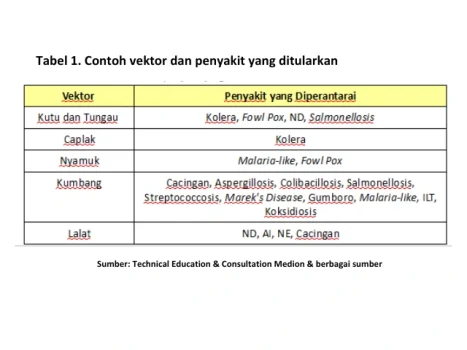
Prevention that can be done to prevent the formation of puddles in and around the cage include:
- Repair of the cage if there is a leak on the roof of the cage and chicken drinking place
- Ensuring the system drainage inside and outside the cage goes well
- Minimize bottle or can waste around the cage
3. Keep litter clean and dry
With increased humidity during the rainy season, conditions litter chickens should also be considered the level of humidity. If the number found litter wet or lumpy just a little, then it can be taken and replaced with litter new clean and dry.
However, if litter the wet / clumped a lot and evenly in the cage, then you should sprinkle lime and stacked with new litter. Addition of herbs such as Ammotrol can also be a solution to reduce the smell of ammonia. Herbal extracts inside Ammotrol can make the texture of feces become drier, so that the smell of ammonia in the cage is reduced.
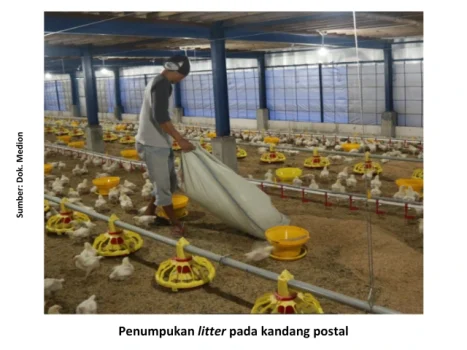
Here are some things to consider so that the litter stays dry and works well:
- Exercise control litter regularly once every 3-4 days. If found litter it's wet, so take care of it litter which clumps in accordance with the conditions
- Repair if there is a roof of the cage or place / drinking water leak
- Make sure there are no leaks in the nipple and Chicken drinking place (TMA)
- Provide quality rations and drinking water so that the stool does not get wet
- Cage density control
- Avoid hasty work, especially during the change of drinking water, do not spill it on litter
- Ventilation of the cage should be good so that air circulation is smooth and the cage is not damp. Add a fan in the cage for better air circulation
4. Maintain drinking water contamination
Disease transmission can come from a variety of things, one of which is through water. Some of the most common types of bacteria and viruses that can be found in the gut (Newcastle Disease), AI (Avian Influenza), IB (Infectious Bronchitis), bacteria E.bra which causes colibasisollsis disease and also bacteria Salmonella sp. which causes salmonellosis in chickens. Prevention of microbial contamination in water can be done with drinking water sanitation using Desinsep with a dose of 30 ml (about 4 packaging caps)/1000 liters of drinking water to kill microbes that come with drinking water.
In addition, it can also be done flushing drinking water pipes regularly to prevent the formation of biofilm in the water channel. There are three methods of flushing, namely:
* Pressurized water, can be done after giving the mixture via drinking water, both vaccines, drugs, and vitamins to prevent the formation of biofilm in the water channel
* Chemicals, such as Bioflush with dosage when Cage contents, 10-20 mL in 100 L, and when cage empty, 1-3 L in 100 L water and leave for 12-24 hours contact then rinse with clean water
* Ultrasonic waves, such as Harsonic to prevent biofilm growth in water pipes
The selection of the three methods can be adjusted to the conditions of each farm.
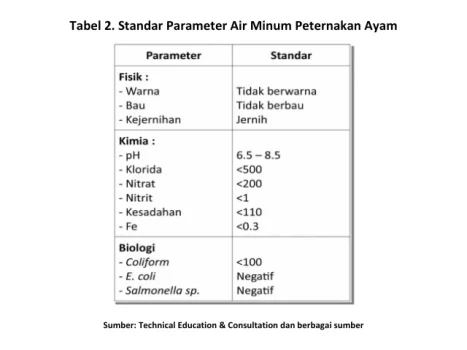
Routine water quality evaluation can be done with water quality tests, both in terms of physical, chemical, and bacteria contained in it. Water samples can be sent to the laboratory to ensure the quality of drinking water is of good quality and free from contamination by disease agents.