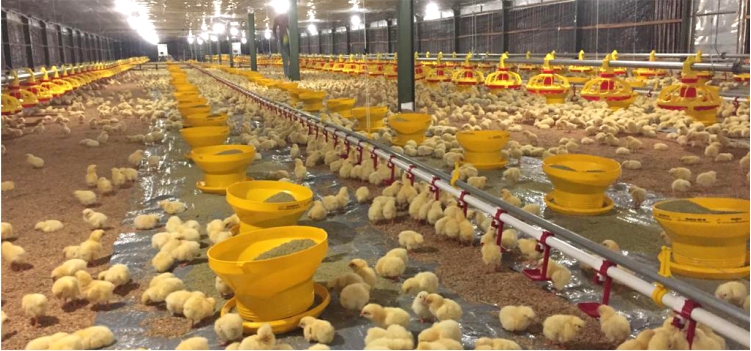
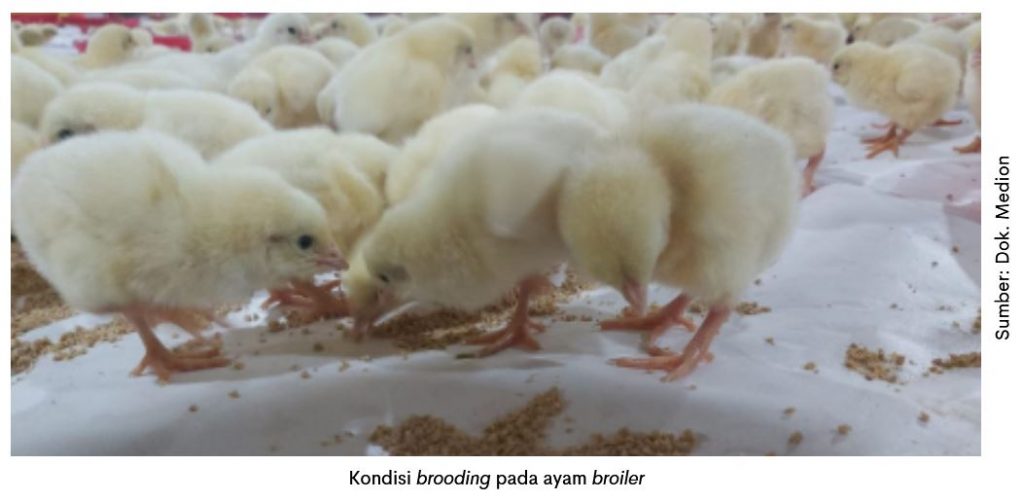
Time brooding period, is the preservation period broiler from DOC to off the heater. The purpose of brooding period, is to provide the state of the environment corresponding to the needs of the chicks. Usually in time brooding period, artificial heating is needed because at the beginning of the maintenance of the chicken body has not been able to adjust to the ambient temperature or so-called poikilothermic that is, cold-blooded animals.
Management brooding period, be important because it has a great influence on performance chickens in the next rearing period. Performance chicken broiler what is desired, among others, is the average daily weight gain (ADG) and feed conversion (FCR).
With management brooding period, good then it is expected to produce a good chicken uniformity, so that the harvest will be optimal.
At the beginning of keeping chickens broiler this is very important because in this period there is a development of organs such as the digestive, respiratory, immune, skeletal and feather organs. In this period, the chicken's thermoregulation is also not perfect so that the chicken cannot adjust its body temperature to the temperature of the surrounding environment.
Things to consider during the period brooding period, is the environmental conditions in the cage and the comfort of chickens. Some factors that affect the comfort of the chicken include :
1. The air consists of:
- Air volume
- Air temperature
- Air humidity
- Air speed
2. Drinking water availability
3. Feed availability
4. Lighting
5. Litter
Air Condition
The air in the cage required for broiler rearing consists of the amount of air, air temperature, air humidity, and air velocity. To meet the needs of the amount of air it can be met by utilizing air circulation regulated by a fan/exhaust fan for cage closed house and open the curtains for the cage open house.
The amount of air is calculated based on the body weight of the chicken in every age, so the more the age of the chicken the need for air will increase.
The quality of the air in the cage largely determines the development and health of chickens. The air quality standards that chickens need are as follows :
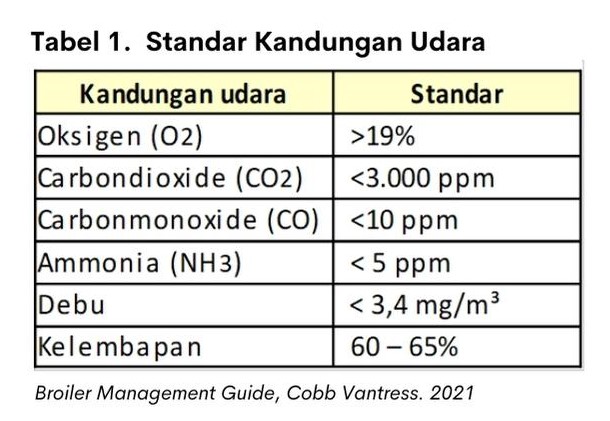
After knowing the ideal air content for the growth of chickens, then the amount of air needs in the cage we must also meet by regulating air circulation. Standard air requirements for chickens broiler as in Table 2.
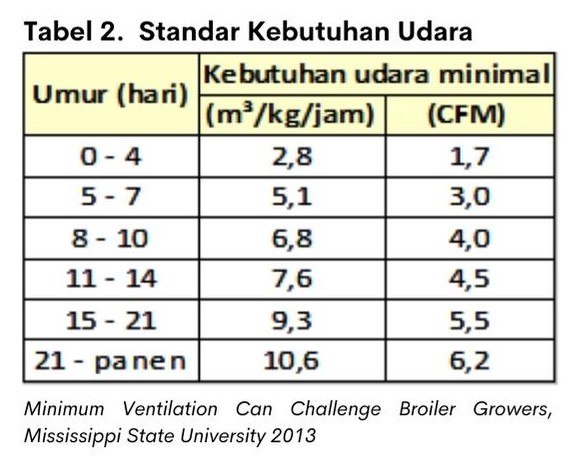
Regulation of air requirements in the period brooding period, so called with minimum ventilation. The objectives of such minimum ventilation include :
- Keeping the temperature in the cage
- Maintain air quality (oxygen supply)
- Releases harmful gases (ammonia)
- Removing moisture
- Removing dust
To regulate the temperature in the cage, an artificial heater is needed. In the initial period of maintenance performance of an artificial heater largely determines the level of comfort and success of the maintenance of chickens broiler. Types of artificial heaters that can be used include :
1.Coal briquette heater
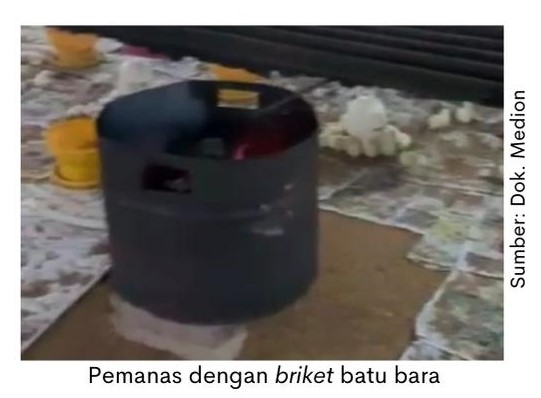
This heater uses coal fuel. The disadvantage of this heater is that it creates smoke. So in preparing and turning on the heater briquettes coal should be the placement of this heater must be right so that the smoke does not spread widely into the area brooder this is bad for DOC.
2.Incandescent lamp heater
These heaters are usually used on a small scale. For example, free-range chicken farmers with a population of 50-200 heads usually use incandescent lamps with a power of 40-100 Watts. This heater is simpler and easier because it remains only to install incandescent lamps in a cage with a size of 1 x 1 x 0.5 m.
3. Gas heating spot heater
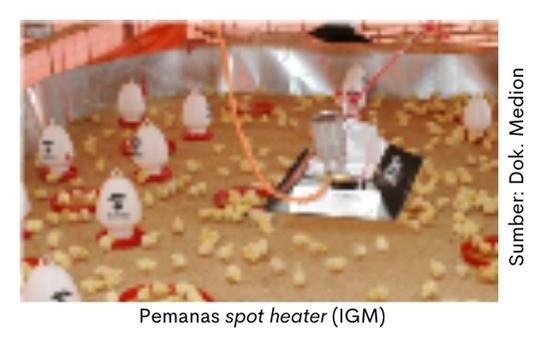
The use of infrared heaters is relatively safer and more practical (does not emit smoke and noise), because it is equipped with a regulator as a regulator of the size of the gas flow and the high temperature required. Heating spot heater this is for example IGM or Medion gas inductor. One unit IGM can be used for 750-1,000 heads.
4.Gas heater space heater
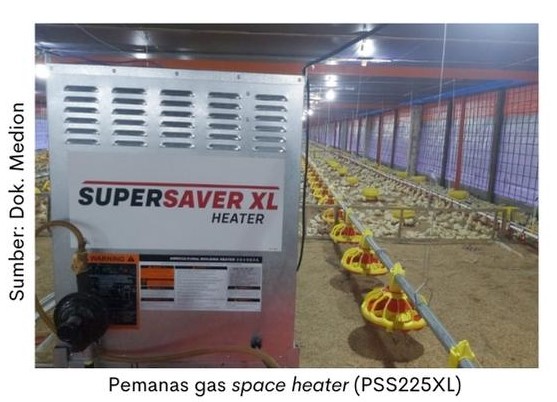
Gas heating space heater is a device for heating the entire room in the cage for example a Super Saver heater (PSS225XL). This heater gives off a stream of hot air with a capacity for 10,000 heads with a gas consumption of 4.8 kg/hour. This heater is efficient because it is able to distribute heat evenly. Air temperature standard period brooding period, as in Table 3.

Humidity and air speed are also important parameters in air conditions and must be met to make optimal chick growth.
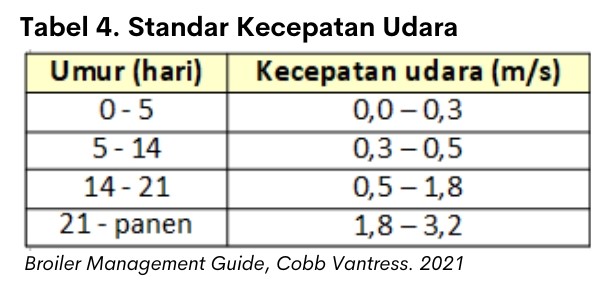
Humidity and air velocity will affect the effective temperature felt by the chicken's body. Ideal air humidity in the period brooding period, is 50-60%, while the air velocity in the period brooding period, is about 0.3-0.5 m/s. The following standard airspeed in the period brooding period, :
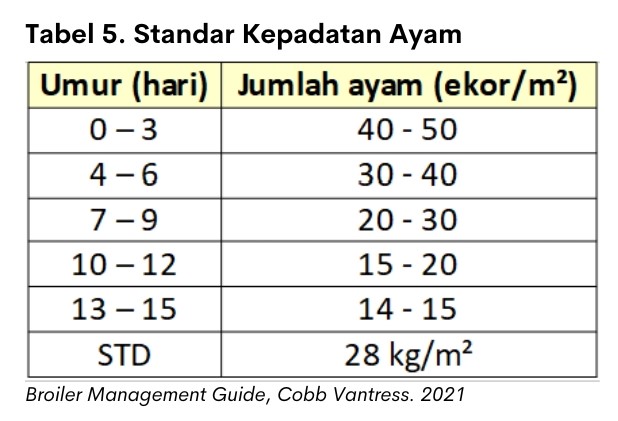
Block widening brooder necessary to maintain adequate air circulation in the area brooder and it would be more appropriate if the dilation is done dilation every day because the chicken broiler it grows quickly in the first week to the second week. Weight gain can reach 4.5 to 5 times the initial weight of the DOC in the first week. The following standard chicken density based on maintenance age Table 5.
Drinking Water Availability
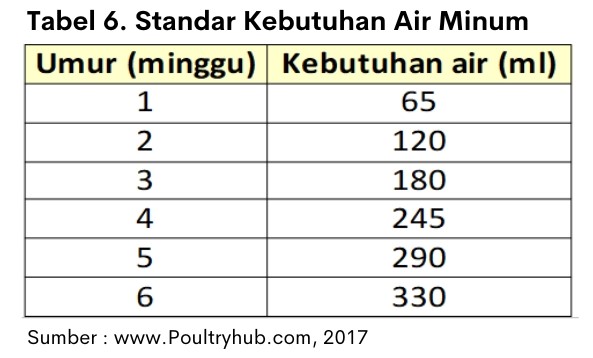
Water is 70% of the chicken's body. DOC needs 1.0 ml/head / hour for the first 24 hours then in the first 10 days the chicks consume drinking water 1/3 of their body weight.
Therefore, the quality and quantity of drinking water must be considered. The provision of drinking water at the beginning of maintenance must be adjusted to the needs of chickens, as in Table 6.
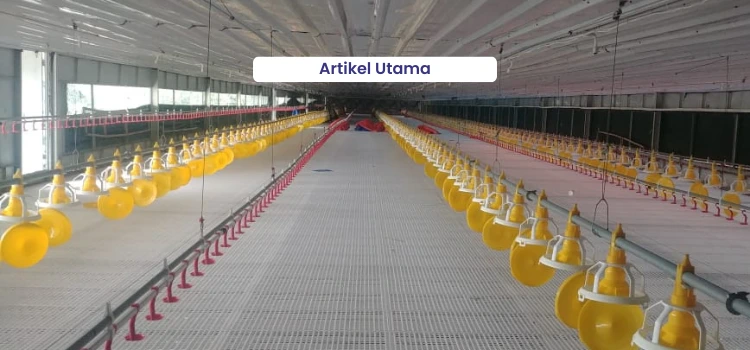
To meet the needs of drinking water is required the availability of drinking places in accordance with the population of chickens in the cage or called water space.
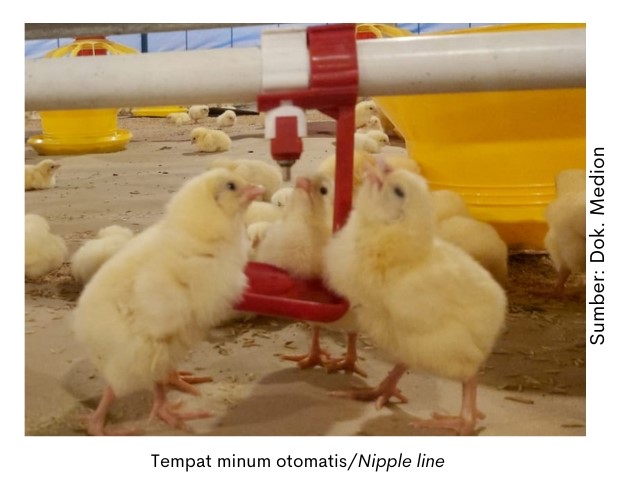
Water space or the amount of availability of drinking places based on the chicken population must be adjusted because it will affect the uniformity of drinking water consumption per head. The number of places to drink water for this type of nipple is 10-12 tail/nipple, while for the type bell drinkers is 80 tail/bell drinker.
Automatic drinker/nipple line already has a water pressure regulator so that the water discharge out of nipple it will be easy to adjust to the needs of drinking water for chickens.
Pressure nipple by age chickens are as follows :
- Week 1 : 25-30 ml/min
- Week 2 : 35-40 ml/min
- Week 3 : 45-50 ml/min
- Week 4 : 50-55 ml/min
- Week 5 : 55 – 60 ml/min
In addition to the number of drinking places, the temperature of the drinking water must also be considered. The ideal temperature of drinking water is 21°C, the temperature range is between 18-24°C, if the drinking water temperature is 24°C, the consumption of drinking water will decrease.
Feed Availability
At the time of chick in, the plan for giving the number of feed places must be determined based on the chicken population so that the chicks will get the appropriate amount of feed and there is no competition or scramble for feed. On the first day can be applied paper feeding that is, feeding on a paper base so that the chicks can easily get feed or make it easier for the chicks to get feed. This is done to maximize early feed consumption/early feed intake at the beginning of maintenance.
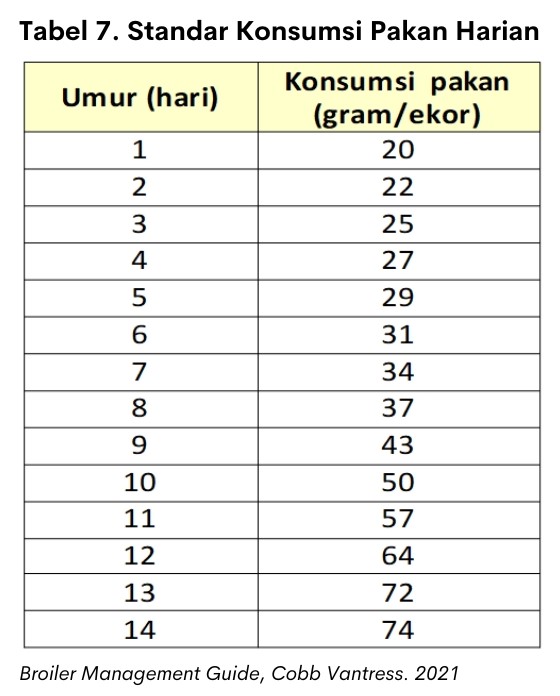
On the first day when chick in the first 24 hours of the day (early feed intake). Feed consumption in this period is about 20-25% of its body weight. Failure at this time of early feed consumption results in a decrease in weight gain/daily gain and uniformity/uniformity which is bad.
About 30 minutes before chick in, feed should be stocked on the doc pedestal so that the chicken will be aroused to eat as soon as the chicken is stocked in the cage.
Checking the cache or crop is needed to find out if the chickens that have been stocked get feed and drinking water. This check is done about 4-5 hours after arrival. Chicken gizzards / crops should already be filled with feed and drinking water for at least 95% of the total population.
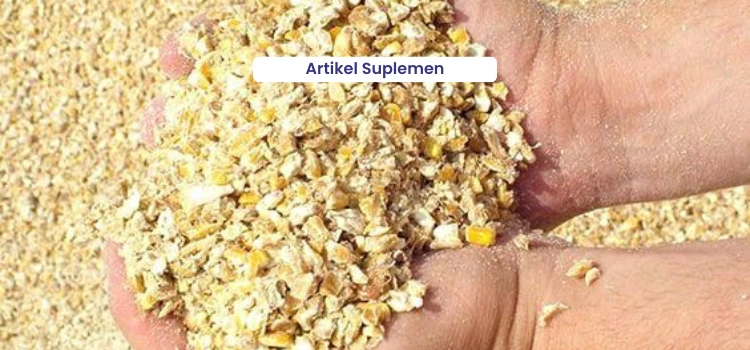
The form of feed particles also greatly affects feed consumption in the initial period of rearing. The proper form is fine crumble or crumble which with the form of feed will make it easier for chickens to eat.
The increase in the number of feeders and the amount of feed given should be gradual and based on the age of the chickens. Capacity of the feed bin for the period brooding period,/starter include:
- Nampan / NRDOC : 40-50 heads / tray
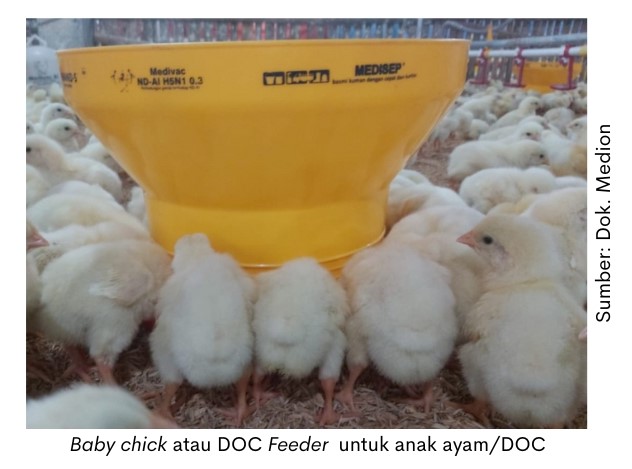
- DOC Feeder/DF : 50-60 tail/DF
- Multi Feeder/MF : 70 ekor/multi feeder
- Pan Feeder : 45-80 tail/pan
- Chain Feeder : 4-5 cm / tail
Control chickens at the time of feeding
Control at the time of chicken eating is important we do to make sure all chickens get the appropriate Feed area and get a sufficient amount of feed.
In the first and second week of growth the Chick undergoes rapid development. Avoid substandard weight in the first 2 weeks because it will interfere with the normal development of each organ and will cause problems in subsequent maintenance.
Feeding is given ad libitum so that the need for chicken feed will always be available at the feed site and there is no feed place in an empty condition. Prevention against spilled feed in the area litter it is important to note that it will avoid waste and high FCR values.
Average weight is an important measure in the maintenance of chickens broiler so that in case of deviation from the standard weight should be corrected immediately. The cause of weight loss is not achieved, among others, due to low consumption of water or feed. Uniformity of weight in one cage is an important measure also because it will determine the optimal crop yield.
The main causes for the problem of low initial weight or not achieved according to standards are :
a. Low water consumption
- Water temperature is too hot
- Nipple not 360 degree
- Water pressure too high
- Nipple nipple clogged dirt
- Dirty water
- Flushing is not perfect
b. Low feed consumption
- Feed quality
- Feed form
- Availability of feed and access to feed places
Lighting
Light is a natural need of animals, in addition to other functions of light is :
- Development of the immune system
- Affect uniformity
- Increase feed consumption
- Animal welfare
Light can change the behavior and activity of chickens. Chickens are very sensitive to red and ultraviolet colors, red light can cause cannibalistic traits. The hormone melatonin and growth hormon it is produced when chickens sleep and is used for protein synthesis.
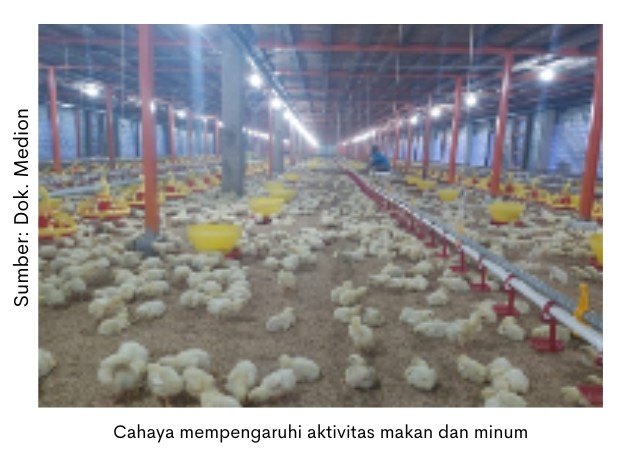
Minimum light intensity for keeping chickens broiler in the period brooding period, is 25 lux. The intensity of such light should be uniform in all areas of the cage. To create a uniform intensity of lighting can be done with:
- The number and type of lamps should be the same
- The distance between the lights must be the same
- Avoid obstructing objects
- Keep the lights clean
Litter
Function litter is as an insulator of the floor and as a heater, absorbs moisture from manure, reduces ammonia and keeps the soles of chicken feet.
If the condition litter good or dry, then the growth of chickens will be good, otherwise if the conditions litter damp or lumpy, then the growth of chickens will not be optimal. Materials that can be used as litter these include husks, sawdust, wood shavings, chopped straw, among others.
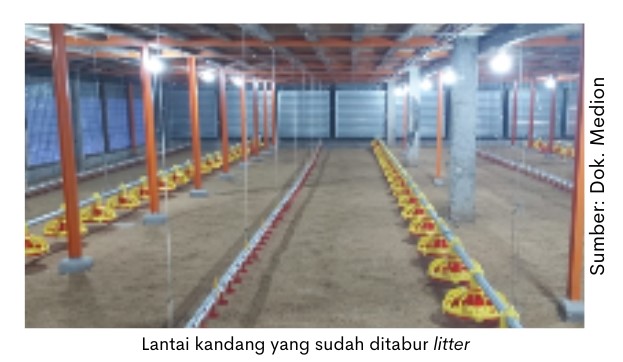
In the initial period of maintenance litter stocked with a thickness of about 5-8 cm while taking into account the humidity conditions in the cage environment.
If the conditions of the cage environment is very humid then it can be done stocking litter starting from 5 cm first then added little by little according to conditions litterher. Factors affecting the condition litter among others:
- Ventilation management
- Drinking water
- Feed
- Quality litter
- Chicken density
To maintain the condition litter agar tetap kering atau dengan kadar air dalam litter <40% maka yang harus dilakukan antara lain :
a. Return regularly
b. If the lump is immediately removed
c. Add or replace New
d. Add lime or zeolite
e. Proper organization of ventilation
Monitoring Weight and uniformity
To calculate the uniformity of body weight in one cage requires weigh data collection using appropriate sampling methods. Weigh the chickens in sufficient quantity and accurately so that they represent the average body weight in one cage. Chickens can be weighed in groups at the age of 7-14 days, then chickens can be weighed individually at the age of 15 days until harvest.
If the weighing of chickens is carried out in groups, then their number is 5-10 heads. The total number of samples weighing is about 2% of the population (Broiler Management Guide, Cobb Vantress 2021) so that the average weight and uniformity will be more precise. Weigh chickens from three different locations (front, center, back) of each cage to make the weigh sample more representative of the entire population in the cage.
To improve sampling accuracy, use a bulkhead/mesh. Do not pick up and weigh chickens at random, and do not force chickens into the bulkhead/net. Weigh each chicken individually in the bulkhead / net. All chickens must be weighed including small chickens.
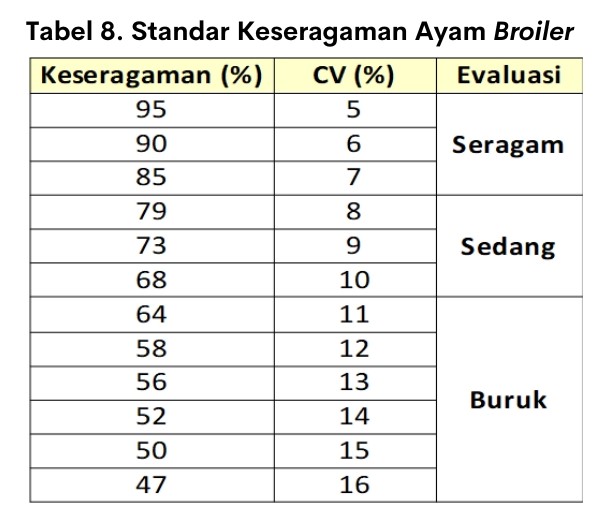
After all the chickens are weighed, release the chickens into the cage. Continue weighing until the whole chicken in the bulkhead/net is used up. Record each weight and calculate the average and distribution of weight. Here are the standards of uniformity of chicken broiler :
Implementation of management brooding period, proper and comfortable care will determine the success of keeping chickens broiler. Things to consider when brooding period, in order to reduce the amount of heat, heat transfer, heat transfer, heat transfer, and heat transfer (early feeding).
It is also necessary to adjust the lighting and litter proper so that the health and activity of chickens to eat and drink can also be optimal. After all the conditions for the comfort conditions of the chicken are met, monitor or monitoring the growth of chickens should be done continuously so that if there are irregularities can be immediately repaired.
Thus at a glance information about management brooding period, chicken broiler hopefully it can add insight and be useful. Greetings.