Mid-January 2017 the public was shocked by the case of anthrax that occurred in Kulonprogo, Special Region of Yogyakarta. According to the news circulating, the outbreak of this case began with the death of a cow followed by the death of several goats (Daily Jogja, 2017). The first case of anthrax was discovered in Teluk Betung, Lampung Province in 1884. In addition to Lampung, anthrax has also been reported in Banten, Padang, Jambi, Nusa Tenggara, South Sulawesi, and Southeast Sulawesi.
What is anthrax?
Anthrax or anthrax is a bacterial infectious disease caused by bacteria Bacillus anthracis. Antraks in Greek means 'coal'. This term is used because the skin of cattle attacked by Anthrax will turn black. Anthrax disease is zoonotic, which means that it can be transmitted from grass-eating animals (cattle, goats, sheep, etc.) to humans, but it cannot be transmitted from human to human. Humans can become infected with this disease when endospores enter the body through the skin with open wounds, inhalation of air, or contaminated food.
Surrounding Bacillus anthracis
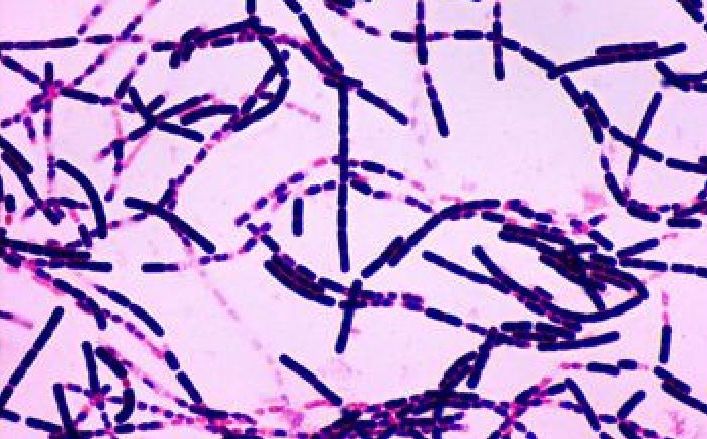
Bacillus anthracis it is a rod-shaped and encapsulated Gram-positive bacterium with a length of 3-5 ° M and a width of 1-3 ° m. The incubation period is 48 hours. This bacterium can form spores, is non-motile/can not move by itself, resistant in acidic conditions, and sensitive to antibiotics of the penicillin group.
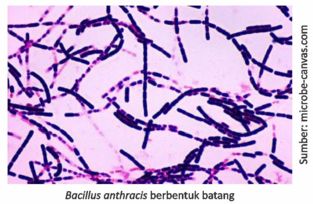
Bacillus anthracis has two stages in its life cycle, namely:
- Vegetative Phase
Can grow at a temperature of 12-44°C and optimal at a temperature of 35-37°C, but can die at a temperature of 54°C for 30 minutes. This phase is sensitive to antibiotics (Medoxy-LA), antiseptics, and putrefactive processes. This phase begins when the spores begin to enter the host's body, it will turn into a vegetative form and multiply.
Vegetative forms live in conditions of low oxygen in the body of an infected host. This form can enter the bloodstream and then be removed from the body through bleeding in the nose, mouth, anus, or other bleeding. When the host dies and oxygen is no longer available in the blood, this vegetative form becomes dormant. When this dormant state comes into contact with oxygen in free air, this vegetative form will form spores (sporulation). That is why the handling of cases of anthrax in animals that have died should not be performed surgical carcass of the animal and should be buried in the place of occurrence of the case to minimize the spread of anthrax.
- The phase of Sporasporulation occurs when the dormant vegetative form meets with oxygen at a temperature of 15-44°C and optimal at a temperature of 25-30°C. While this form of spores can die at a temperature of 140°C for 3-4 hours, H2O2 for 60 Minutes, and 10% formalin for 4 hours. Spores can survive / resistant to various types of disinfectants and animal skin processing.
Clinical Symptoms Of Anthrax
The signs that can appear in animals affected by Anthrax (generally in cattle, goats and sheep) are as follows:
- Sudden death without accompanying clinical symptoms.
- Body temperature rises to 42°C and looks lethargic.
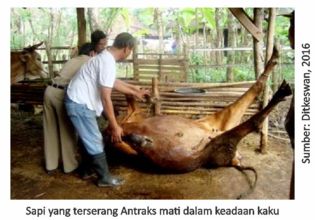
- If left untreated, the animal will die after 2-3 days and the animal looks stiff and trembling.
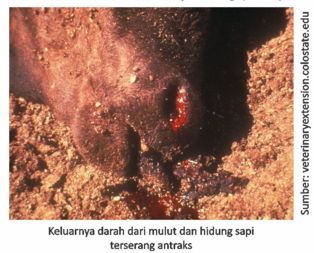
- Blood can come out of the body's natural openings such as: anus, ears, mouth, nose, and external reproductive organs.
- Blood that comes out of the body is black and tends not to clot easily.
- In very acute cases, animals that look healthy, can suddenly lose consciousness accompanied by paralysis and can die within minutes or hours.
- The carcass of an animal attacked by Anthrax is usually swollen and quickly decomposes.
In addition to seeing clinical symptoms, to make sure the animal is affected by anthrax can be done several diagnostic tests. When the animal is still sick or dead, rapid diagnosis can be made by taking blood samples for Gram staining and identifying bacterial morphology. Other more accurate tests can be performed by isolation and identification of bacteria Bacillus anthracis, PCR, and serological test (ELISA).
Prevention Of Anthrax
Some principles of anthrax prevention that need to be done include:
- Control of the spread of anthrax. Carry out Control and supervision of livestock traffic. Livestock allowed in and out of an area must come from an area where there have been no reports of anthrax cases in the last 20 days. Livestock must have an Animal Health Certificate (SKKH), and no clinical symptoms on the day of delivery.
- Vaccinate livestock in endemic areas. Carry out routine vaccinations en masse for the Prevention of hosts such as cows, buffaloes, goats, sheep. Vaccines should be available in sufficient quantities to meet the needs, especially in endemic and surrounding areas.
- Increases endurance. In addition to vaccination, an increase in the body's resistance of animals with vitamins (ADE-Plex injection) is considered important as prevention from within the animal's body.
How is anthrax treated?
Furthermore, to deal with cows that have already been attacked by Anthrax, farmers can take the following actions:
- Every case of occurrence or suspicion of anthrax must be reported to the local animal husbandry office, to determine the steps for handling animals suspected/attacked by Anthrax. This needs to be done because the impact can be very wide if the wrong handling is done. Still the emergence of anthrax disease because there is no mature coordination.
- Sick animals can be given treatment with antibiotics from the penicillin and tetracycline groups by injection for 2 weeks (in isolation). Animals can be removed from isolation if the animal has not shown symptoms of illness for 14 days from the beginning of the attack. Of course, this handling is supported by the supervision of the local livestock office.
- As already written earlier, animals that die from anthrax should not be dissected for fear of vegetative forms of the bacterium Bacillus anthracis those that are dormant will come into contact with oxygen in the free air and will form a spore phase, where this phase is an infective phase and is more resistant to disinfectants than the vegetative phase. For this reason, the carcass of the animal must be immediately buried at the site of the case to minimize the spread of spores. Not only dead animals, products of animal origin that are proven to be contaminated with anthrax bacteria must be buried.
- Burials were carried out to a depth of 2 meters and burning of animal carcasses was carried out. Once the animal is inserted in the grave hole immediately sprinkle active lime on it. If this is not possible, the animal can be left to rot at the site of the case, because the bacteria in the vegetative phase (in the animal's body) will die in an atmosphere of Decay. In addition to the natural holes of the animal as a place of discharge of blood and soil around it needs to be watered using formalin (Formades) and left to soak for at least 4 hours.
After knowing more about anthrax disease, it is expected that we can take preventive measures so that these events do not occur to the detriment of our livestock management practices. May be useful. Greetings.