Pertanyaan dari Bapak Sofyan Sugiarto – By email
What factors affect egg weight? Why moment hen day high egg weight tends to be small and vice versa when hen day low weight large eggs? Thank you.
Answer
Thank you Mr. Sofyan Sugiarto for the question submitted. Eggs are the main product of chicken farming layer. In addition to the number of eggs, the quality of eggs is also a major concern for farmers. The weight, color and thickness of the eggshell are parameters that indicate the quality of the egg.
Advantages of chicken layer of course, it will depend on the ability to produce high-quality eggs, large quantities with the most appropriate size for each market.
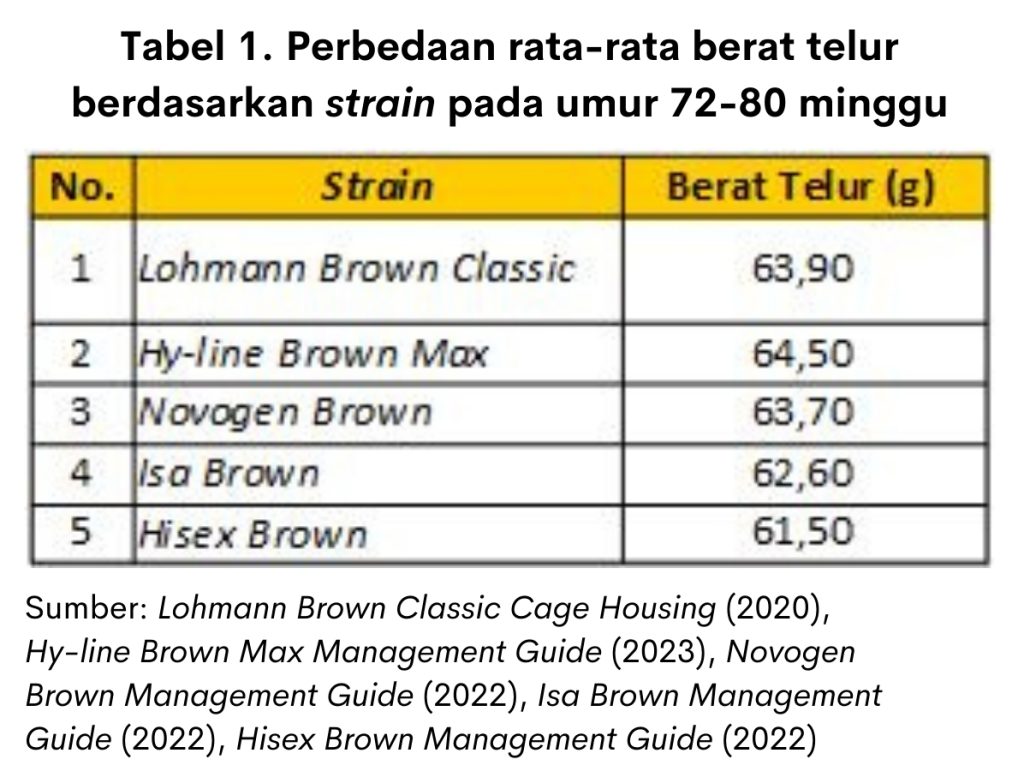
Breeder usually consider the genetic potential of each strains to produce eggs in a certain size range. However, genetics affects only a part of the eggs that are inherited in nature (about 40% of the influence).
The biggest impact on egg weight is from the environment, nutrition and management (about 60% of the influence). Non-genetic factors can be manipulated by chicken farmers layer to achieve the desired egg size (Hy-line International, 2018). Here are the factors that can affect egg weight:
A. Genetics
Breeding companies determine their breeding goals according to customer needs which may vary in each region. For the region of Indonesia, Lohmann brown, Isa Brown, Hisex Brown, Hyline Brown, and Novogen Brown there are 5 types of chicken layer which has the ability to produce eggs that vary by weight.
B. Weight loss
An important factor in determining the weight of eggs is body weight pullet when sexually mature. Heavier chickens tend to produce more eggs and will have larger egg sizes. Body weight is influenced by many factors such as vaccination program, beak cut, transfer, challenge disease (Hy-line International, 2018), lighting, density and nutrition. The achievement of a good target weight and uniformity is important for the management of egg size.
C. Early age of production
In general, It's Brown mentioning the age of the beginning of production that is backward 1 Week will cause the weight of the egg to increase by 1 gram. For example, at the beginning of laying eggs age 18 weeks egg weight It's Brown is 42.3 grams/grain and if the beginning of production retreated to 19 weeks then the weight of the eggs will be heavier mecapai 43.3 grams / grain. Conversely, if the early age of production too early will result in a smaller egg weight, the early age of production backward 1 Week will cause the egg weight is reduced by 1 gram.
D. Lighting
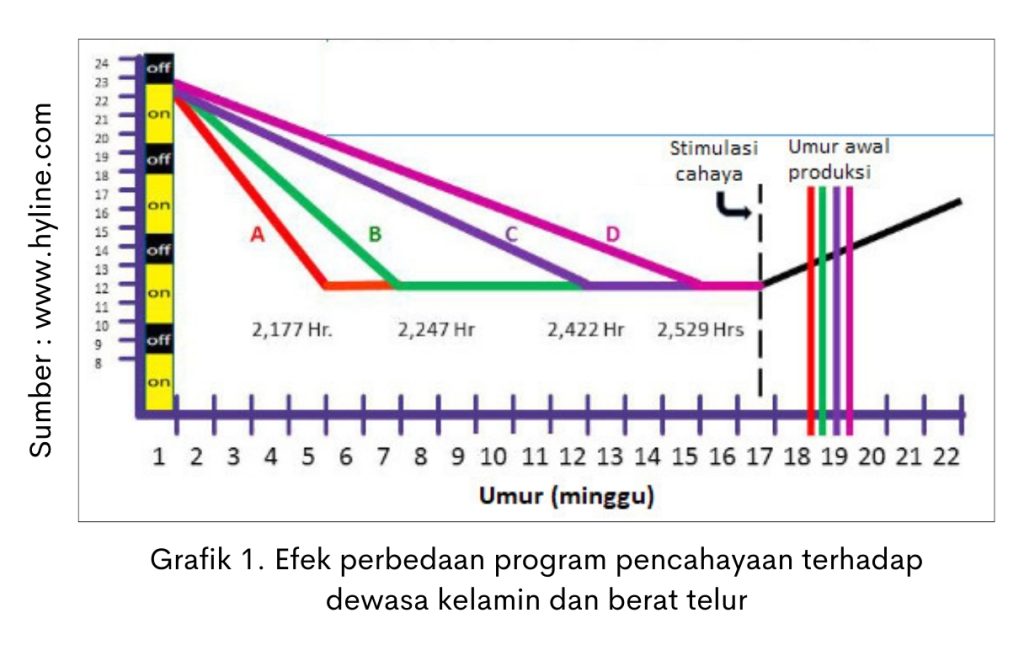
Chickens are very responsive to long changes in lighting duration and this will result in significant effects on egg production and egg weight. In Graph 1, the C and D curves during rearing provide a Lighting program with more light duration for the chickens to be able to eat and grow.
A slower reduction in light duration can also delay genital maturity and increase egg weight. Conversely, faster reductions in light duration such as Curves A and B can lead to slower growth and early genital maturity with smaller egg weight.
E. Nutrition
There are several nutrients that have a significant effect on egg weight. These nutrients include the amino acids methionine / cystine and other essential amino acids, total fat content and linoleic acid from the feed. Therefore, the protein and energy content in the feed must be balanced to ensure that the daily requirement of essential amino acids is met for optimal production performance.
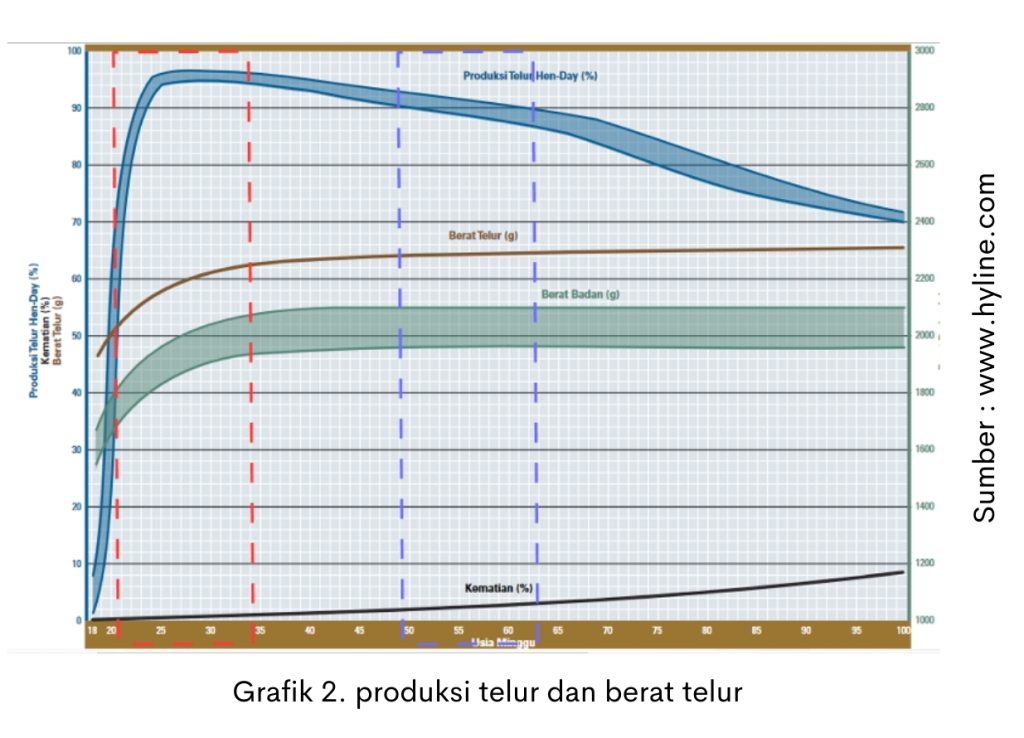
From graph 2 can be seen that the increase henday drastically until reaching peak production occurs from the age of 18-25 weeks. At the same age when viewed weight gain curve of the egg is still increasing or in other words the weight of the egg is still not maximal and continues to grow. Therefore, at the time henday high egg weight tends to be low because it is still in the early age of production.
Different case if you look at the age of 50-60 weeks, the chart henday it has been steadily decreasing each week with greater egg weight. Percentage henday and the weight of these eggs will be greatly influenced by the age of the chicken. The older the age of the chicken, the weight of the eggs produced will be greater while henday will continue to decline after the peak life of production.