Email : ilham.askuri@yahoo.com
After ration pre starter to the ration starter, my chickens even like to rummage through the husks rather than eat up feed intake does not enter and weight is not achieved. What is the cause? And what kind of solution? Please explain.
Answer:
Thank you for the submitted question. Related issues feed intake down so that the weight is not reached can be caused by several factors, namely :
Abrupt change of ration
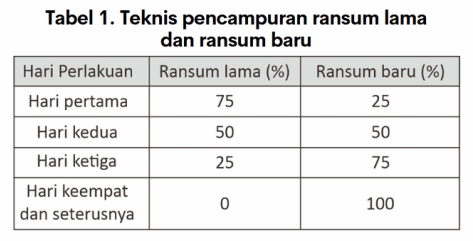
The quality of the ration, both in terms of physical and nutritional content, must be appropriate and meet the needs of chickens. The presence of changes in physical condition (aroma, taste, color, texture, etc.) on the ration usually indicates a change of its nutritional content. Basically, chickens like rations that are fresh, attractive in color, odorless, and not moldy. Chickens also tend to choose rations that are the same size or smaller than their beak size. Changes in the physical condition of the ration will reduce consumption because the palatability (level of preference) ration and chicken appetite will decrease. When there is a sudden change in the type of ration, then this can also trigger stress in chickens. If chickens experience stress, the result is a decrease feed intake and weight loss. So in the replacement of rations, we need to give chickens the opportunity to get to know new types of rations. So that the chickens are not too stressed during a change in the type of ration. When performing the alternation of rations can be applied as in the following table :
Before and during the change of ration, multivitamins such as Vita Stress to minimize the occurrence of stress in chickens.
Impaired digestibility of nutrients
This can be caused by both damage to the tissues of the intestinal mucosa and the presence of mycotoxins or fungal toxins in the ration. Damage to intestinal tissue will cause the process of digestion and absorption of nutrients is not optimal. As a result, there is a nutritional deficiency so that the growth and weight gain of chickens becomes not optimal. The cause of the damage to the intestinal tissue can be due to illness or stress due to hot ambient temperatures (heat stress). When conditions are hot, intestinal cells experience oxidative stress and produce free radicals, this can cause cell damage. So that the absorption of nutrients from the ration in the intestine is disrupted.
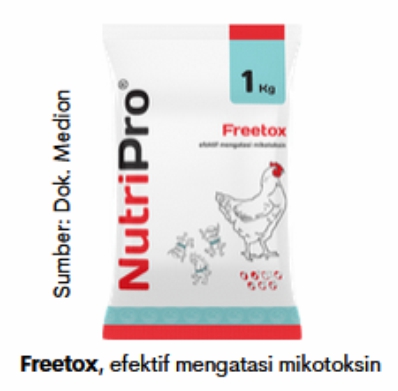
In addition, what is sometimes not observed is the presence of fungi in the ration. Fungi that contaminate the ration can reduce the quality and nutritional content of the ration, so that the absorption of nutrients is not optimal. Some types of fungi can also produce fungal toxins or mycotoxins that can cause irritation in the digestive tract such as gizzard/ gizzards, another impact is to reduce the production and immunity of chickens. Mycotoxins are chemicals that are stable and can survive for a long time even though the fungus that produces them has died. To reduce the adverse effects of such mycotoxins, assign toxin like Freetox in the ration. Freetox potent binding mycotoxins are strong in the digestive tract of chickens, so that the adverse effects of mycotoxins can be reduced.
Condition brooding period,
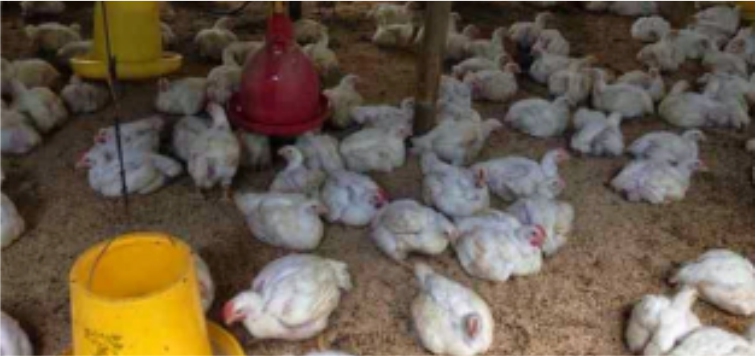
Time brooding period, is the decisive moment in the development and growth of organs in chickens. Temperature and humidity conditions during brooding period, must be in accordance with the needs of chickens, because at that time the condition is still DOC poikiloterm this means that these chicks are not yet able to regulate their own body temperature. The body temperature of the chicken will be greatly influenced by the ambient temperature (temperature brooding period,). Only at the age of 5 days, chicks begin to be able to regulate their body temperature. Important when DOC stocked in the cage brooding period, should immediately get a comfortable temperature. If it is too high or low it can have a negative impact on uniformity, growth, feed intake, feed conversion (FCR), mortality and weight achievement. To determine whether the temperature conditions in the cage brooding period, already comfortable or not, can be observed by looking at the spread of chicken. If the chicken spread evenly may indicate that the condition brooding period, already comfortable, chicken spread gathered near the heater can indicate cold, while the spread of chicken away from the heater can indicate overheating or heating temperature is too high.