A parasite is a smaller organism that lives attached to the body of a larger organism called the host. Ectoparasites are parasites that attack their hosts on the outside of the body, such as flies, mites, ticks, fleas. The high and low population of ectoparasites on a farm can be influenced by several things such as the location of the cage (close to shrubs, plantations, ponds), moist areas of the cage, cleanliness and sanitation of the cage and the environment.
Ectoparasites in cattle
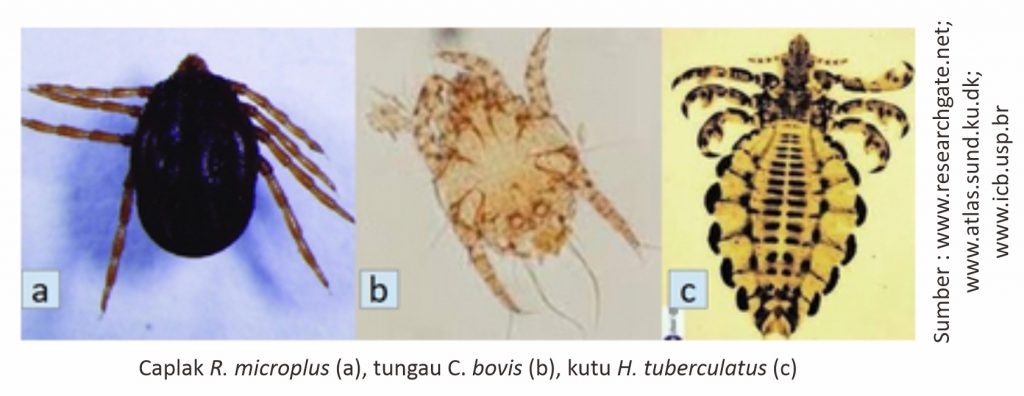
Ectoparasites that are often found in ruminants include ticks Rhipicephalus microplus, mites Chorioptes bovis and Psoroptes ovis, box Haematopinus tuberculatus as well as flies Chrysomya sp., Tabanus sp., Musca sp., Chrysomya sp.
Ticks Rhipicephalus microplus when attached to the body of cattle, it can suck blood, causing damage to the skin. Tick bite wounds can also invite flies to perch and lay eggs so that they can cause myasis or maggots. If cattle are infected with ticks, it will certainly cause losses, such as decreased milk and meat production due to decreased appetite, anemia, and ticks act as vectors for babesiosis, ricketsiosis, anaplasmosis.
Common mites that attack cattle are Chorioptes bovis and on the GOAT is Psoroptes ovis. On the body of cattle, mites are located on the hair follicles. The mites will dig under the skin, create tunnels and secrete fluid in the tunnels and form nodules or lumps. The toxins released can cause itching and skin irritation. Cattle infected with mites can lead to weight loss (chronic cases), stunted growth, livestock discomfort and damaged skin.
Lice H. tuberculatus many are found in ruminants. Ruminants have thick enough hair so that lice safely hide and lay their eggs. The losses caused, among others, interfere with the comfort of livestock, causing itching and thus reduce appetite and reduce livestock productivity., Lice infestation on the body of cattle can cause some clinical symptoms such as irritation, alopecia, or hair loss and anemia.
Flies are insects that are often found on farms. Flies can cause discomfort and stress in livestock. Flies can also cause myasis or maggots. Female flies lay their eggs on the edges of the wound then the eggs hatch into larvae or maggots. The larvae of these flies will eat the host's tissue.
Control Of Ectoparasites
Control of ectoparasites aims to reduce the population, development and attack of ectoparasites in livestock. In its implementation, it is necessary to pay attention to several things, such as knowing the nature and life cycle of ectoparasites, easy control (effective and efficient), safe or not causing harm to humans. In addition, ectoparasite control must also be effective for the target (target pest stage), the chemicals used do not cause poisoning, low cost, easy to obtain and do not interfere with environmental sustainability. Control can be done in several ways, namely:
Control on livestock (internal).
With sanitation programs and immediate treatment of sick cattle.
- Bathe cattle regularly to clean dirt and ectoparasites on the surface of the body.Dirt is a preferred medium for some types of vectors such as flies.
- If wounds are found, immediately Spray With Wound medicine Dicodine to dry quickly and prevent flies from perching.
- Spraying antiectoparasites on livestock to control mites, fleas, ticks, flies. For example with Delatrin or Kututox-S.
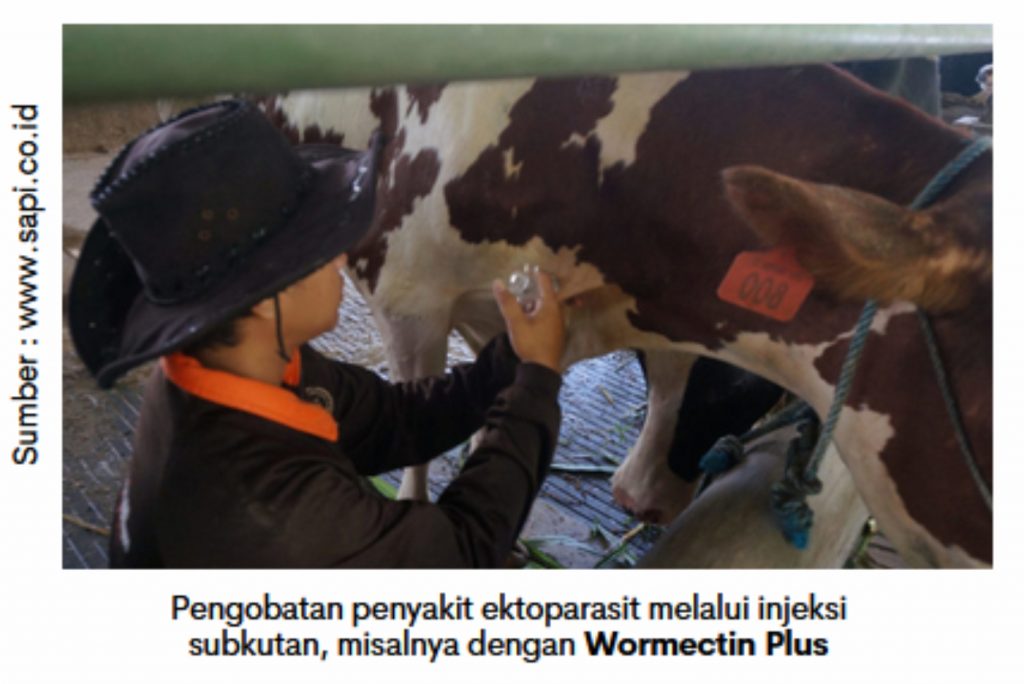
- Immediately separate the sick cattle & treatment by a team of animal health personnel. Cattle affected by ectoparasites can immediately be treated with Wormectin Plus or Wormectin Plus Bolus.
Control on the environment (external).
Control of the environment can be done physically (cage management & environment), biological (biotic agents against ectoparasites), and chemical (using chemicals). This is to break the life cycle of ectoparasites.
Physical Control
With Cage and Environment Management Control.
- Clean the cage regularly every day, or once a week or depending on needs.
- Routinely clean the rest of the feed especially if the condition is wet.
- Keeping the cage environment dry/not allowing water to stagnate.
- Clean the rest of the drinking water regularly.
- Ensure smooth air circulation.
- Regularly clean the bushes around the cage.
- Maximize waste management and dirt (so as not to become a breeding ground for flies).
- Perform rotation of the shepherd's area. Tick larvae will die if they do not attach to the host.
Biological Control
By exploiting the natural enemies of ectoparasites. For example, beetles (Carcinops pumilioand the beesSpalangia nigroaensa) these predators will kill flies at the time of the larval and pupal phases. This method is rarely used because it is difficult to do, the predator cycle is relatively longer and predators can also be carriers of disease agents.
Chemical Control
By administering drugs to eradicate ectoparasites. The administration of these drugs is not the essence of ectoparasite control techniques, but rather a refinement of control with management control. Each chemical used has its own target in killing its target. For example, the use of fly repellent products can be given based on the life cycle of flies. Larvae to kill larvae. For example Larvatox. Fly medicine is given to kill adult flies so that they do not produce fly eggs. Examples Flytox. Control of fleas, mites, ticks with Kututox-S or Delatrin sprayed on the cage floor and cage walls.