Cattle is a fairly popular livestock in Indonesia and one of the potential commodities in the development of animal husbandry. It can be seen from the population growth in 2017 of 2.7% and in 2018 of 3.8% with a total population of beef cattle in Indonesia of 17 million heads in 2018. Raising cows is interesting and anyone can pursue the business.
Raising cattle has received support from the government to reduce the number of meat imports. The government continues to strive to achieve food security for beef commodities through the compulsory pregnant cattle special efforts program (UPSUS SIWAB). The Program is aimed at optimizing the reproduction of cattle so that it can accelerate the increase in population.
One of the obstacles that can affect the accelerated development of cattle breeding is disease. Disease not only causes economic losses because it can reduce livestock productivity but can also lead to death.
Another negative impact that can arise is the declining interest of farmers to develop their business. One disease that affects many cattle is worms.
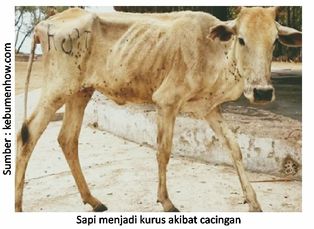
Worms in cows
The maintenance system that is still traditional, namely by letting the cattle find their own feed will make it easier for cattle to be infested with worms than cows that are kept in a modern way. The types of worms that infect many cattle in sequence are gilig worms, leafworms and tapeworms.
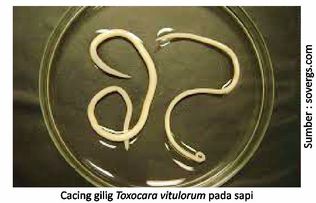
The most common cases of gilig worms are found because according to the weather conditions of Indonesia, which has a tropical climate with high humidity which is very conducive to gilig worms developing. Toxocara vitulorum is a Convex worm that is commonly found in calves. This disease causes the productivity of cows to decrease and even lead to death.
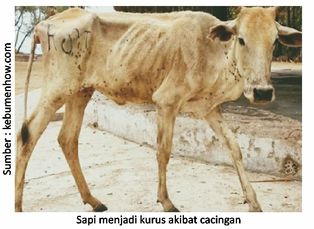
These worms are transmitted vertically or transmitted from mother to child through larvae in the uterus into the fetus and are transmitted horizontally, namely from sick cows to healthy cows through feed, drinking water, and colostrum contaminated with worm larvae. In severe infections, cattle may appear symptoms of diarrhea, loss of appetite, emaciation, respiratory symptoms due to pneumonia.
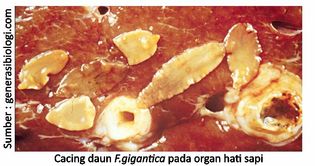
The next type of worm that is commonly encountered is the leafworm. With the case that many farmers harm is the liver worm which is often called Fasciolasis. This disease is caused by F. hepatica in temperate climates and F. gigantica in areas with wet tropical climates such as Indonesia.
Liver flukes can cause enormous economic losses, so they are referred to as economic diseases. Fascioliasis is economically detrimental to farmers because it lowers the selling price of cattle, productivity levels, calf weaning weights, and growth rates.
Fasciolasis will also spur an increase in livestock for in culling. Fasciola sp requires an intermediate host of snails of the family Lymnaeidae for the development of its life cycle. Then it is transmitted to healthy cows through grass contaminated with larvae (metacercariae) of worms. In cases that have been going on for a long time, cows can experience digestive disorders in the form of difficulty removing feces, or in severe cases diarrhea can occur. Cows will show symptoms of weakness, and stunted growth.
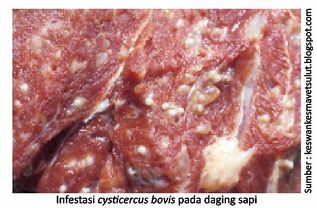
The most common type of tapeworm found in cattle is Taenia saginata. Worm eggs that are eaten with grass will develop into the larval phase of the cow's body. The worm larvae are in the cow's intestine then along with the blood flow to the muscles called Cysticercus bovis.
Larvae eaten from raw or undercooked beef can develop into adult worms in the human small intestine. In mild cases the symptoms are not clearly visible while in severe cases there is a lump under the skin or muscle tissue.
How To Know Wormy Cattle
To determine whether cattle are affected by worms or not, some observations can be made such as the following :
- Clinical symptoms of worms at the beginning of an attack rarely show symptoms or changes in livestock. Changes can only be seen in already severe cases.
- Laboratory tests can be performed in mild or severe cases by looking for the presence of worm eggs in feces. Laboratory tests are considered the most effective because they can determine the presence of eggs or larvae of worms qualitatively and quantitatively.
- Findings on internal organs can only be seen in dead or cut cattle by finding adult worms in the organs if wrong one or several cows are found infected with worms, this can be interpreted in one group of cattle affected by worms. This will certainly be related to the handling that needs to be done for the livestock group.
Handling and Prevention
Control and handling of cases of worms in livestock can be done in a simple way, which is to break the life cycle of these worm parasites. Some things that must be considered related to efforts to control and handle cases of worms include:
- Quality feeding with a sufficient content of nutrients and their quantity. Good quality feed, both grass and concentrate, can help increase the endurance of livestock because the necessary nutrients are met. If you need to add Mineral Feed Supplement S to prevent mineral deficiency and make beef cattle fatter.
- Pay attention to the sanitation of the cage and environmental cleanliness by not allowing cow dung to accumulate and cleaning the remaining feed regularly, maintaining the drainage of the cage and the surrounding environment so that it is not damp and muddy, and avoiding waterlogging of the soil. In addition, plants and weeds around the cage cleaned and disinfected the cage regularly using Antisep, Neo Antisep or Formades for an empty cage.
- Cattle should not be grazed too early because at that time the worm larvae are usually dominant on the surface of the grass is still wet. In order to break the life cycle of worms, the grazing system should be carried out in turns. This means that cows are not constantly grazed in the same place. Giving fresh forage grass is highly discouraged in intensively reared cattle. The grass should be mowed first before being given to cows to avoid the ingestion of worm larvae attached to the grass.
- Eradicating the host population between needs to be done by keeping the humidity and around the cage is not wet to prevent the survival of the freshwater snail. Breeding populations of freshwater snails as worm hosts can also be reduced by keeping ducks or ducks that act as natural predators of intermediate hosts.
- Conduct regular health checks and deworming programs. Deworming is the main step in the control and treatment of worms in both calves and adult cattle. Anthelmintic/ anthelmintic administration Program should be done from a young age (age 7 days) and repeated periodically every 2-3 months in order to completely eradicate the worms and break the life cycle of the parasite. Medion anthelmintic products that can be used to eradicate gilig worms, leafworms and tapeworms in cattle are Wormectin Plus and Wormzol-B.
- Giving multivitamins regularly every 2-3 months which serves to increase the immune system of livestock, making it more resistant to disease (including worms).
- Monitoring eggs and larvae of worms need to be carried out regularly (once every 2-3 months) through a stool test. This stool test aims to find worm eggs both qualitatively (types of worm eggs) and quantitatively (number of worm eggs per 1 gram of feces). This will certainly be related to the time of repetition of deworming and the determination of deworming drugs that will be given according to the type of worm that infects. Currently Medion has a laboratory that can serve the test, namely MediLab which has spread in several regions in Indonesia.