Herbal ingredients have long been known by the people of Indonesia as a medicine and to improve metabolism. Popular scientific reports indicate that the use of various herbal ingredients for humans is also effective in suppressing various diseases in livestock, but scientific facts have not revealed much. Improvement of metabolism through the administration of herbs will indirectly improve the performance of livestock through bioactive substances they contain. Thus the livestock will be healthier because it has a better immune system, and the food products produced are safer.
Respiratory System Of Chickens
Chickens have a different respiratory system from mammals because in chickens there are air sacs. The respiratory system of chickens consists of the respiratory tract (nose, nasal sinuses/infraorbital sinuses, larynx, trachea, bronchi), lungs and air sacs. The larynx and trachea are composed of muscles and cartilage. On the inner surface (epithelium) there are Cilia, as a means of defense against foreign bodies.
The presence of cilia (vibrating bristles) on the surface of the nasal cavity serves as filter so that the contamination agent in the form of particles will be retained. But not all particle sizes can be filtered, because only particles with a size of 3.7-7.0 microns can be retained. Small particles 0.091-1.100 microns in diameter will escape and be retained along the respiratory tract and lungs. Cilia always perform dynamic movements directed forward.
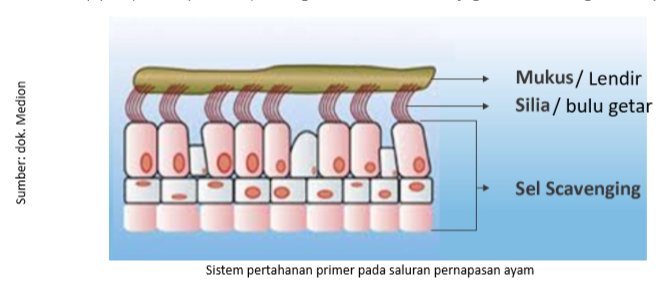
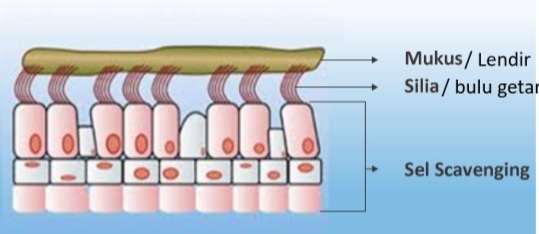
What about the agents of the disease that managed to escape the “ambush” of the cilia? Even if it passes, the agent of the disease it will be “confronted” with the mucus produced by some non-ciliated cells that line the entire surface of the respiratory tract. The mucus contains enzymes and surfactants (surface tension lowering) so that it is able to kill disease agents. In addition, this mucus also serves to dilute or wash away disease agents and contamination particles so that it can facilitate the work of cilia in removing or eliminating contamination. The mechanism of elimination of the contaminating agent is also assisted by the presence of a cough or sneezing reflex.
Malfunctioning of the defense system, will provoke the entry of infectious agents. And when an infectious agent enters the chicken's body, if it is not immediately treated appropriately, the chicken will get sick and can even lead to death.
Snoring is one of the symptoms of respiratory distress that occurs due to a blockage in the respiratory tract. Snoring can be caused by infectious agents (diseases, red) and non-infectious, such as dusty air, ammonia, weather changes, etc. Some infectious diseases that have clinical manifestations of respiratory disorders, and always occupy the top 10 ranking of diseases in broilers and layers, including CRD, colibacillosis, korisa, ILT, ND, IB and AI. However, diseases that specifically have the main target in the respiratory organs are CRD, colibacillosis, korisa and ILT. While ND, IB and AI, in addition to attacking the respiratory organs also attack other chicken organs.
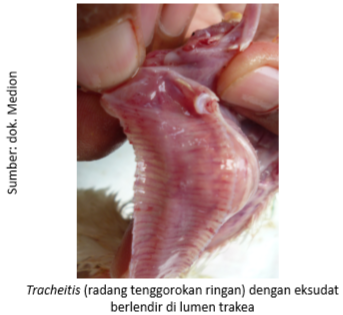
The factors that cause chicken snoring are many kinds, and it indicates that the respiratory organs of chickens have experienced interference/ damage. This certainly cannot be allowed to drag on and be taken for granted, so the cause of chicken snoring must be quickly traced so that it can be dealt with immediately.
The administration of mucolytic and anti-inflammatory drugs using natural products (herbs) is one of the right treatment options to overcome respiratory disorders. Hal ini sejalan dengan dukungan World Health Organization (WHO) terhadap konsep back to nature specialists who recommend the use of herbal remedies in the treatment of diseases.
Herbs work as mucolytics and anti-inflammatories
Herbal medicines are natural remedies derived from plants that can be used to support livestock productivity improvement. In general, herbal medicines are classified into three types: traditional medicines or jamu, Standardized Herbal Medicines (OHT), and phytopharmaceuticals.
Currently we understand that traditional medicine or herbal medicine is a type of natural medicine that is quite widely used by farmers in the field. While standardized herbal medicinal products and phytopharmaceuticals are still of little use because they are still limited in both types of products on the market.
Please note that compared to herbal medicine, standardized herbal products intended for livestock have better quality, when judged from the raw materials used. In standardized herbal medicines, the manufacturer already uses raw materials in the form of plant extracts. While in the use of herbal medicine, farmers must process herbal plants first to get extracts and this requires energy and cost is not small. Especially if the herbs will be used continuously every day.
Realizing the need to provide standardized herbal medicinal products for farmers, Medion is now starting to develop standardized herbal products that are safe and standardized, one of which is herbal medicine Respitoran. Respitoran is a liquid form of supportive herbs that serve to overcome respiratory disorders in chickens.
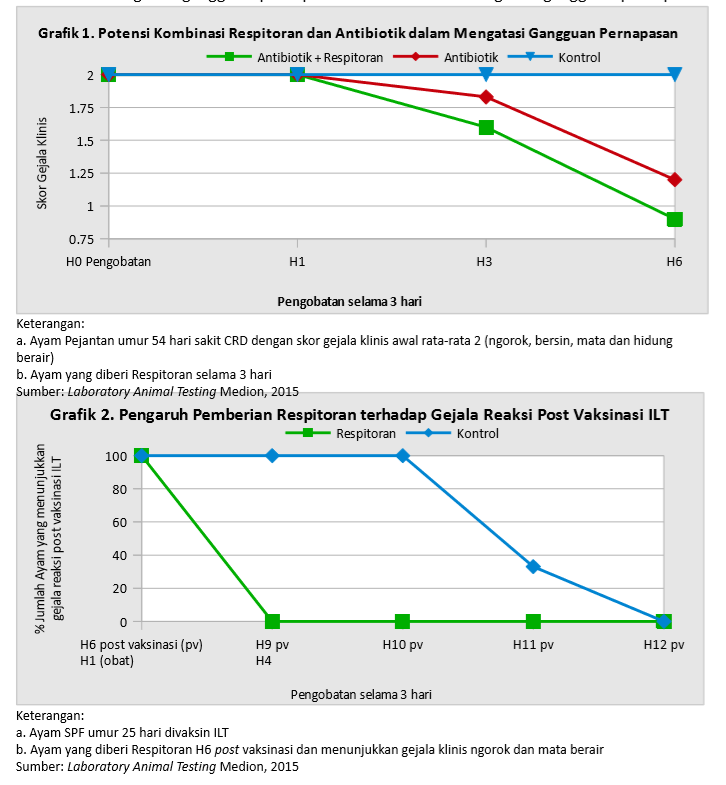
From the results of research Lat Medion (2015), giving Respitoran proven to help overcome respiratory disorders when bacterial infections such as CRD and Coryza, as well as viral infections such as ILT, ND, and IB. (Graph 1). Respitoran given for 3 days and assessed decrease in clinical symptoms, the smaller the score of clinical symptoms of CRD in chickens, the chicken's condition has improved. It is noticeable that the 1st day after administration Respitoran able to reduce the clinical symptoms of chicken due to CRD.
In addition, Respitoran also able to help overcome respiratory disorders due to reactions post vaccination of active vaccines as in ILT, ND, and IB infections (Chart 2). Respitoran given the 6th day post vaccinate when chickens already show symptoms of snoring and watery eyes. The healing of these clinical symptoms began to appear on the 4th day after administration Respitoran.
When a bacterial infection occurs, inflammation will arise in the respiratory tract which then causes excess mucus or mucus production. Excess mucus will cause narrower respiratory tract and difficulty breathing chicken. Respitoran contains herbs that act as anti-inflammatory, decrease mucous secretion, and thin phlegm.
Respitoran it should be given 3-5 days in a row and combined with antibiotics during bacterial infections to work optimally in overcoming inflammation. To reduce clinical symptoms due to reactions post ILT vaccination, Respitoran can begin to be given on the third day post vaccinated or adjusted usually when symptoms of respiratory distress appear. Respitoran safe to use for long term and does not interfere with the formation of antibodies post the ILT vaccine.
Do not mix Respitoran with disinfectants or chlorine to maximize the action of active substances in Respitoran. Water containing disinfectants or chlorine must still be precipitated 6 hours before use to mix drugs, vitamins, and Respitoran.
Thus the discussion about herbs to overcome respiratory disorders. In addition to providing treatment to chickens, keep in mind other factors such as improved management and biosecurity. May be useful.