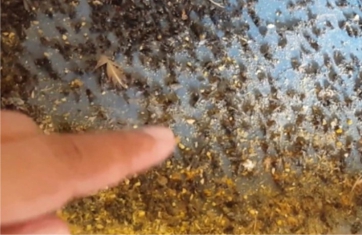
Worm disease not only attacks commercial chickens, but fighting chickens can also be attacked by this disease if the application of cage hygiene is not good. Some hobbyists also tell their pets are sick with worms. An unclean Cage will trigger the development of vectors or intermediaries for diseases, for example, flies.
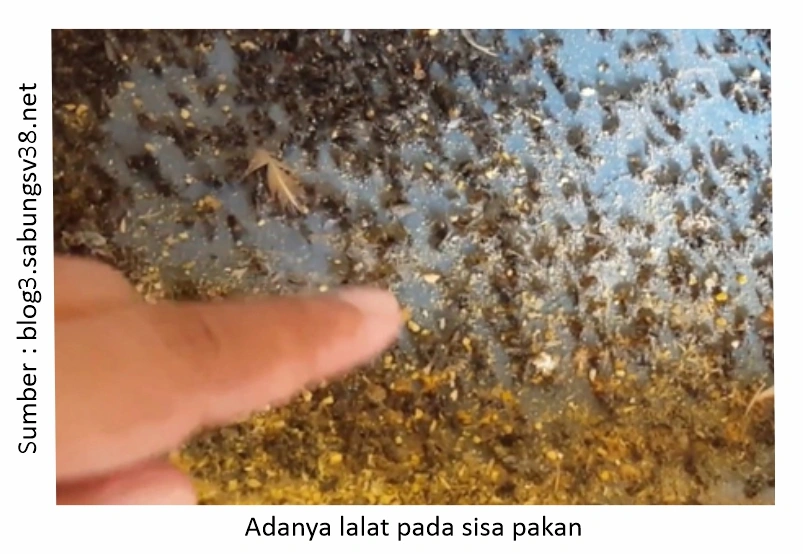
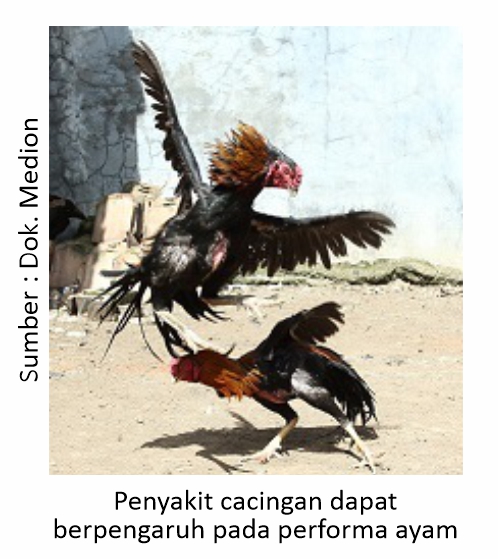
Fighting chickens affected by worms will look pale and lethargic, decreased appetite, weight loss, wet or even watery feces, matted feathers so that their ability to compete decreases. In severe cases it can also have an anemic effect so that it greatly affects the performance of the chicken. If the fighting chicken is attacked by this disease, it must be treated immediately so that it will recover and the chicken's performance will be excellent again.
The risk of getting worms will increase when the fly season or fly population increases. Especially during the rainy season. High rainfall, increased cage humidity and scattered feed conditions will increase the fly population.
The larvae of flies and adult flies can act as intermediate hosts for tapeworm infection (Rillietina P.S. on the chicken. Larvae and adult flies are often eaten by chickens so that chickens can be attacked by the tapeworm. In addition, the fly also acts as a mechanical vector for the gilik worm (Ascaridia galli). Flies as a mechanical vector that plays a role in carrying eggs or worm larvae to move from one place to another, to stick to feed, drinking water, or other media. Chickens will then become infected with earthworms if they swallow worm eggs along with feed or drinking water. Gilik worms and tapeworms are types of worms that often attack chickens.
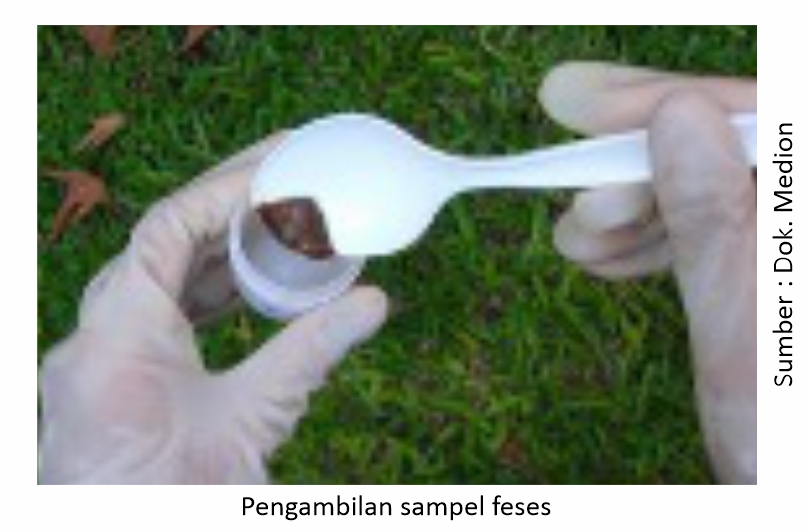
To detect fighting chickens that are kept affected by worms or not, it can be detected early. That is, conducting parasitological laboratory tests using stool samples for examination.
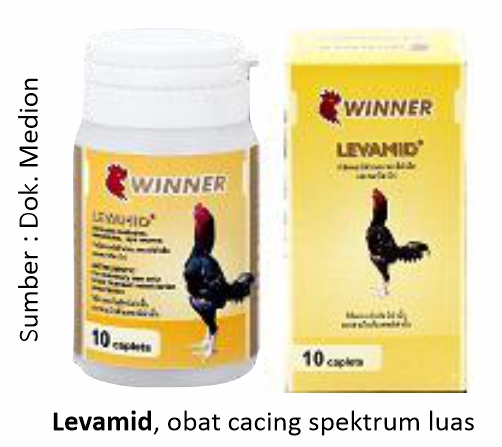
If the fighting chicken has been affected by worms, the treatment will be optimal if the treatment technique is done correctly, including the right drug, the right dose, and the right administration technique. The selection of worm medicine is said to be appropriate if it has a spectrum of action in accordance with the type of worm that attacks (gilik worm or tapeworm). However, if the chicken is attacked by earthworms as well as tapeworms, the fighting chicken can be given worm medicine with a broad spectrum of action, namely with products Levamid for the chicken.
Deworming must be precisely dosed, i.e. a single dose (one administration). Then related to the technique of deworming, it requires a repetition process. The repetition can be adjusted according to the life cycle of the worm and the conditions of the cage. Gilik worms have a life cycle of 1-2 months, while tapeworms are about 1 month. So that deworming can be repeated 1-2 months later.
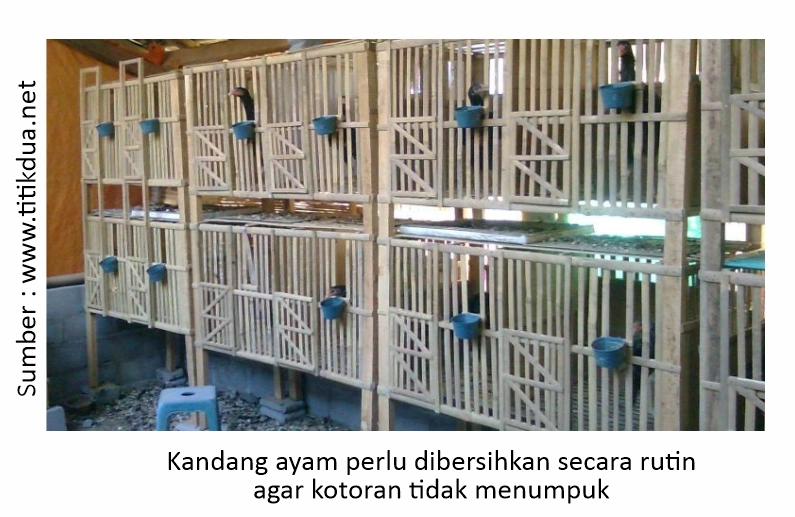
An effective effort to prevent worms is to keep the cage environment clean and control the vector. Sanitation and disinfection activities of the cage and the environment need to be carried out regularly. Perform a thorough cleaning of the cage then spray with a disinfectant such as Medisep or Zaldes.
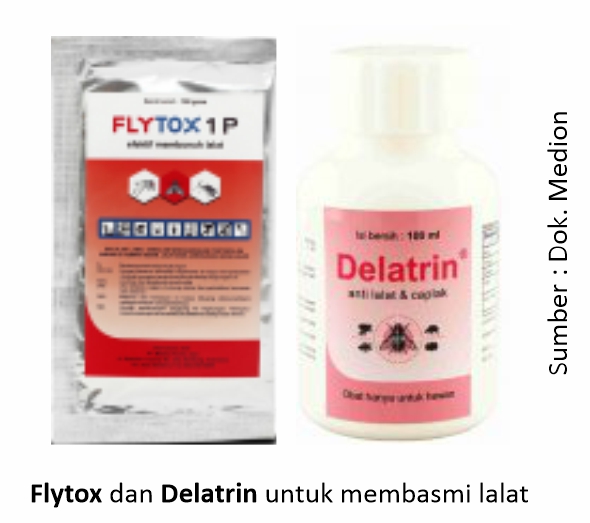
To get rid of adult flies, it can be used Flytox or Delatrin. Flytox applied by sowing in a moistened plastic sack. While Delatrin applied by spray directly to flies that roam the cage area.
Worms rarely lead to death. But that does not mean that worms can be ignored. Some people give deworming when the chicken has worms. The thing to watch out for is that in cases of mild worms or early attacks often do not show clinical symptoms and are difficult to detect early except by conducting laboratory examinations. In this condition the chicken still looks healthy but with decreased performance. Taking this into account, worm control with a prevention program, namely deworming, is a good effort. After several repetitions, it does not mean that deworming medication must be continuously given in the following months. It is good to do a routine stool examination, for example in MediLab (Medion laboratory) so that the presence of worm eggs in the stool can be detected early. This is the basis for whether or not deworming is necessary for the long-term period ahead and for the accuracy of Drug Administration.