
Digestion is one of the important organs in supporting the performance of the chicken's body, both from growth and productivity. A healthy digestive tract condition is needed to be able to digest the nutrients present in the ration. If the chicken's digestive tract is impaired, this will be a risk to the health and performance of the chicken's body. Therefore, we need to know the proper management and solutions to maintain the health of the digestive tract in order to achieve optimal performance.
Cases Of Occurrence Of Diseases Of The Gastrointestinal Tract
Based on data from the top 10 Disease rankings that have been collected over the past 3 years, it is known that cases of gastrointestinal diseases, namely Colibacillosis, coccidiosis, and NE, are still often found in broilers, while in laying hens there are also cases of intestinal worms that attack the digestive tract. Colibacillosis is caused by bacteria Escherichia coli it is a disease that can be transmitted vertically from the mother to the chicks through the ovaries or oviducts or horizontally through contact with contaminated cage material or equipment.
This is related to the low sanitation and cleanliness of the cage so that the bacteria easily contaminate the cage environment. Coccidiosis caused by protozoan parasites Eimeria sp. it is also a frequent case due to its short life cycle and its high proliferation in a home environment and causes disease, while NE is a disease caused by bacteria Clostridium perfringens which often appears along with coccidiosis.
This is because the bacteria is a normal flora that lives in the digestive tract of chickens, when chicken conditions are bad and supported by uncomfortable environmental conditions, the bacteria will infect. This is because when the condition of the chicken's body decreases, and the concentration of bacteria continues to increase so that there is an imbalance of microflora in the intestine, deworming disease is also still a frequent case in laying hens due to poor cage sanitation and worm vectors such as flies that predispose to this deworming disease. Worms can damage the intestinal villi so that the absorption of feed nutrients will be disrupted.
In addition to factors of infectious agents that attack, imbalance of microflora in the intestine, and environmental factors such as lack of sanitation of the cage, health problems in the digestive tract can also be caused by other factors such as the presence of fungi and mycotoxin levels, poor ration quality, and stressful chicken conditions.
The Importance Of Maintaining A Healthy Digestive Tract
The digestive tract is an organ that plays a role in receiving rations, digesting, absorbing nutrients from rations, and removing the remaining unabsorbed rations. Good health of the gastrointestinal tract will have a significant impact on the utilization of the ration in the body of chickens. The digestive tract contains long, finger-like intestinal villi throughout the intestine that function to absorb food juices (nutrients) that extend from the base of the intestine towards the intestinal lumen where food will be digested and absorbed. Villi that are getting longer or wider will increase the area of nutrient absorption in the intestine so that nutrient absorption is more optimal.
In addition, in the digestive tract there is a (gut associated lymphoid tissue). GALT is part of the lymphoid tissue that serves as a site for the mucosal immune response to produce antibodies and receive stimulation of the mucosal immune response. Lymphoid tissue is spread in the epithelium, lamina propia, plate peyer’s patches, and caeca tonsil.
The digestive tract of chickens begins in the beak and ends in the cloaca. Organs of the digestive system, namely the beak, esophagus, cache, proventriculus, Gizzard (gizzard), small intestine, appendix, colon, and cloaca (coprodeum), and equipped with organ accesories namely the liver,bile, and pancreas. In the intestinal tract there is a microflora in which the balance of the microflora population is very important to maintain the normal functioning of the intestine. Intestinal health depends on the balance between the condition of the chicken, intestinal microflora, intestinal environment and feed components. If there is a disturbance, the process of digestion and absorption of nutrients will not be optimal and malabsopsi so that it will be used for overgrowth of bacterial populations.
Chicken Gut Health Management
To maintain the health of the chicken intestine, we need to ensure the balance of microflora in the intestine is maintained, therefore the thing that needs to be done is to apply optimal management, namely:
Improvement of ration management
Giving rations according to needs with the right nutritional value, make sure the quality of the ration meets the standards, and avoid giving that has clumped or contains fungi in chickens. Ration storage areas need to maintain temperature and humidity conditions, while also avoiding pests such as mice and other insects.
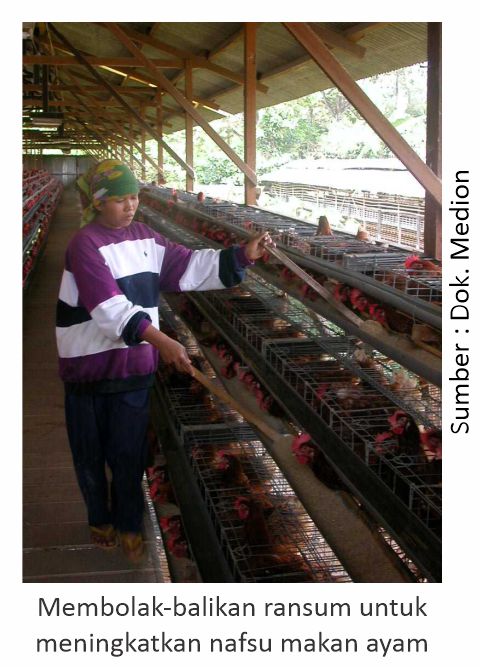
Ration replacement is also carried out gradually to minimize stress in chickens. Do it monitor against the consumption of rations and doing periodic flipping rations to increase appetite.
Maintain drinking water quality
Drinking water quality greatly affects the health of chicken intestines, to find out we need to test the quality of drinking water includes physical (clear, colorless, and odorless), chemical (pH neutral, not hard, the content of chloride, nitrate, nitrite, and iron does not exceed the standard), and biological (free from bacterial contamination E. Coli infection, Salmonella sp. or other pathogenic microorganisms). Checking the quality of drinking water is carried out periodically in the laboratory, if contamination or bacterial contamination is found coliform, E. Coli infection or other pathogenic bacteria can be sanitized drinking water using Medisep or Desinsep. The cleanliness of drinking places also needs to be maintained to prevent contamination from bacteria.
Minimize stress factors
Stress factors appear in certain conditions such as travel using transportation, density levels, weather influences, vaccination treatments, or when changing rations. Pay attention to temperature, humidity, ventilation, and cage density. To increase endurance and overcome stress can be given multivitamins Vita Stress or herbal products Imustim which can improve immunity and endurance.
Severe litter and feces
Litter and feces are an ideal medium for pathogenic microorganisms to multiply. Litter frequently used to prevent litter wet, litter wet or lumpy ones need to be sorted out and removed from the cage.
Reducing the population of seed diseases around chickens
The minimum cage rest period is carried out for 2 weeks, calculated after the cage is clean and disinfected, aiming to break the life cycle of disease seedlings from the beginning of maintenance. Disinfection when empty cage using Sporades or Formades. During the maintenance period, spraying of cages and equipment is carried out both where rations and drinking places use Medisep.
Medication for digestive health
To prevent diseases of the gastrointestinal tract can be given AGP substitute products such as organic acids. Its purpose is to reduce the spread of infection, reduce the number of pathogenic bacteria, maintain the balance of intestinal microflora, and improve the absorption of nutrients.
In addition, it can also be given herbal products for example Fithera which works by damaging the membranes and cell walls of bacteria so that it is effective to help accelerate the healing of diseases caused by bacterial infections such as Colibacillosis and also overcome coccidiosis.
The role of organic acids for Digestive Health
Preventive measures and anticipation of disorders of the digestive tract can be done one of them with the administration of organic acids to maintain the health and performance of the digestive system.
Organic acids or acidifier is an acidic compound that is added to the ration to maintain microbial balance in the digestive tract by maintaining the pH of the upper digestive tract below 6 and helps lower the pH of the digestive tract, so it can indirectly suppress the colonization of pathogenic bacteria such as E. coli, Salmonella sp, Pseudomonas, and Clostridium sp. by disrupting the stability of bacterial cell walls, stimulating the production of endogenous enzymes to help improve the digestibility of feed nutrients, and help increase the population of beneficial microflora in the digestive tract.
Organic acids disrupt the stability of the bacterial cell wall. Asortin it is a product that contains organic acids to maintain the pH of the digestive tract and kill pathogenic bacteria so that the balance of microbes in the digestive tract is maintained and nutrient absorption becomes optimal.