Bapak Hardi – by email
For the preparation of cages that have a history of disease cases. How does a good disinfection program include the disinfectant used and how many times is it repeated?
Answer:
Thank you Mr. Hardi for the question submitted. Preparation of the cage needs to be done so that the condition of the cage is clean and ready to be used for the next maintenance period. After harvesting, there will be remnants of chicken maintenance, such as dirt, feathers, and dust that need to be cleaned and seeds of diseases that need to be eliminated. Seeds of diseases that exist in the cage, especially those that have attacked in the previous period, need to be eliminated by cleaning and disinfection. In addition, it is also necessary to consider the use of appropriate disinfectants in order to get maximum results.
Cage cleaning and disinfection
Cage cleaning needs to be done before disinfection to clean organic matter such as feces in the cage. The presence of organic matter that is still attached can reduce the effectiveness of the disinfectant because it will block the contact between the disinfectant and the seeds of the disease. The steps in cleaning the barn that need to be done are :
- Remove the cage equipment and then wash thoroughly until there is no dirt, mucus and Moss attached. Then rinse and soak with disinfectant. All clean equipment can be stored in the warehouse first.
- Scrape off husks, feces or remaining cage waste with a shovel until there is no residue left.
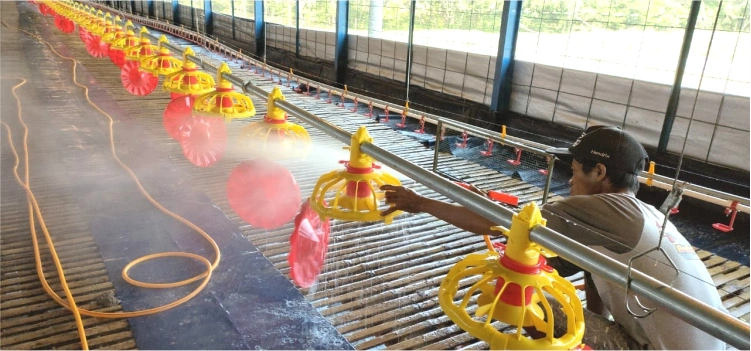
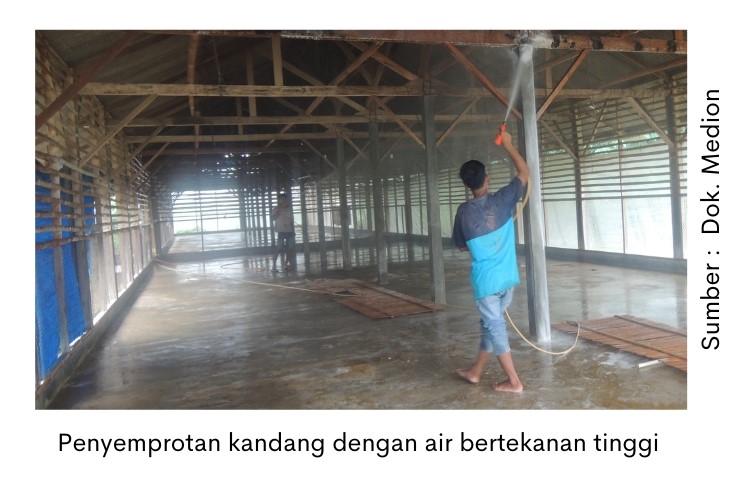
- Clean all parts of the cage by spraying high-pressure clean water. Then the floor/slat, between floors, bulkheads and walls are brushed with additional detergent and then rinse again with water. After that, the entire cage both inside and outside can be disinfected with Formades or Sporades.
- Wild grass and shrubs around the cage also need to be cleaned so that they do not become a breeding ground for disease vectors (Franky beetles, mosquitoes and other insects).
- Perform insecticide/anti-ectoparasite spraying on the cage and the surrounding environment to eliminate fleas and insects using Delatrin.
- Ditches / ditches in the enclosure area are cleaned so that the flow of waste water disposal is smooth.
- Perform Liming under the stage cage and all parts of the cage to reduce moisture and kill residual disease-causing microorganisms. Drain the water reservoir and flushing water pipes for removal biofilm which is attached along the water channel.
Use Of Disinfectants
The principle of disinfection is to minimize the number of disease seeds in the farm environment. Some things to consider when using disinfectants include :
- Choose a disinfectant according to the type of disease seedlings to be eradicated. For example, in the case of Gumboro farms, the disinfectant chosen is iodine class (Neo Antisep) or aldehyde (Sporades). The causative agent of Gumboro in the form of a virus is not amplified, so suitable disinfectants are Antisep/ Neo Antisep/ Sporades/ Formades.
- The dose of disinfectant should be adjusted according to the rules of use listed on the product etiquette or packaging. How to use a dehumidifier (,) should be carried out until the surface is wet with disinfectant.
- The pH level of the water should be neutral or 5-8, and the water is not hard (the content of Ca2⁺ and Mg2⁺ ions is small) so that the disinfectant works optimally. PH levels and water hardness can affect the performance of disinfectants, especially QUATS and iodine groups.
Shortly after application, the disinfectant begins to degrade so that its effectiveness gradually decreases. As a result, the shorter the contact time required to eradicate microbes, the more efficient the disinfectant. Disinfection of the QUATS group and oxidizing agent known to have a relatively short contact time (10-30 minutes) compared to Phenol so it has a faster killing power.
After the cage is cleaned and disinfected as a whole, the cage must be emptied for at least 14 days from the time the cage is finished cleaning and sprayed with disinfectant. Repeated disinfection can be carried out with Formades/Sporades when preparing for DOC's arrival after the cage equipment is installed.
Preparation of the cage with good cleaning and disinfection can minimize the seeds of diseases in the cage. In addition, it is necessary to consider several things in the selection of disinfectants so that the results are maximum.