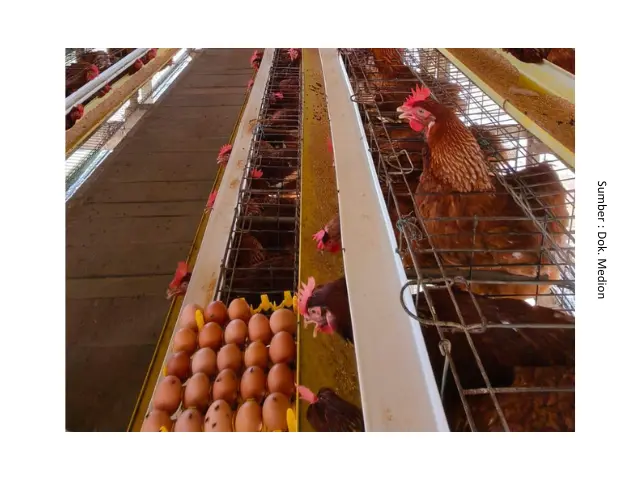
It is widely known that water is the most important and most widespread compound on Earth. Water is also the foundation of all kinds of life. In poultry farming, water is essential for a variety of purposes, including hydration, regulating body temperature, aiding digestion and metabolism. The role of water also supports aspects of overall health such as its use as a solvent for drugs and vaccines, as well as in the process of sanitation and disinfection. Water is very important and necessary in the poultry industry because of its involvement in almost every physiological and operational process in the survival of livestock. Water is an integral part of many biological processes, so it is a must for farmers to pay attention to the quality of water used on farms, especially water that will be drunk or consumed by poultry. To determine the condition of water quality, can be observed and measured from several parameters, namely:
- Physical qualities
Observation of physical quality of water including color, odor and water clarity - Chemical quality
Observation of chemical quality in water include pH, chloride, nitrate, nitrite, iron and water hardness - Biological quality
Observation of biological or bacterial quality in water can be measured qualitatively and quantitatively. Qualitative measurement by looking at the presence or absence of bacterial contamination. While quantitative measurements by calculating the total amount of bacterial contamination such as Coliform, Eschericia coli and Salmonella sp of 100 mL of water sample.
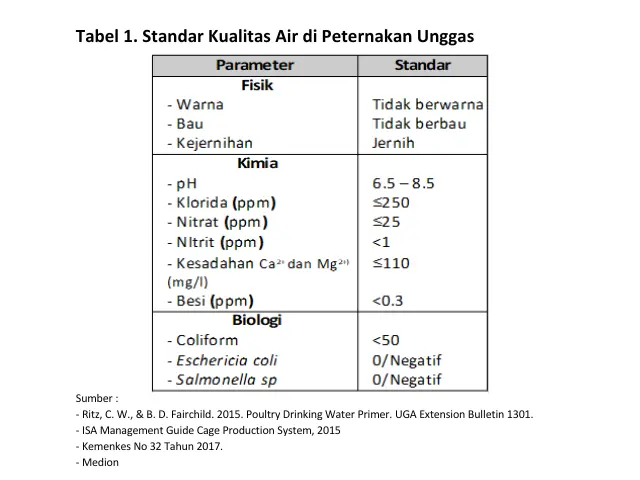
Poultry typically consume about twice as much water as feed by weight (Abbas et al., 2008). The quality and availability of adequate water is very important to optimize the performance of poultry. Water quality is very important because it represents 50-70% of the live weight of adult poultry and its consumption is usually 2 to 2.5 times greater than that of feed. In addition to being the main component of the body, water is also the main solvent involved in many metabolic processes including nutrients, medicines, vitamins, herbs and active vaccines applied via drinking water. Poor water quality can affect the gut microbiota of chickens, affecting nutrient absorption and causing heavy metal deposition that poses significant health risks. In addition, water quality that is not in accordance with standards can have an impact on the success of vaccination and treatment via drinking water. The following are water quality standards in poultry farms.
Water quality problems on farms
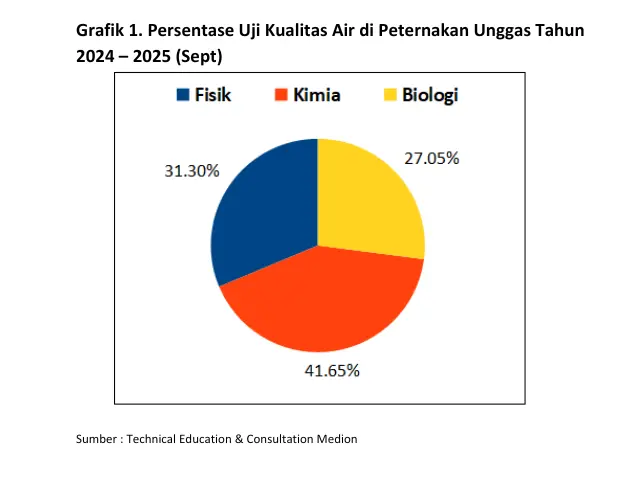
Good water quality control begins with knowing its physical, chemical and biological characteristics at the source, reservoir or drinking place. Based on Graphic 1 above, the percentage of water quality tests in Medion Laboratories in 2024 to September 2025 was the highest, namely chemical parameters of 41.65% from tens of thousands of samples tested. Then the physical parameters of 31.30% and biological parameters of 27.05%. The Data shows that concerns about water quality, especially chemistry, are still a dilemma in poultry farming in Indonesia. Considering the chemical quality of water has a significant impact on the success of vaccination and treatment via drinking water. If there is a discrepancy between the recommended value and the actual value of the water quality indicator, it is necessary to immediately carry out special treatment so as not to adversely affect the physiological or operational processes in the poultry farm. Water quality can have a direct or indirect impact on poultry performance. High levels of minerals, heavy metals, bacteria or other pollutants in drinking water can adversely affect normal physiological properties resulting in lower poultry performance.
a. Physical Quality Of Water
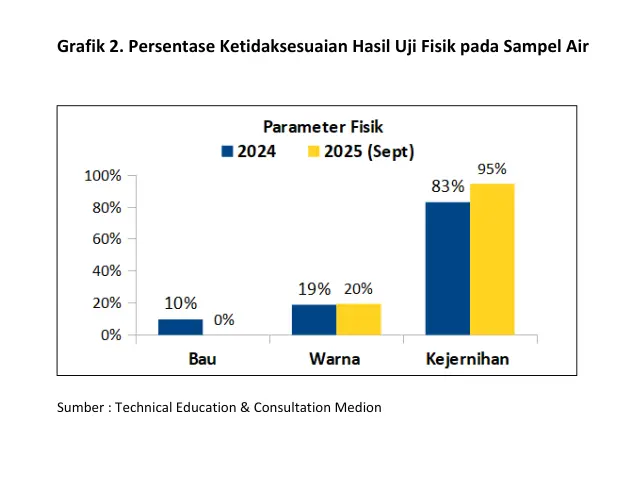
Observations of the physical quality of water in the Medion Laboratory include odor, color and water clarity. Based on the data presented in Graphic 2, the percentage of incompatibility of water physical test results in 2024 to September 2025 is still quite high, especially water clarity. On the parameters of the physical quality of water, the percentage of discrepancy between odor, color and clarity is 10%, 19-20% and 83-95%, respectively. According to Hess and Macklin 2019, chicken drinking water should be clear, odorless, tasteless and colorless. The physical quality of water that is problematic is usually related to levels of chemicals such as minerals and heavy metals or the number of bacteria that exceed standard limits. So that the condition can cause changes in smell, color and water becomes cloudy. This can ultimately have an impact on reducing chicken drinking water consumption and indirectly affect the success of vaccination and treatment via drinking water.
b. Chemical Quality
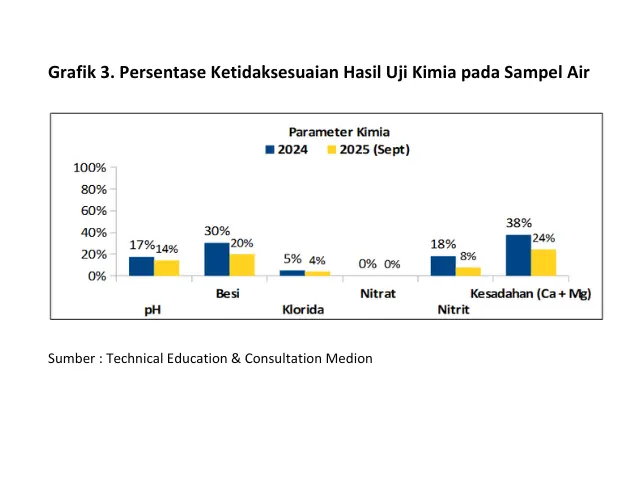
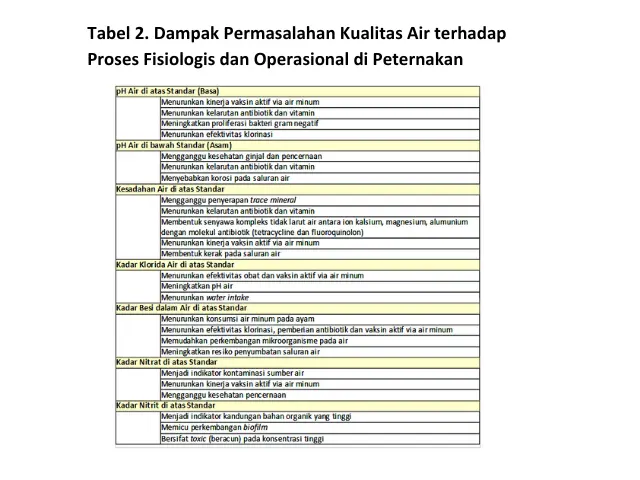
Observation of water chemistry quality in Medion Laboratory includes pH, iron content, chloride, nitrate, nitrite and hardness (calcium and magnesium). Based on the data presented in Graphics 3, the percentage of water chemistry quality mismatch in 2024 to September 2025 is still quite high. In the parameters of water chemical quality, the percentage of mismatch between pH, iron content, chloride, nitrate, nitrite and hardness respectively with the value 14-17%, 20-30%, 4-5%, 0%, 8-18% and 24-38%. Problematic water chemical quality can affect the chemical processes that occur in the chicken's body when consumed. It can also trigger chemical reactions when used as a solvent media for active vaccines, drugs, vitamins and herbs via drinking water and disinfectants. This chemical reaction will eventually lead to a decrease in the performance and effectiveness of the pharmaceutical and biological products used. According to the French Research Institute ITAVI, here are some of the impacts caused if the chemical quality of the water is not up to standard.
Water Quality Management on farms
Based on the data above, various water quality problems, especially physical and chemical, can have an impact on the success of vaccination and treatment via drinking water. So that a solution to the problem of water quality is needed. Here are some ways to deal with the physical and chemical quality of water on a farm ;
- Carry out regular installation and change of water filters. Filtration method using a filter in the form of silica sand / zeolite, activated carbon and manganese before flowing to torn cage. The filter must be replaced regularly so that the filtration process continues to run smoothly and effectively.
- Usage Water Treatment Plant (WTP) to process raw water into water that is suitable for consumption for livestock. Water Treatment Plant (WTP) is also able to maintain the quality of livestock drinking water according to standards.
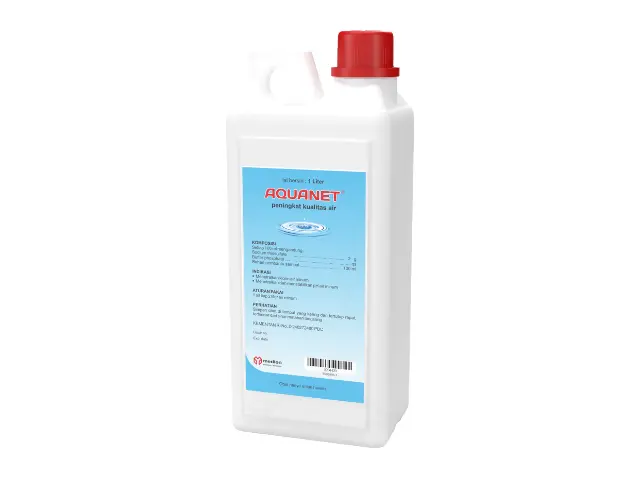
- Use Aquanet to help deal with water chemistry problems. Aquanet contains Sodium Thiosulfate which can neutralize chloride/chlorine levels in water. In addition, Aquanet also contains Buffer Phosphate which can neutralize and stabilize the pH of the water. Aquanet can be mixed in water as needed at a dose of 1 ml per 2 liters of drinking water.
- Do flushing regularly to prevent growth biofilm in the water channel.
- Test the water quality periodically, especially during the rainy season, dry season and the change of seasons.
In addition to being the main component of the body, water is also the main solvent involved in many metabolic processes, distribution and absorption of various nutrients, drugs, vitamins, herbs and active vaccines via drinking water. So it is very important in maintaining drinking water quality in accordance with standards. Therefore, good water quality control begins with knowing the physical, chemical and biological properties of the water used through periodic water quality tests. Because quality water will support the success of vaccination and treatment via drinking water.