Question from Mr. Moh. Ramadhan – by Email
Are the risks and mortality rates of LSD the same as PMK and Jembrana disease?
Answer
Thank you Mr. Ramadhan for the question. Currently in Indonesia is spreading three diseases in cattle that attract attention because of the increasing cases or outbreaks. Such diseases are lumpy skin disease (LSD), mouth and nail disease (FMD) and Jembrana.
The growing number of cases of the disease and its spread to different regions cause concern. Death in livestock is one of the most worrying things for farmers. There are differences in risk and mortality rates between LSD, FMD and Jembrana (Table 1).
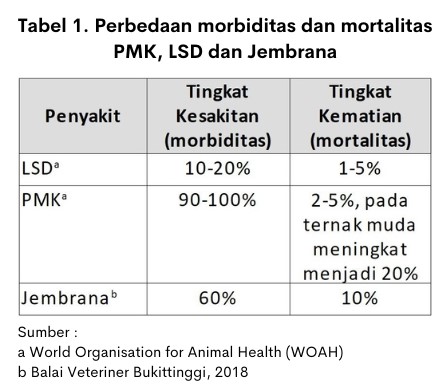
The risk and mortality rate of the three diseases can be influenced by several factors, such as the severity and treatment efforts undertaken. If the cow is infected with high severity and poor handling, it will increase the likelihood of death.
Meanwhile, if the livestock is supported by good endurance and handling is done quickly and appropriately, the possibility of recovery increases.
Here is a glimpse of the disease to be able to distinguish the characteristics of the disease, transmission routes, clinical symptoms and appropriate treatment to reduce the death rate.
Lumpy Skin Disease (LSD)
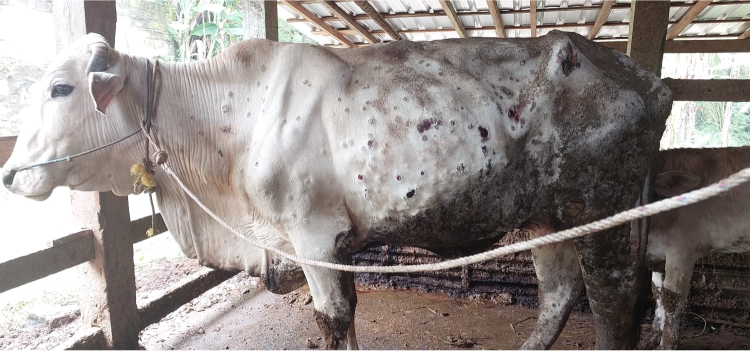
LSD is a viral infectious disease characterized by the presence of hard nodules on the skin in almost all parts of the body. In addition to cattle, this disease can infect Buffalo but is not transmitted to humans (not zoonotic).
Transmission of LSD can occur through short distances, namely direct contact with sick livestock, bites of insect vectors (flies, mosquitoes, ticks) and repeated use of syringes. While long-distance transmission involves transportation of infected livestock to other areas and the presence of flying insect vectors.
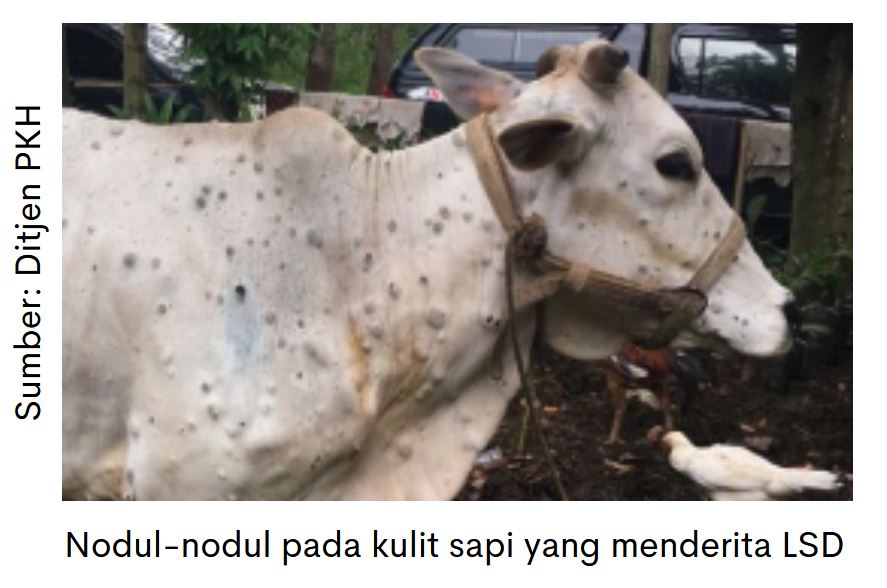
The incubation period of LSD occurs for 2-5 weeks. Clinical symptoms that can be seen in addition to the presence of nodules on the skin are high fever, decreased appetite, melting of the nose, excessive salivation and tears and enlargement of superficial lymphonodus glands.
LSD treatment is done by separating symptomatic cattle.Then overcome the symptoms that appear such as giving Antisep on the wound in the skin and give Medipiron Injection as anti-inflammatory, anti-pain and fever-lowering. Additionally give Injekvit B-Plex or ADE-Plex Inj as supportive and antibiotic therapy Neo Meditril 10 LA to cope with a secondary infection.
Mouth and nail disease (PMK)
FMD is a viral disease that is acute and highly contagious in even/split hoofed animals. In addition to cattle, the disease can infect buffaloes, sheep and pigs. But this disease is not zoonotic or not transmitted to humans.
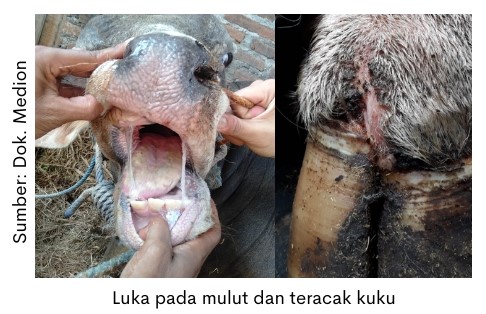
Transmission of FMD occurs through direct contact with sick livestock, indirectly through media that have been contaminated with the virus and through the air. The incubation period of FMD occurs for 2-14 days. Typical symptoms of FMD are the presence of sores in the mouth area and ruffled nails.
In addition, cattle will experience high fever, decreased appetite, hypersalivation, lameness, more often lie down and can also be found wounds on the nipples.
Handling FMD begins with separating sick livestock from healthy livestock. Then give Medipiron Injection to overcome the symptoms of fever, pain and inflammation and give multivitamins Injekvit B-Plex. Antibiotics may be prescribed (Lincomed LA or Tysinol).
In the case of dry skin and dry skin, it is recommended to use an antiseptic (Antisep) to accelerate healing. In addition spray Dicodine on the wound in the nail so that it dries quickly and prevents myasis.
Jembrana Disease
Jembrana disease is a viral disease that only affects Balinese cattle and causes a decrease in endurance. The disease is acute and not transmitted to humans. Cows that have recovered from Jembrana disease will be carrier (individual carrier). For more information about Jembrana disease, please refer to the livestock variety section (Page 18).