CPC. Denny Andryan – by email
What methods are performed in the examination of feces as early warning system on infection with worms? What are the parameters in the stool examination? Is treatment what else is done besides deworming if the worm infection is already severe?
Answer:
Thanks Denny for the question. Earlier we described at a glance the symptoms of chicken worms. Chickens infected with worms with a mild infection usually do not show specific clinical symptoms. Clinical symptoms that appear usually depend on the worms that attack and the degree of infection is quite heavy or the number of worms is large. When worms attack the digestive tract, which will appear usually in the form of diarrhea, while if the respiratory tract is attacked such as Syngamus trachealis then it will show symptoms of shortness of breath. Other symptoms that are not specific include decreased appetite, weakness, lethargy and pallor. In chicken feces infected with worms will usually show the presence of worms or worm segments in the feces but not all cases of worms will show it.
Apart from the examination of clinical symptoms, to detect intestinal worms and efforts to prevent intestinal worms, one of them is by laboratory tests through stool examination. As explained at the beginning, because in mild cases of worms, chickens may not yet show significant clinical symptoms. So that the sample needed for laboratory tests is a stool sample. Examination of feces is used to determine the presence of helminth infections in the body of livestock. This is also the basis for deworming for the long-term period ahead and for the accuracy of Drug Administration. This lab test for stool examination can be done at Medion Laboratories (MediLab).
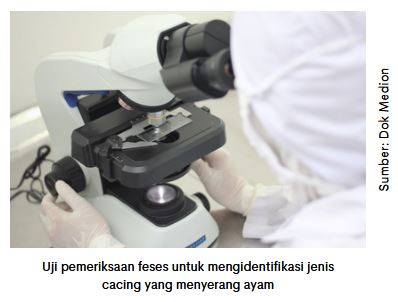
Stool examination methods there are many kinds of qualitative examination by native methods, sedimentation, and setrifugation, while quantitative examination by mac master. The Parameter of qualitative examination is the presence of worm eggs in the feces, worm eggs from each species of worms will be different so that from The Shape of the worm eggs we can identify the type of worm that infects, while the quantitative examination parameter is the number of worm eggs counted in one field of view.
When your chickens have worms, they need to be treated with anthelmintics. Treatment with anthelmintics should be carried out simultaneously in one cage with worms. In order for the handling of cases of worms can be more complete and optimal, anthelmintic administration techniques must be done properly include proper drug selection, proper dosage, and proper administration techniques.
Anthelmintic administration must also be precisely dosed, because it is only given in a single dose (one administration). Then related to anthelmintic administration techniques, deworming also requires a repetition process. The repetition can be adjusted according to the life cycle of the worm and the conditions of the cage. Gilik worms have a life cycle of 1-2 months, while tapeworms are about 1 month so giving anthelmintics is first recommended when the chicken is 1 month old. If chickens are kept in postal cages, anthelmintic feeding will need to be repeated after 1-2 months. Whereas if kept in a battery cage, repetition is done 3 months later because the chicken does not contact with litter.
In addition to anthelmintics, the administration of vitamins such as Vita Stress or Fortevit and such premixes Mix Plus can be done to increase endurance, complement the nutritional needs of chicken, and help repair intestinal damage (especially vitamin A which plays a role in repairing damaged villi-villi tissue and intestinal mucous membranes).
Other actions that you need to do are:
- Minimize contact between chickens with feces containing worm eggs through routine stool cleaning every 3 days.
- Prevent wet feces or damp husks.
- Exterminate flies and intermediate hosts (ants, beetles) that can become vectors of worms. To get rid of flies, use products Larvatox, Flytox, and Delatrin.
- Prevent things that can invite a lot of flies, such as broken eggs or dead chicken carcasses that are left alone, as well as clogged and rarely cleaned water drains.
- Sanitation and disinfection activities of the cage and the environment need to be carried out regularly. Perform a thorough cleaning of the cage then spray with a disinfectant such as Medisep or Zaldes.