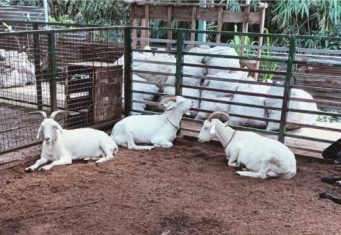
A good Cage is a comfortable cage for livestock as a place to live and carry out their survival. Good Cage management is one of the factors that support livestock to be able to produce well. The function of the cage for goats is :
- To protect livestock from predators and extreme environmental conditions (rain, heat, strong winds, etc.)
- A place for goats to be productive (live, mate, give birth, and produce meat)
- A place for goats to eat, drink and rest
- Prevent goats from damaging surrounding crops
- Where to care for sick cattle
- To facilitate the control of goat livestock
When going to make a cage it is necessary to take into account the following three factors (Ahmad Fanani, successful goat breeding book (2019)) :
- Biological factors
The sensitivity response of each type of goat to climate or weather conditions is a biological factor that needs to be considered. In goats that are sensitive to hot weather, it is necessary to design such a cage with good air circulation and does not cause uncomfortable conditions in goat livestock.
- Technical factors
Cages must be built using materials that are strong and durable in order to provide maximum functionality. The construction, materials and layout of the enclosure building must be carefully taken into account.
- Economic factors
The purpose of raising livestock is to provide economic value for the farmer. The manufacture of cages should also consider in terms of economy. Cages that are a fixed and long-term investment should be built using materials that are strong but not too expensive. The cost efficiency of cage construction also depends on the layout and design of the cage building scale capacity.
Types and models of goat cages
Basically, there are three models of goat cages that can be used, namely :
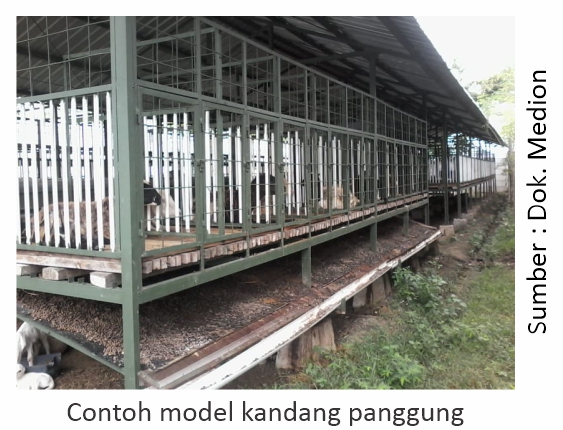
- Stage cage Model
Cage construction is made on stage, there is a hole to accommodate dirt. The pit is dug and made lower than the soil surface so that dirt and urine do not stagnate. The distance between the floor of the cage and the ground is at least 50-80 cm or 2 meters for large scale farms. The floor of the cage with a gap distance of the floor of the stage is 1.5-2 cm with the aim of dirt falling easily and the legs of the livestock are not mired. These cages are usually the most widely used on goat farms.
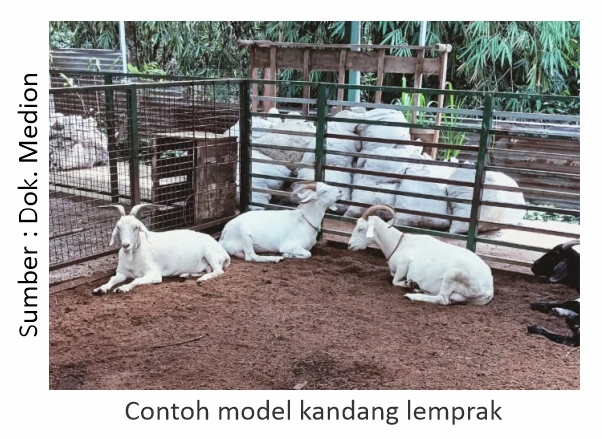
- Model cage lemprak
Cages with an earthen or cement floor and covered with straw or dry grass and the remains of forage feed. The disadvantage of this cage model is that cleanliness is difficult to control so that security from disease is less guaranteed. Feces or floor mats are usually transported after 3-6 months later. Can be modified by giving a bamboo or wood floor 5-10 cm thick as a base for cattle beds.
- Combination of stage cage and lemprak cage
Some cages are stage models and some have soil or cement floors. Usually used for breeding goat livestock.
Based on the number of goats in each plot, there are two types of goat cages, namely group cages and individual cages.
- Individual types
The type of cage that is given a baffle, usually enough 1 tail. The size of each cage is between 1.2 x 1.2 m to 1.2 x 1.5 m. The purpose of blocking is to limit the movement space of livestock so that the development of the body is expected to be achieved faster. The advantages of the individual cage system, such as comfort and health of livestock are better maintained, a more controlled maintenance system so that it can increase the rate of weight growth and make it easier for mutilation and evaluation.
- Colony/Group type
The size is relatively wide and made without insulation between goat herds. The area of the barn is adjusted to the age and number of goats kept.
Tata Laksana Perkandangan Ternak Goat
There are several things to consider in building a goat farm as follows :
- Location of the cage
- The ideal location is an area located far from residential areas but easily accessible by vehicle. The goal is to avoid the smell of goat manure that can disturb the surrounding community. The distance from the cattle pen to the settlement is at least 200 meters. While the distance between the cage and the breeder's residence is at least 10 meters so as not to be polluted by odors and dirt (regulation of the Minister of Agriculture No. 40 / Permentan/OT.140/7/2011).
- Peternak juga harus memilih lokasi yang berada pada wilayah yang bebas penyakit ternak, misalnya seperti Penyakit Mulut dan Kuku (PMK), yang berpotensi merugikan peternak.
- Mudah dijangkau sarana transportasi seperti muatan ternak, truk pakan hingga memudahkan proses pemasaran atau pengiriman ke rumah potong hewan.
- Lokasi dengan sumberdaya air dan cukup sinar matahari.
2. Struktur kandang
a. Atap kandang
Bahan atap yang sebaiknya dihindari yaitu seng. Bahan tersebut gampang menyerap panas dari permukaan dan menyebarkan panas tersebut di dalam kandang dan ketika hujan menjadi sangat berisik. Pilihlah bahan-bahan yang kuat dan tahan dari sengatan panas matahari dan tidak menimbulkan panas di dalam kandang. Disarankan untuk memilih genting dari tanah, selain harganya murah dan mudah didapatkan, juga tidak menyerap mudah panas.
Minimal jarak dari permukaan tanah hingga atap minimal 3 meter, dengan kemiringan 30°. Tujuannya agar sirkulasi udara di dalam kandang bisa berlangsung dengan baik, dan air hujan cepat turun hingga tidak menimbulkan genangan.
b. Dinding kandang
Dapat terbuat dari kayu, bambu atau tembok dan dibuat sesuai kondisi ternak yang dipelihara. Dinding kandang yang rapat sebaiknya dibuat setinggi 70-80 cm (sejajar tinggi penyekat) agar kambing terhindar dari angin kencang. Dinding tetap dibuat bercelah agar udara dan sinar matahari pagi dapat bebas masuk ke dalam kandang.
c. Lantai kandang
Lantai kandang harus cepat kering dan mudah dibersihkan. Celah pada lantai panggung dibuat kurang lebih 1,5-2 cm agar kotoran dapat jatuh kebawah, tetapi kaki kambing tidak sampai terperosok. Untuk lantai panggung, sebaiknya gunakan bahan kayu atau bambu bercelah atau bisa menggunakan slat bahan plastik yang aman.
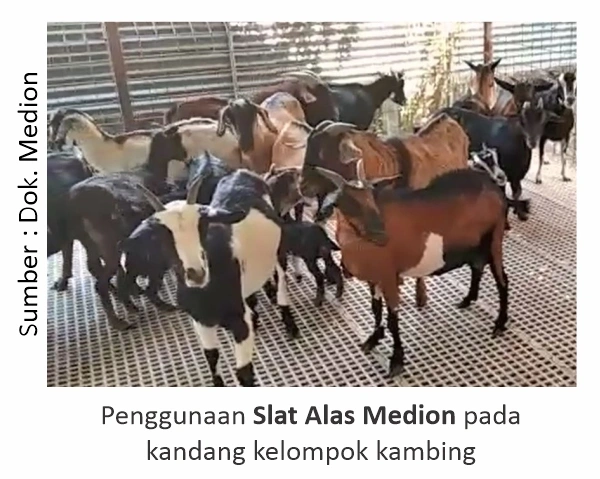
SLAT Alas Medion merupakan alas berbahan plastik yang multifungsi. Selain untuk alas kandang ayam juga dapat digunakan sebagai alas pada kandang panggung kambing. Fungsinya bisa menggantikan slat kayu/bambu pada kandang panggung/ untuk lantai kandang. Keunggulan SLAT Alas Medion among them :
- Desain sederhana sehingga mudah dalam instalasi (bongkar pasang dan perawatan)
- Mudah dibersihkan dan feses tidak akan menempel lama sehingga lebih higienis
- Konstruksi lebih kokoh karena desainnya yang tebal sehingga tidak mudah rapuh dan patah
- Tahan lama karena dari bahan baku murni dan berkualitas.
3. Tempat pakan dan minum
Tempat minum tidak mudah bocor dan harus mudah dibersihkan. Posisi tempat makan dan minum dibuat berdampingan. Ketinggian tempat pakan dan air minum harus proporsional dengan tinggi ternak kambing.
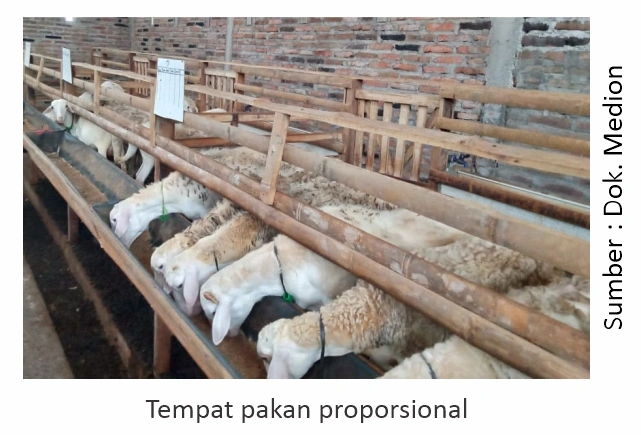
Tempat pakan harus dibuat kokoh agar bahan pakan yang diberikan tidak tercecer keluar. Ukuran alas tempat pakan 25-40 cm, lebar bagian atas 40-50 cm, sedangkan kedalaman tempat pakan 30-40 cm. Tempat pakan pada kandang ganda dapat dibuat di tengah kandang agar peternak lebih mudah memberikan pakan dan minum. Tempat minum berukuran lebih kecil dibandingkan dengan tempat pakan, yang disesuaikan dengan bentuk kandang kambing tersebut.
4. Penyediaan area pendukung lainnya
Area lainnya yang juga tidak kalah penting dan perlu ada seperti area penanganan ternak, area bongkar muat ternak, lokasi timbangan, kandang jepit, dan gudang pakan. Selain itu sebaiknya disediakan pula tempat umbaran dan tempat kotoran/kompos. Umbaran berfungsi sebagai lokasi exercise bagi ternak. Ternak kambing yang kesehariannya dipelihara dalam kandang perlu bermain di tempat umbaran secara teratur agar kesehatannya terjaga terutama untuk tujuan pembibitan.