Feed plays a big role in the success of poultry because it spends 70-85% of the total cost of maintenance. Appropriate nutrient composition of feed is needed so that the costs incurred by farmers are proportional to the production results obtained. In order to minimize costs and improve feed efficiency, modern chicken feed is now starting to be formulated with amino acid bases.
According To Walsh et al. (2013), of the 500 types of amino acids found in living organisms, 20 of them have been genetically coded. Of these 20 amino acids, 10 are classified as essential, that is, they cannot be synthesized by the body or are not produced quickly by the body for metabolic needs. Therefore, these essential amino acids need to be supplied through feed to support optimal poultry productivity.
The content of amino acids in poultry feed is important to know because it determines the quality of protein in it. Lysine and methionine as the first and second limiting amino acids are familiar to us and are widely supplemented in modern chicken feed. However, it is also necessary to know the role of other essential amino acids that turned out to play an important role to bring up the genetic potential of modern poultry is high.
Getting To Know Threonine
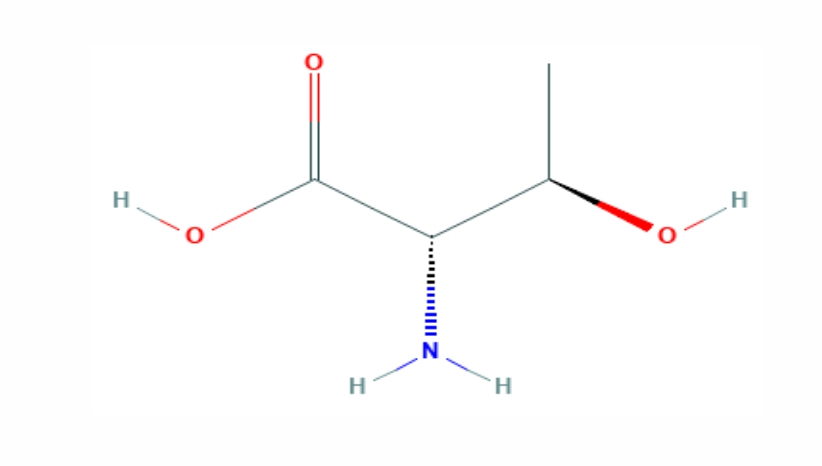
Threonine (C₄H₉NO₂) is the third limiting amino acid in corn and soybean meal-based poultry feed. Poultry cannot synthesize threonine, so the amino acid is essential for poultry. Therefore, commercial L-threonine is commonly added to poultry feed to balance the amino acid content in it. This amino acid is widely found in the liver, muscles, bones, central nervous system and intestinal mucosa in high concentrations (Figueiredo et al., 2012).
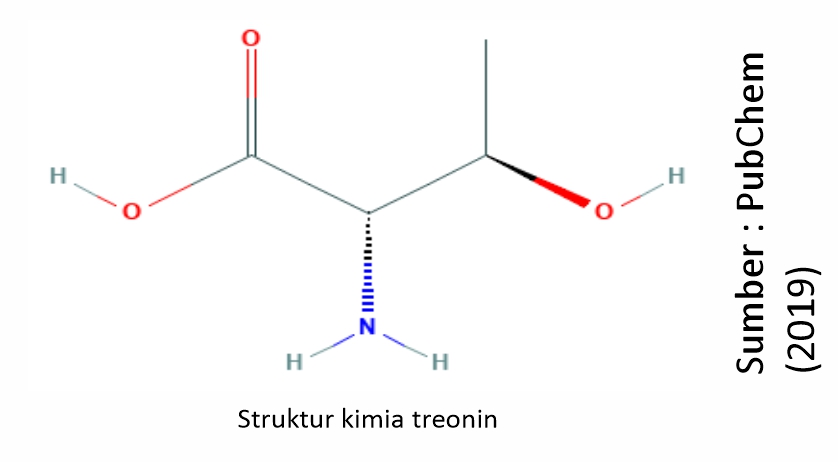
Threonine is important for poultry
Threonine plays an important role in protein synthesis and metabolism in the poultry body. The role will optimize the body's metabolism, so that the performance of poultry will be optimal. The other role of threonine on poultry performance is :
1. Digestive tract health
Threonine is one of the precursors for the formation of mucin (mucus) in the digestive tract. The Mucin will form a layer that protects the surface of the digestive tract from excess acid and pathogenic microbes, and filter incoming feed nutrients to be absorbed by the body (Debnath et al., 2018). Threonine can also keep mucin stuck to the surface of the digestive tract, so that the protection provided is more optimal (Saadatmand et al., 2019).
2. Improve feed digestibility
Threonine is able to stimulate the liver to produce more bile salts. Threonine can be converted to the amino acid glycine which is a precursor to the formation of bile salts. Bile salts function to emulsify feed fats so that they dissolve in water and can be digested by the enzyme lipase.
Bile salts can be formed from cholesterol, so as the production of bile salts increases, the amount of cholesterol in the body decreases. In addition, the conversion of threonine will produce pyruvic and propionic acids necessary for the formation of energy (Debnath et al., 2018).
3. Boost the immune system
Threonine is able to increase the immunity of chickens by :
- Optimizing the development of lymphoid organs, namely the bursa, thymus and spleen, so that antibody production is more optimal (Qaisrani et al., 2018).
- Being the main constituent component of plasma g-globulins (antibodies).
- Increases the level of IgG in the serum, the level of IgG and IgA in the mucosa of the small intestine and preserves the memory of the immune response for a long time (Abbasi et al., 2014).
- Inhibits apoptosis (cell death) and stimulates the multiplication of lymphocyte cells to fight viruses, bacteria and fungi (Debnath et al., 2018).
4. Antistress
In general, normal cellular metabolism produces free radicals or Reactive Oxygen Species (ROS). High ambient temperatures can increase ROS production and cause cells to experience oxidative stress. To counteract the effects of ROS, the body naturally produces antioxidant enzymes.
Threonine plays a role in increasing the concentration and activity of antioxidant enzymes, namely malondialdehyde (MDA), superoxide dismutase (SOD) and glutathione peroxidase (GSH-Px) dan copper-zinc superoxide in order to ward off these free radicals (Li et al., 2019). This ability is because threonine is an amino acid that can bring copper (copper) in the blood (Debnath et al., 2019).
Percentage of threonine in poultry ration
Poultry amino acid requirements are influenced by various factors, including ration, environment, genetics and production performance. Chicken broiler and layer modern has the genetic potential to produce high and maintained in a volatile environment in Indonesia.
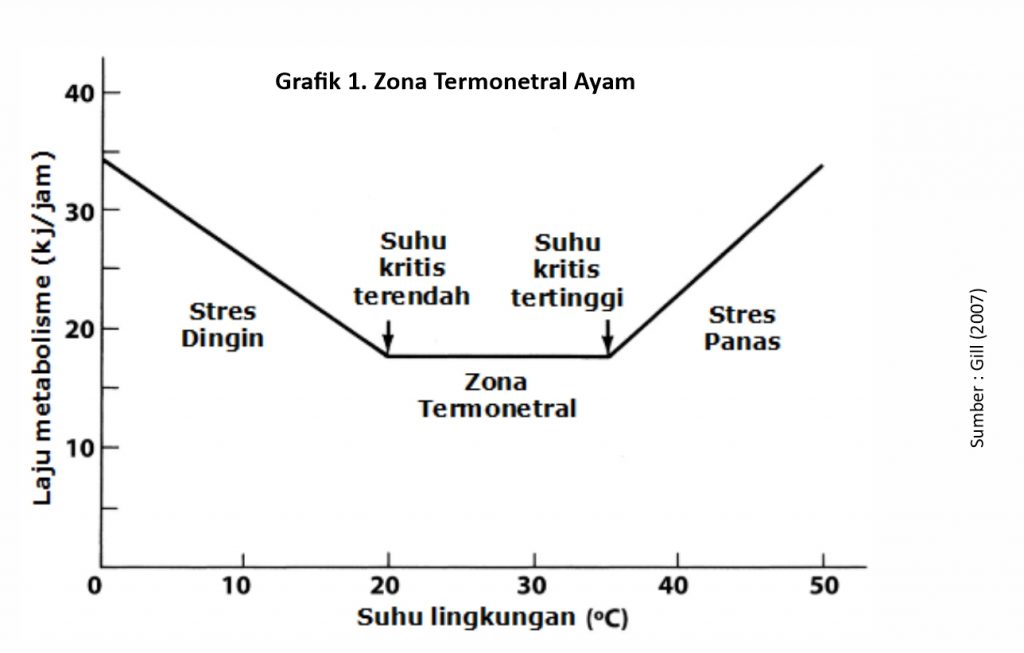
Meanwhile, the recommended amino acid ration of National Research Council or NRC (1994) is only suitable to be applied to the thermonetral environment (Graph 1.), a condition in which chickens are able to maintain their body temperature constantly without metabolizing excess heat.
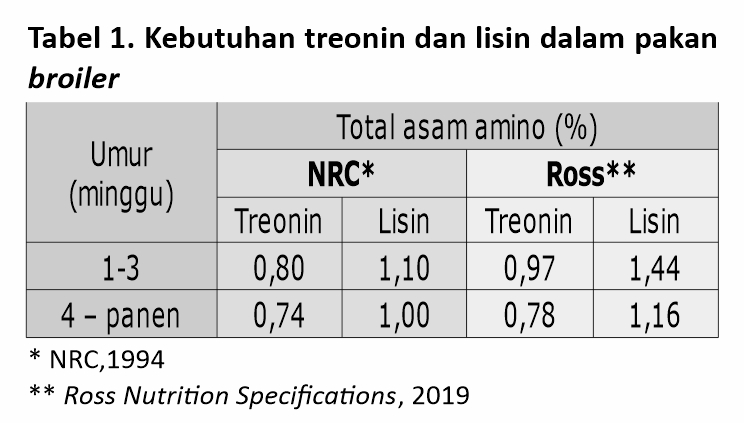
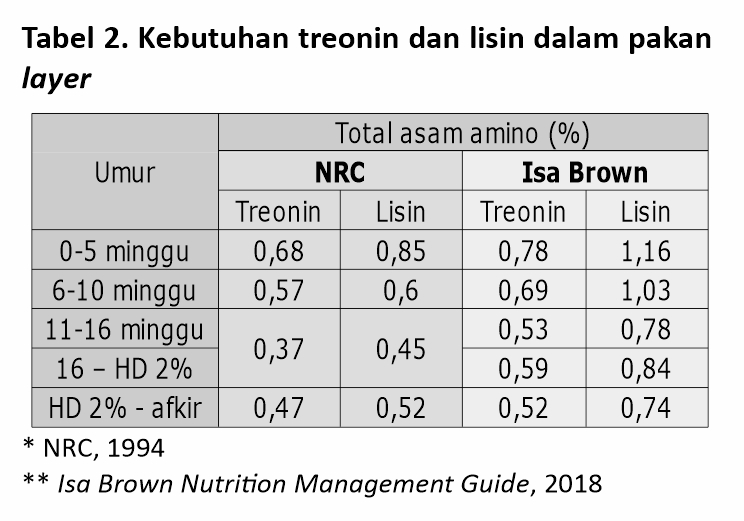
Therefore, today commercial poultry rations contain amino acid ratios higher than the NRC recommendations. As the third limiting amino acid, threonine supplementation in feed is inseparable from its balance with lysine.
This is because lysine is directly used by the body to maintenance (treatment), is not used as a constituent of other compounds and can avoid imbalance between amino acids that can have an antagonistic effect and be toxic to poultry.
Effects of threonine on chicken performance
In general, supplementation of amino acids in the feed aims to complement the nutritional needs of the ration and support optimal poultry productivity. Here are some research results that show the effect of threonine supplementation on chicken performance broiler and layer :
1. Feed consumption, weight and FCR
Debnath Research et al. (2018) showed threonine supplementation at levels 100%, 110%, 120% and 130% of the recommendations broiler strain Vancobb 400 it is still safe and proven to provide the effect of feed consumption and increased weight gain and more efficient FCR. These results also prove threonine supplementation above NRC recommendations (1994) can produce more optimal performance.
Increased feed consumption along with increased levels of threonine administration occurs because threonine is able to balance the amino acid profile in the blood. In general, the brain's mechanism of regulating appetite depends on blood amino acids, where unbalanced levels can reduce appetite (Debnath et al., 2018).
Threonine is also able to stimulate the thyroid gland to produce more thyroxine hormone, so that the metabolic rate increases and feed consumption will increase as well (Al-Hayani, 2017). Meanwhile, increased weight gain occurs because threonine plays an important role in protein synthesis, muscle protein deposition and synergizes with calcium and phosphorus in the formation of bone tissue. Results show threonine supplementation 110% of recommendations Vencobb 400 produce the most optimal feed consumption, weight gain and FCR.
2. Egg production
Threonine supplementation has been shown to improve the performance of chickens layer. Wareth et al. (2014) proved that supplementation of threonine as much as 0.2% and 0.4% in basal feed (PK 18.2%) chickens layer age 68-72 weeks able to increase the percentage (%) hen day, egg weight and egg mass.
Threonine is an important component of the protein composition of the gastrointestinal tract (up to 30%), so it is able to maintain the health of the gastrointestinal tract and the digestibility of the feed increases. In addition, threonine was able to increase the height of the villi, epithelial cell thickness and the number of mucus-producing goblet cells in the digestive tract of chickens (Azzam et al., 2013). With the increased function of the digestive tract, the productivity of chickens layer will also be optimal.
However, excess threonine in the feed was able to inhibit the growth of livestock. According To Kidd et al. (1996) one of the contributing factors is the imbalance between threonine and methionine in the formulation, resulting in enzyme activity threoinine dehydratase increases and much is oxidized threonine. Based on the results of these studies, supplementation of 0.40% threonine in the ration resulted in the most optimal performance of egg products.
3. Egg quality
Besides being able to increase egg production, threonine also affects the quality of eggs. Still in the same research as before, Wareth et al. (2014) proved that threonine supplementation is able to increase the score Haugh Unit And scrambled eggs.
4. Immune system
The immune system of chickens is increased by threonine supplementation. Azzam et al. (2011) proved that supplementation of threonine as much as 0.1%; 0.2% and 0.3% in chicken feed layer (PK 16.4%) was able to increase the concentration of antibodies in chicken blood serum.
IgG is the main systemic antibody in poultry that plays an active role in fighting infection. The increased concentration of IgG occurs because threonine is the main component of the g-globulin or antibody. Meanwhile, IgM acts as an antigen receptor and IgA functions to prevent the attachment of infectious agents on the body surface. With the increase in the concentration of these antibodies, the chicken's immune system increases and is more resistant to infection.
Thus, at a glance, information about threonine, the third limiting amino acid in poultry rations. Hopefully it can add to our vision. Greetings.