Bapak Arief Faizal Listyawan – by email
When the chicken layer already indicated Coryza disease, what next steps should be given? Giving antibiotics first or directly vaccinating?
Answer:
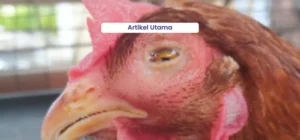
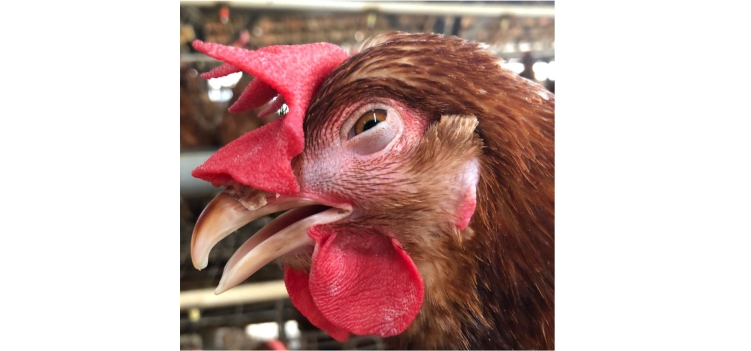
Thank you Mr. Arief for the question submitted. When the chicken has indicated clinical symptoms of Coryza, such as sluggish chicken, no appetite, lazy to move, began to sound snoring, and seen in the area of his face began to swell the isolation by putting the sick chicken into a separate battery cage (different paralon or drinking water lines) to be treated. This separation aims to provide more appropriate and equitable treatment and avoid the transmission of Coryza bacteria that can spread quickly through water media, for example through a paralytic pathway. When the Coryza case strikes again, it can arise due to the uneven treatment effect (there are chickens that have recovered, but there are also chickens that only “look” cured or have not completely recovered). So when conditions are not optimal, chickens that” look " cured will relapse.
The principle of treatment in the case of Coryza is based on the severity of the indicated clinical symptoms. We can group them into mild, moderate and severe cases. Mild to moderate cases we can provide treatment through drinking water using the right antibiotics.
Avibacterium paragallinarum the cause of Coryza is Gram-negative bacteria ( - ) that can
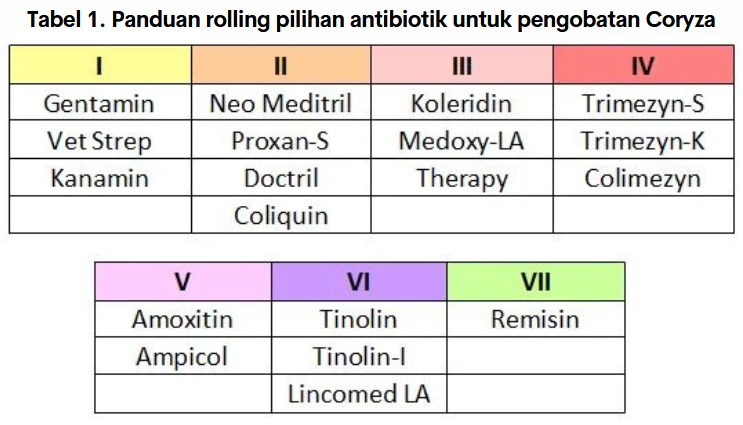
eradicated using various types of antibiotics. However, the selected antibiotic should have good absorption in the digestive tract so that it can be optimally distributed to the target organ, namely the infraorbital sinus. Antibiotics that can be used are groups of fluoroquinolones, tetracyclines and penicillins such as Tinolin, Remisin, or Neo Meditril. In the principle of correct treatment, do rolling antibiotics to prevent resistance.
Chickens with severe symptoms such as swelling in the infraorbital sinus area so that the eyes close and are unable to reach the drinking place, give injection drugs such as Vet Strep or Lincomed LA. Supportive herbs Respitoran it can also be given to accelerate healing. This herb is able to shed mucus accumulated due to Coryza infection and minimize inflammation so that the condition of the chicken will soon recover. This Coryza treatment must be done correctly and thoroughly to prevent chickens that have recovered but can still act as carrier (carrier).
Take multivitamins, such as Injekvit B-Plex or Fortevit to help restore stamina, repair nasal sinus membranes that are inflamed, and stimulate the appetite of chickens. When chickens are attacked by Coryza, their appetite decreases, causing impaired productivity.
If the case occurs in chickens layer before the age of production, after the treatment is completed, vaccination can be done so that the formation of antibodies can be optimal and provide protection during the production period. Vaccination Program to prevent Coryza disease in chickens layer done at least 2x before the production period. Vaccinations can use Medivac Coryza T Chito or Medivac Coryza T Suspension.
Control of this disease requires a combination of maintenance management and biosecurity which should also be increased. Also perform maintenance management improvements, giving multivitamins such as Fortevit or immunostimulants such as Imustim to increase the body's resistance. Spray the cage every day, wash and sanitize the feed and drinking place every 3-4 days, and disinfect drinking water with class disinfectants quaternary ammonium (QUATS)Medisep/Zaldes) so that the population of the causative agent of Coryza is reduced and the sanitation of drinking water by Desinsep to reduce the spread of Coryza disease via drinking water. Starting from an empty cage is optimal at least 2 weeks after the cage is cleaned and disinfected. Re-check the smooth circulation of air and setting open and close the curtains more routinely done.