Email : sapij0745@gmail.com
What are the causes of chicken broiler remove calcareous stools and green color over the age of 18 days?
Answer:
Thank you for the submitted question. The condition of chicken feces that are sick can experience changes in consistency and color. Normally, chicken feces will be solid greenish or brownish with a white part covered with uric acid at the top. The condition of calcareous feces and green color can be caused by several diseases. To determine the exact diagnosis of the disease, additional information such as Anamnesis and clinical symptoms is required. Surgical examination of the carcass (necropsy) also needs to be done to see changes in the anatomy of the organ.
The case of defecation in chickens is caused by diseases such as Salmonellosis (pullorum), but there are also other diseases that have clinical symptoms of defecation, namely Gumboro disease. While the condition of green stools can be caused by cholera. Salmonellosis (pullorum) and cholera are caused by bacterial agents and can be acute systemic in nature.
Salmonellosis (pullorum) is a disease caused by Salmonella pullorum. S. pullorum it is a Gram-negative bacterium, non-motile, facultative anaerobic, and does not form spores. These bacteria can live along the digestive tract, spleen, gallbladder and ovaries.
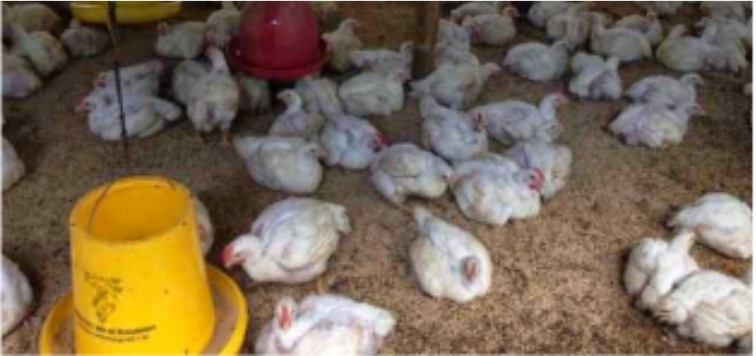
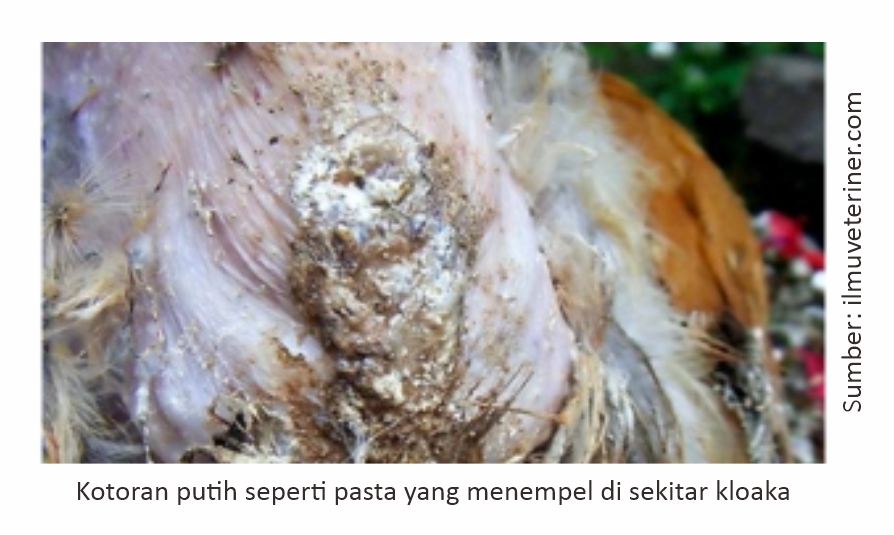
Disease of pullorum often attacks on Chicks and can lead to death. This disease has symptoms such as loss of appetite, lethargy, clustering in one place, there are white stools like paste, as well as general weakness. Chicks that have recovered will experience drastic growth disorders, stunted weight gain and feather growth disorders.
The next disease that causes green poop is acute cholera. Cholera is caused by Pasteurella multocida which belongs to Gram-negative bacteria, non-motile, does not form spores and can grow aerobically and anaerobically. These bacteria are resistant to living in the soil, litter or materials that rot for several months.
Symptoms seen in chickens suffering from acute cholera are lethargy, fever, anorexia, mucous discharge from the mouth and diarrhea. Discoloration of the stool can also occur from initially whitish and watery to greenish and watery. Cyanosis or bluish-purple discoloration of the skin on Combs and wattles sometimes appears shortly before the chicken dies.
Treatment that can be done for the disease pullorum and cholera with the administration of one of the antibiotics such as Therapy (0.2 grams / kg BB, mix drinking water for 5-7 days), Sulfamix (1.2 ml / kg bw, mix drinking water for 5 days), or Neo Meditril (0.1 ml / kg BB, mix drinking water for 3-5 days). Also give multivitamins Vita Stress (1 gram / 2 L of drinking water) after administration of the drug to restore the health of chickens.
Prevention efforts should be done so as not to occur pullorum disease and cholera. Perform routine cage sanitation, prevent guests and wild animals from entering the cage environment, and routine disinfection with Medisep for livestock equipment. Control of disease vectors such as mice and flies also needs to be done. Larvatox or Flytox can be given to minimize the population of flies around the cage.