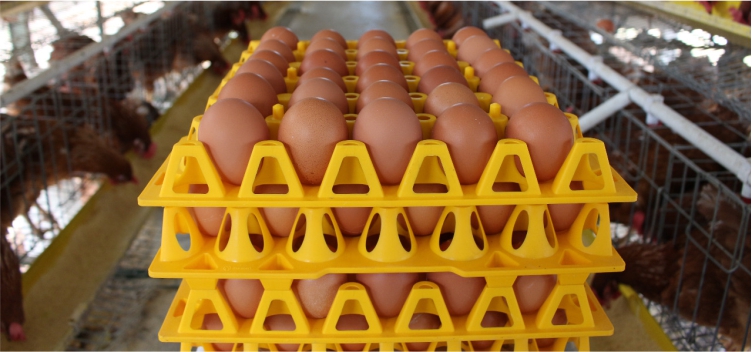
Eggs are the main product of laying hens. Number of eggs (hen day, red), the quality of eggs is also the main concern of breeders. The weight of the egg, the color and the thickness of the Shell are parameters that indicate the quality of the egg.
Eggs produced from cages, there are sold based on the number of units (grains) and weighing weight (kg). But in Indonesia, more farmers sell eggs by weight. Therefore, many farmers focus on increasing the weight of the eggs so that the profit is higher.
Structure and composition of eggs
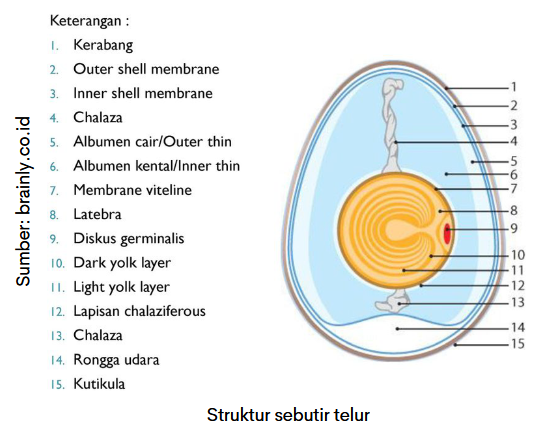
An egg consists of several parts, ranging from shellfish, egg white, yolk and air cavity. In detail, the structure of the egg is listed in the following figure below.
Eggs are composed of several nutritional components, ranging from carbohydrates, proteins, fats and minerals and water. Therefore, in order for the eggs to be formed optimally, the chicken must get a supply of nutrients, both from ration and drinking water in the amount and quality that suits the needs of chickens. Table 1 shows the composition of an egg.
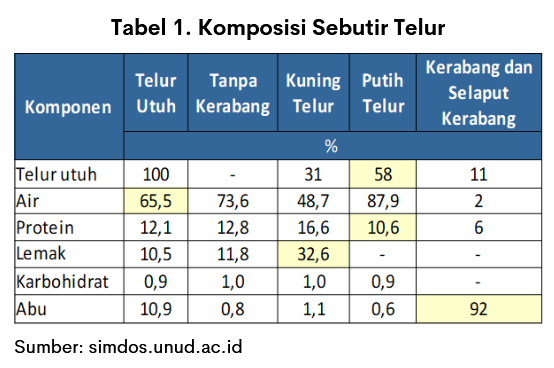
The largest share of an egg is egg white (58%), then yolk (31%) and shellfish (11%). Knowing the composition of the egg is very important so that we are able to provide the right treatment when there is a problem of egg production and egg weight.
Water is the largest nutritional component that is vital for the formation of eggs. This is because 65% of the constituents of eggs are water. As for proteins, fats and ash (mineral) contribute 11-12%. The yolk part is made up of 48% water and then fat (32.5%). In other words, if we want the size of the yolk to increase then we need to add a higher supply of fat in the ration.
Similarly to the yolk, water is the most component that makes up the egg white reaches 87%, then the second component is protein (11%). Protein contained in the ration, especially amino acids will improve the quality of egg whites, especially from the level of viscosity of egg whites. Addition of amino acids, such as methionine, lysine and threonine, as contained in Mix Plus will help improve the quality of egg whites.
Ash (mineral) becomes a dispersed component that makes up the eggshell, which reaches 93.5%. And it turns out that egg shells are also composed of protein (4.5%), namely in the membrane of the shellfish which is rich in protein-cystein.
Our understanding of the structure and composition of these eggs will help in the identification of egg quality problems. Please note the analysis of the parts we need to improve (improve, red) so that the quality of the eggs is getting better. Even so, when we have a problem with the weight of the egg, then we can sort the analysis of the problem. It can be known that this is due to the egg white being the largest part of the problem, or due to the thin shell of the egg.
Increase Egg Weight
The weight and size of the eggs will increase in line with the increasing age of the chicken. The optimal egg weight is in the range of 62.5 grams per egg or 1 kg containing 16 eggs. To achieve this optimal egg weight, it becomes mandatory to consider the first is the level of consumption of drinking water. Remember, water is the largest component of an egg.
Drinking water should be available in optimal quantities and quality, especially during hot weather (heat stress). Drinking water should always be checked. The amount of drinking water consumption is often not a control in the maintenance record (recording, red). Except for farms that have added water meter (water meter, red), as in closed house. Ration consumption patterns were strongly influenced by the consumption of drinking water. When certain conditions, drinking water consumption can increase dramatically, and this condition will result in decreased ration consumption. This is especially true when conditions heat stress.
In addition to drinking water, factors that affect the weight of eggs include :
1. Strain chicken
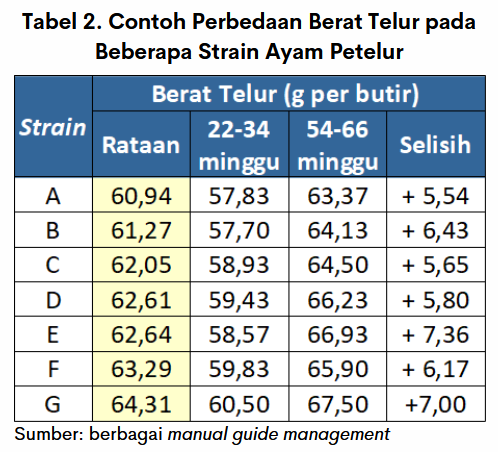
ISA Brown, Lohmann Brown, Hisex Brown, Hyline Brown dan Novogen Brown merupakan 5 strains laying hens used by farmers in Indonesia. Fifth strains these laying hens have the ability to produce different eggs. In detail this can be seen from manual management guide. Nevertheless, environmental conditions and maintenance management greatly influence the achievement of this egg weight. It would be better, we analyze the data recording owned by each farm. Could be a more suitable area to use strains Lohmann Brown, but in other areas more appropriate maintain strains It is Brown. And this can be checked with egg production data (hen day) and the egg weight of each strains. Table 2 shows an example of the difference strains chickens will produce different egg weights.
2. Early age of production
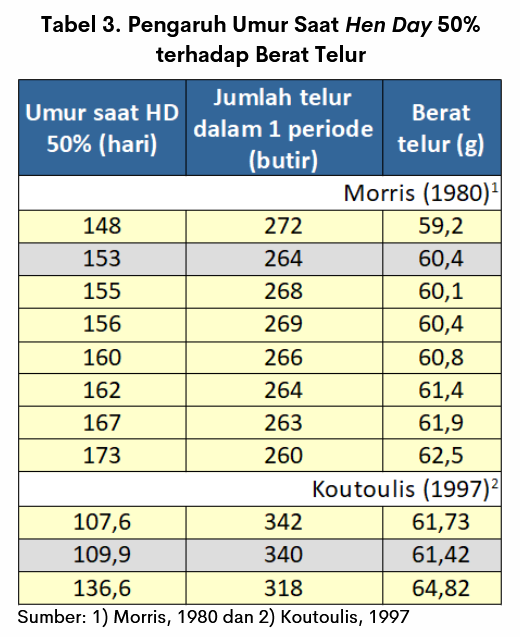
In general, ISA Brown said that the age of the beginning of production that retreated 1 Week will cause the weight of the egg to increase by 1 gram. For example, when the beginning of laying eggs aged 18 weeks ISA Brown egg weight is 42.3 grams/grain and if the beginning of production retreated to 19 weeks then the weight of the egg will be heavier, reaching 43.3 grams/grain. And age when it reaches hen day 50% is also very influential on the weight of eggs (Table 3).
3. Weight loss
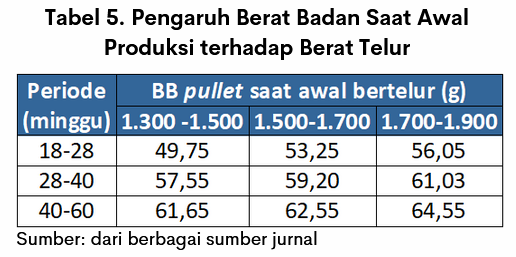
Weight loss will affect the weight and size of eggs produced. This weight loss starts from the phase starter until the beginning of egg production.
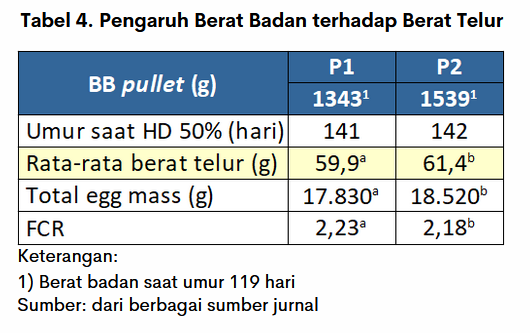
A small weight will result in eggs of small size and light weight (Tables 4 and 5). ISA Brown concluded that a difference of 80 grams of body weight at the start of production would increase the weight of the egg by 1 gram.
4. Oil addition
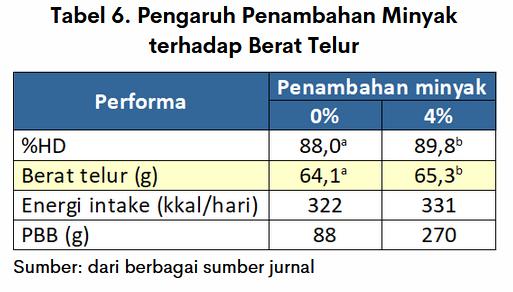
Oil is an energy source raw material. The added oil in addition to increasing energy also plays a role in improving the palatability (taste preferences) rations because it lowers the level of dusty rations. The oil can also increase the supply of linoleic acid, which can increase the size and weight of eggs. Sources of oil that can be used include coconut oil, palm oil, soybean oil and fish oil. Addition of oil when conditions heat stress very well done, considering the energy produced from oil is safer when hot conditions. Because oil produces heat increment (body heat) is lower than other energy sources, so it does not add heat stress on the chicken. Table 6 shows the addition of 4% Oil will increase the weight of the egg significantly.
5. Amino acids
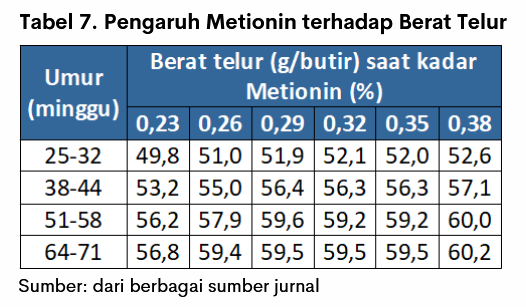
Amino acids is the main component that makes up the egg white. Methionine, lysine, threonine, isoleucine, tryptophan and valine are examples of some amino acids that affect egg weight. Table 7 shows the reduction of the amino acid content (methionine) will lead to a decrease in egg weight.
In addition to methionine, the addition of threonine in the ration will also increase egg production and weight (Table 8). Mix Plus LLM3A is one example premix which contains amino acids.
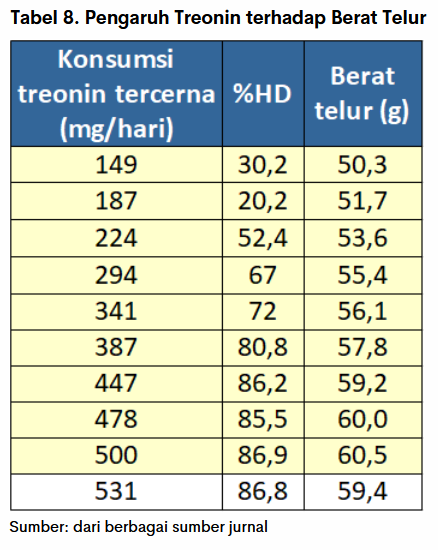
Its use will help increase egg production and weight. For the concentrate ration, the addition of Mix Plus LLM3A by 2-5 kg will increase the weight of eggs. As for the ration self mixing dosage Mix Plus LLM3A is 15 kg per ton. However, if necessary, the dose can be increased to help improve egg weight and quality.
6. Dosage form of ration
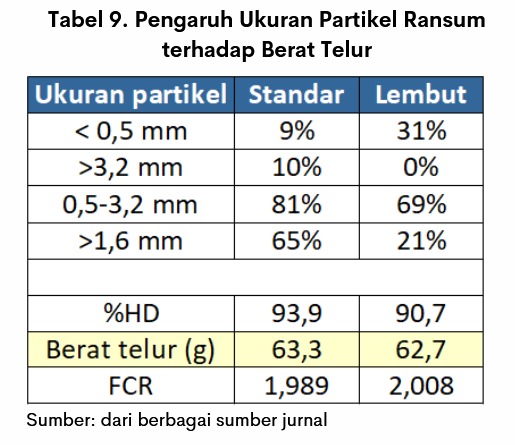
Too soft ration particle size will cause feed intake, egg production and egg weight decreased (Table 9).
The optimal weight of eggs is an important parameter for achieving the performance of laying hens. Understanding the structure and composition of the egg, then connected with the factors that determine the weight of the egg will be an important capital in order to be able to produce eggs with optimal weight. Thus, I hope this article is useful. Greetings.