Andriansyah
Karang Baru-Central Java
How to deal with worms in chickens pullet?
Answer :
Poultry at the beginning of time pullet (<12 minggu), biasanya sebagian besar kasus cacingan didominasi oleh infeksi cacing gilig. Hal ini terutama terjadi pada ayam yang dipelihara dalam kandang postal karena terjadi kontak antara ayam sehat dengan litter contaminated feces that may contain worm eggs. So, if in the cage, there are chickens that have been infected with worms, then quickly the infection can be transmitted to other chickens. While before adulthood and throughout the production period (age > 12 weeks), when the chicken pullet already occupying the battery cage, generally the one that infects is the tapeworm. This is related to the presence of intermediate hosts that develop a lot along with the condition of feces that start a lot, accumulate under the cage, wet and damp, making it possible for contamination of the ration by the host through flies or ants.
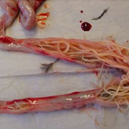
Convex worms are worms that are round and long like threads. During its life, the gilig worm goes through 3 stages of development including eggs, larvae and adult worms. The life cycle of this gilig worm does not need intermediate hosts or vectors, so its transmission occurs only through rations, drinking water, litter/ husks or other material contaminated by feces containing infective eggs (containing embryos of larvae ready to develop) of gilig worms. While tapeworms are flat, ribbon-shaped, white, and segmented worms. These worms infect chickens through intermediate hosts / vectors such as house flies (Musca domestica), ants, and beetles. The prepatented period of the gilig worm lasts between 21-56 days, while that of the tapeworm is 14-21 days. The prepaten period is the time span between the entry of infective eggs into the chicken's body until the release of new worm eggs produced by adult worms from the chicken's body into the external environment. On this basis, if chickens are kept in postal or non-slat cages, repeated deworming is carried out every 21-56 days or about 1-2 months. Whereas if the chickens are kept in battery cages / slat repetition can be done every 3 months because the chicken does not contact the litter.

To control the disease of worms, the strategy is to give deworming in the first 1 month before moving the cage, then repeated every few months. Drugs that can be given to eradicate gilig worms can use Vermixon Sirop with the application of passing drinking water. At the time of application by drinking water, chickens should be fasted 2 hours before Administration. It is intended that the chicken can drink directly at the time given Vermixon Sirop it is mixed into drinking water. To eradicate the tapeworm Levamid with application is mixed into the ration. Before mixing Levamid in the ration, the father must take into account in advance the amount of needs Levamid population of chickens on the farm. Mixing Levamid in the ration can be done gradually, namely mix Levamid and rations in small quantities to evenly distribute. From the mixing is then mixed with a larger amount of ration.

It's good to do a routine stool examination in MediLab (Medion laboratory) so that when the presence of worm eggs in the stool can be detected early. This is the basis for whether or not deworming is necessary.
One more thing that is also important in controlling worms on farms is the control of hosts / vectors such as flies (with products Flytox) and ants (with insecticides). If the father is able to control this host, then the period of repetition of deworming during the production period can be longer/longer.