Along with the increasing need for animal protein, one of them is Eggs, making poultry farming commodities in Indonesia growing rapidly. Based on the statistical data center from the Director General of Animal Husbandry and Animal Health, there has been an increase in the number of laying hen populations of around 6.25% from 2020 to 2021 in Indonesia (Ministry of Agriculture, 2022). It can be concluded that the business prospects of laying hens are still promising.
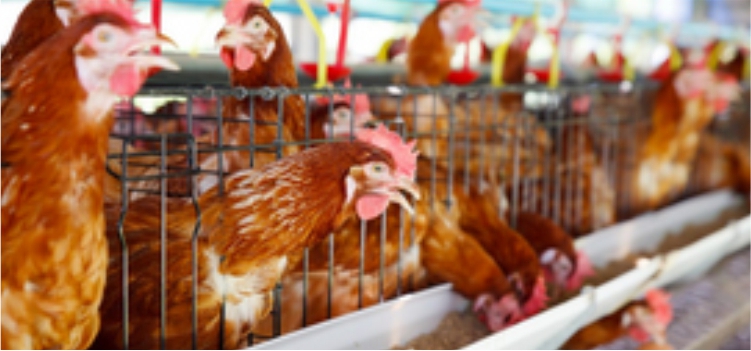
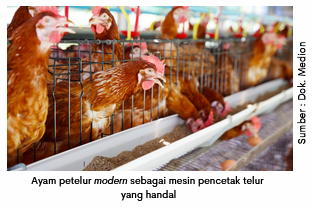
Poultry layer or laying is a reliable Egg printing machine and can be cultivated until the age of >90 weeks. Through genetic engineering, laying hens modern currently, it has better potential such as being able to produce large quantities of eggs, achieve peak persistence of long egg production and have good ration efficiency.
Genetic development of laying hens modern very spectacular indeed. If followed by the implementation of appropriate maintenance procedures, then one chicken is capable of producing at least about 450 eggs per hen house 90 weeks of production. The weight of the eggs was also greater, which had ranged from 56-62 grams per grain to 60-65 grams per grain. This certainly makes people more tempted by the profits generated through the cultivation of laying hens modern.
Problems Of Raising Chickens Layer
Behind some of the advantages of laying hens modern it still has the disadvantage of being more sensitive to changes in weather or other environmental conditions. Various challenges in the cultivation of laying hens are also very varied and must be prepared to be faced by farmers, especially the challenge of a disease. Here's the data survey data collected by the TEC Medion team from the last three years to the present on cases of the disease in laying hens nationwide (Graph 1).
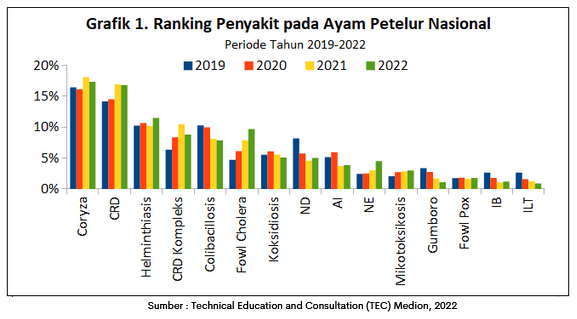
Based on Graph 1 Above, the high incidence of disease cases in laying hens caused by bacteria, viruses or other infectious agents is still a scourge among farmers. So this increases the vigilance of farmers related to the threat of disease seeds that lurk their farms. As well as we know that diseases caused by bacteria or parasites have found a cure. In contrast to diseases caused by viruses for which no cure has yet been found. Therefore, control measures of cases of diseases caused by viruses are pursued only in appropriate preventive measures and assisted by supportive provision and good management practices.
Preventive measures in the control of cases of disease by the virus include combining the application of biosecurity and the proper vaccination program. In addition to this, it is also recommended to monitor (monitor) on the health status of chickens through routine serological testing.
Methods Sampling and serological tests
Serology test is defined as a test performed to see a picture of antibody titers in the body of chickens. This test technique uses blood serum as a sample, as it contains antibodies (humoral antibodies).
Ideally, the number of blood samples that can be taken each time the test is 0.5% of the total population or at least at least 15-20 samples per cage. Sampling was carried out randomly throughout the cage. There are several types of methods used in serology tests, some of which are as follows :
- Haemagglutination Inhibition test (HI tes)
- Enzyme-linked Immunosorbent Assay (ELISA)
- Serum Plate Agglutination test (SPAT)
- Agar Gel Precipitation test (AGPT))
- Serum Neutralization test (SNT)
Serological tests that are most often the choice for farmers are ELISA and HI methods test. Serological testing using the ELISA method in MediLab can be used to monitor the status of antibody titers against diseases such as :
- Infectious Bursal Disease (IBD) / Gumboro
- Infectious Bronchitis (IB) virus of
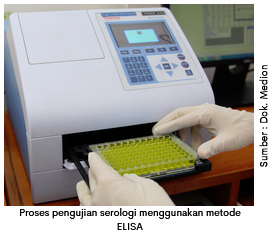
As for serological testing using HI methods test at MediLab it can be used to monitor the antibody titer status against several diseases such as :
- Avian Influenza (AI)
- Newcastle Disease (ND)
- Egg Drop Syndrome (EDS)
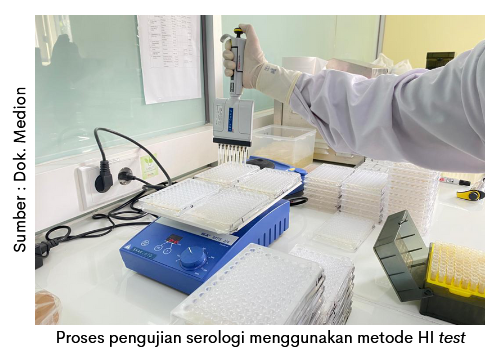
Being aware of the importance of serological tests for farmers, Medion presents laboratories, namely MediLab which also provides serology testing services, both HI method test and Elisha. Some types of diseases that are often tested include AI, ND and IB. The disease is often monitored until the production period because the disease can have an impact on losses due to decreased productivity of laying hens.
MediLab has a variety of advantages such as accurate and fast testing process, using advanced technology facilities, and complete with interpretation of the results. Not only laboratory test results, MediLab also provide interpretation of test results as well as advice and follow-up treatment of disease cases.
Purpose and benefits of serological tests
In general, the purpose and benefits of serological testing is to monitor (monitor) health status and to help confirm the diagnosis. Monitoring health status is synonymous with prevention efforts. Monitoring consistent and thorough livestock health will support an efficient and effective rearing program. Monitoring these include determining the first Gumboro vaccination schedule, determining the time of revaccination, knowing the success of vaccination, and as early warning system. Benefits that are no less important is to help confirm the diagnosis related to handling actions taken when a case occurs. Here's an explanation of each of the benefits of serology tests :
- Determination of the first Gumboro vaccination schedule
Measurement of maternal antibodies through serological tests is often done to determine the first Gumboro vaccination schedule or in young chickens. Thus, it will be predicted that the maternal antibody titer will decrease so that it can be estimated the right time for the first Gumboro vaccination using the active Gumboro vaccine (conventional live vaccine). The critical point when sampling in this case is that the sampling should be carried out on Chicks aged 0-4 days and the number of samples should be at least 18-20 pieces per cage. In addition to the determination of the first vaccination Gumboro, serological testing can also be done using HI test to measure the level of maternal chicken antibodies as database baseline titer.
- Seeing the success of vaccination
To see the success of vaccination can be done by doing serological testing using chicken blood samples to measure the formation of humoral antibodies (antibodies circulating in the blood). This serological test can be done 2-3 weeks post when a vaccine is used, it is an active vaccine.)live vaccine) or 3-4 weeks post a vaccine is a type of vaccine that is inactivated (killed vaccine). Measurement of humoral antibodies will provide a representative picture, if done on chickens that have had a perfect humoral immune formation system that is > 5 weeks old. The results of this study are based on the results of a randomized, randomized, randomized, randomized, randomized, randomized, randomized, randomized, randomized, randomized, randomized, randomized, randomized, randomized (Geometric Mean Titer( % ) and ( % ) is invulnerable and has a value of ( % ) CV (Coefficient of Variation) which is good.
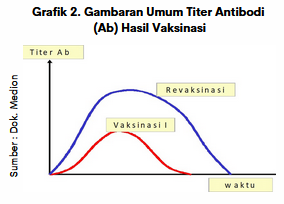
Based on graph 2 above, it can be noted that the results of the first vaccination still show a picture of a lower antibody titer. It can be concluded that the result of the first vaccination is priming or the initial introduction between the antibodies present in the chicken's body and the antigens derived from the vaccine. Then the body will respond by forming cells memory which serves to remember antigens from vaccines that have entered the body. So that when revaccination with the same antigen is done, the body will respond faster in forming antibodies that are inseparable from the role of cells memory that led to higher results.
- Determination of revaccination time (repeat vaccination)
Routine titer monitoring through serological tests, especially during production can be done every 1-2 months. Protective antibody titer picture will continue to be monitored and can be estimated the right time for chickens to be vaccinated again. This is so that the timing of vaccination can be scheduled before the antibody titer is below the protective level. The following is an example of a pattern chart of the results of routine monitoring of antibody titer and immune % in laying hens:
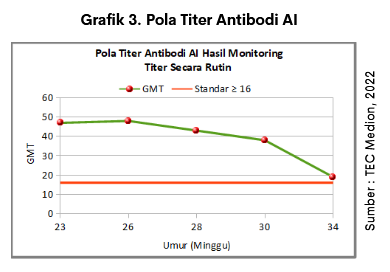
Based on graph 3 above shows that the titer pattern AI antibodies from age 23 weeks to age 34 weeks have a decreasing pattern and at age 34 weeks, the titer antibodies are still at a level slightly above the standard.
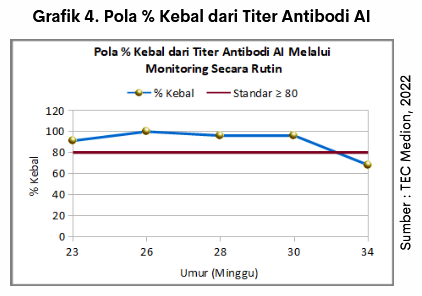
While graph 4 about the pattern of % immune from AI antibody titer also has a pattern of decreasing from age 23 weeks to 34 weeks. However, we need to note that the % immune at 34 weeks of age is already below the standard even though the antibody titer is still slightly above the standard, it can be concluded that chickens need to be revaccinated. This aims to keep the antibody titer can rise and be at a protective level.
- Helps to diagnose the disease
Some types of diseases, especially those caused by viruses such as Newcastle Disease (ND), Avian Influenza (AI) and Infectious Bronchitis (IB) is sometimes difficult to distinguish when it does not show symptoms or changes in typical anatomical pathology. In these conditions, serological tests can be performed to assist in directing the diagnosis. To be able to analyze the interpretation of the results of this serological test, it is necessary to support data such as chicken performance both mortality and production and vaccination history. Some indications that can be concluded from the test results are as follows :
- Have never been vaccinated but antibody titers are read, then this may indicate the presence of challenge disease in the field. Because what makes the antibody titer formation response by the immune organs is the presence of pathogens that infect chickens or maternal antibodies can also be read from the parent at the age of 0-4 days.
- With post vaccination that is long but the antibody titer produced is much higher than the standard and the titer is varied or not uniform, then this can also indicate a disease challenge in the field. Because what forms such a very high antibody titer is the infecting disease agent apart from the vaccination result. Considering also the titer produced is not uniform due to the different body conditions of each individual chicken in getting the number of pathogens that enter.
- In chickens that have been vaccinated, antibody titers produced with range normal (>standard) and the titer distribution is good or uniform. It can be concluded that these conditions are natural and are the expected result of the vaccination carried out. Because the vaccination is given at the same dose in each individual, the antibody titer produced is also better and uniform.
- Early warning system
System early warning or early warning of the condition of the chicken can walk if farm we have data baseline titer of chickens raised and obtained through serological tests routinely every month in 2-3 maintenance periods with a record of healthy chicken conditions. Through the application of early warning this, then farmers can detect early if there is a deviation of antibody titers from baseline titre that occurs in farm the. Baseline titer is a range of titer values that are set based on history or experience to determine the desired and protective average antibody titer in a farm. This is so that the chicken is safe from certain diseases. Some things to consider when making baseline titer is derived from a group of healthy chickens, the age and time of sampling is also the same, one type of vaccine and the same vaccination program, derived from the cage or farm the same as well as the season and region of an area. By conducting routine serological tests, farmers will be able to monitor the condition of their chickens and immediately respond when there is a problem such as a deviation in the antibody titer value of baseline titer. Things that can be done when antibody titer deviations occur are as follows :
- Immediately do cross-check on the condition of chickens in cages (mortality and production)
- Immediately make improvements to the management of the cage if there is a mismatch of processes and factors that cause stress or immunosuppression
- Assign immunostimulants such as Imustim to help increase the endurance of chickens
- Tightens biosecurity by controlling personal traffic, goods or vehicles, and perform sanitation and disinfection in the cage on a regular basis using Medisep or Neo Antisep, as well as give Desinsep in drinking water for drinking water sanitation chickens in order to avoid diseases that can be transmitted through drinking water.
Serology Test Program
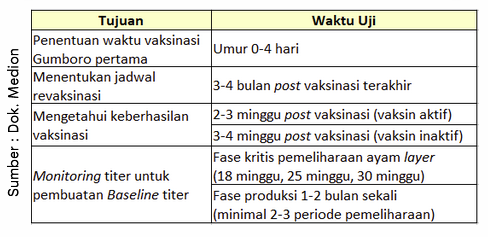
Given the importance of serological tests to monitor the health status of livestock, a proper serological test program is needed. The timing of serological testing will certainly differ depending on the purpose of the test. The following is an example of a serological test program in laying hens that can be carried out from the phase starter up to phase layer (production) :
Case Study Examples
A farm layer X routinely perform serological tests in MediLab to monitor the status of the condition of AI antibody titers in chickens. Farm layer This X has a routine AI vaccination program that is 3 times before the production period and 2 times during the production period. The vaccination Program and monitor serology on farm this in the period of maintenance for 2 periods remains the same. The AI vaccination Program in the period before the production phase was carried out at the age of 1-2 weeks, 9 weeks and 17 weeks, while the AI vaccination program in the production period was carried out at the age of 33 weeks and 49 weeks.
The monitoring Programmonitor) serology against AI disease in farm layer X is done routinely every 3-4 weeks to get baseline titer of farm such. After getting baseline titer for 2 times the maintenance period in a healthy chicken condition obtained results as in Graph 5.
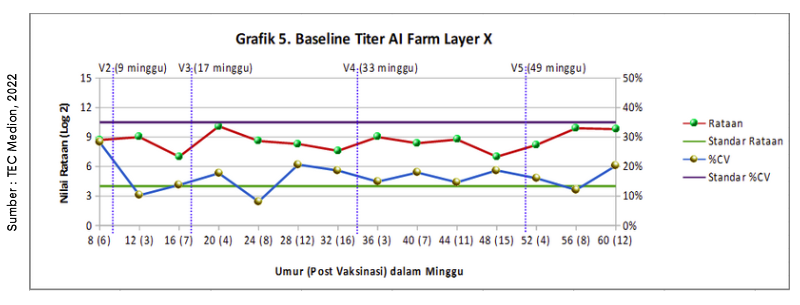
Based on graph 5 above, it can be analyzed related to the movement pattern of AI antibody titer. So that farm this can tell normally when the AI antibody titer will decrease and need to be revaccinated.
After we look at the graph 5, it can be analyzed that the picture of the average antibody titer pattern during the examination is above the standard, as well as the picture of the pattern % CV (Coefficient of variation) which is also good. This is supported by the implementation of scheduled vaccinations when the antibody titer begins to decrease, so that the antibody titer during the monitoring schedule is above the standard or always remains at the protective level.
Through the right vaccination program and supported by routine antibody titer monitoring, various benefits can be obtained in supporting chicken health.
But on the other hand, for example, we have baseline titer, then in the next Maintenance Period want to do the examination or monitoring of antibody titer. At the same time and the same vaccination program, it turns out that there are conditions in which the average antibody titer obtained from serological test results is lower or there is a significant decrease compared to baseline titer, then this can be early warning for farmers related to the condition of the chicken. So that farmers must immediately cross-check performance of chickens in cages to ensure their condition.
Thus farmers can immediately provide the following treatment :
- Give treatment supportive in the form of multivitamins or immunostimulants such as Imustim

- Give antibiotics such as Neo Meditril /Tinolin/Fithera if there is a disease that leads to bacterial
- Farmers can evaluate the implementation of management and biosecurity at farm and can immediately correct it if found nonconformities in maintenance management practices and biosecurity compared with standard operating procedures applied in farm the.
In conclusion, regular monitoring of antibody titers in chickens layer has a variety of benefits to support the health status of livestock. Thus, when the condition of livestock is healthy, the resulting productivity is also more optimal and the profits of farmers will also increase.