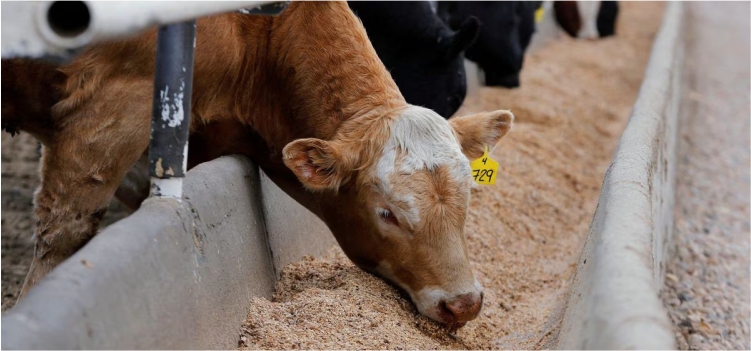
Beef cattle fattening business opportunities continue to increase when the need for beef continues to grow. Generally raising beef cattle fattening is done by buying going to be fattened for 3 to 4 months and then resold.
Maintenance is quite short compared to breeding cattle breeding makes capital turnover will be shorter as well, so profits will be more quickly obtained.
There are several things to consider when you want to start raising beef cattle fattening, one of which is in terms of selection going. Good fodder for fattening can be selected Bulls when the growth period is optimal (aged 1.5-2.5 years).
The type or nation of cattle selected can be local or imported cattle with good growth rate characteristics and adaptability.
Next, pay attention to physical conditions such as a wide chest, ideal height and body length, strong legs and normal genitals. Finally, pay attention also to the health of going which is characterized by good appetite, bright eyes, supple skin and shiny clean hair.
Feed supplements for beef cattle
One of the important factors that will determine success in fattening beef cattle is feed. The feed given must be of quality and meet the needs of the livestock.
Quality feed must necessarily contain the necessary nutrients such as carbohydrates, proteins, fats, vitamin and mineral complexes. The need for the amount and quality of feed that is met will have a positive impact by increasing daily weight gain.
One of the efforts to improve the quality of feed to meet the nutritional needs of livestock is to add supplements. Feed supplements are additional feed ingredients that are useful for increasing nutrient levels and absorption of nutrients in feed.
The nutritional content of supplements can consist of micronutrients such as vitamins, minerals and amino acids. Although the percentage of mineral and vitamin content is only a little in the feed, it has an important role in the body's metabolism.
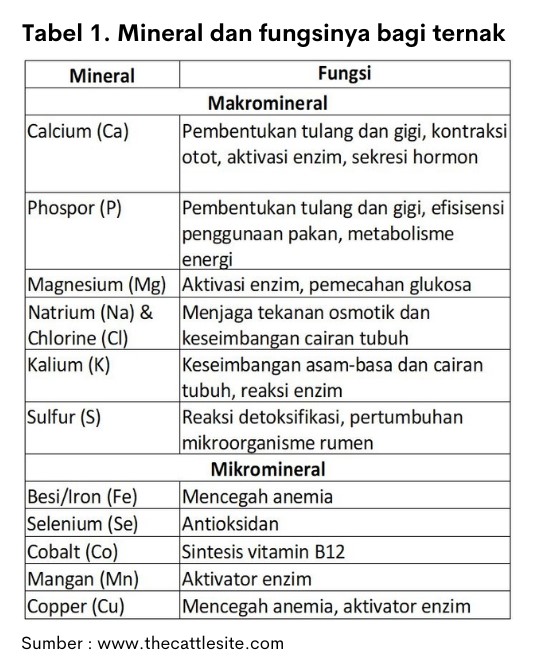
Beef cattle need mineral elements in the feed to optimize growth, reproduction and health. Minerals that the body needs in large quantities are called macrominerals, while those that the body needs in small amounts are microminerals. Each of these minerals has a different function (Table 1).
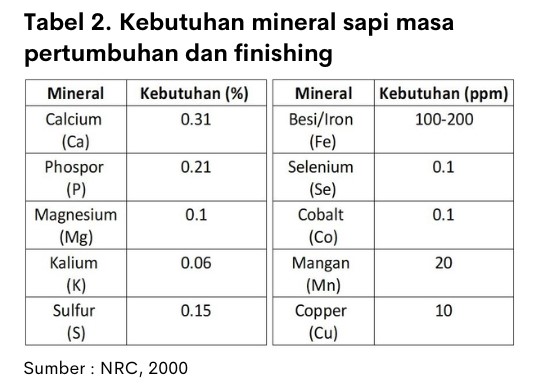
Mineral requirements for beef cattle will depend on several things such as age, weight, sex and phase of production. Mineral needs of cattle during the period of growth and finishing can be seen in Table 2. These needs need to be met balance because if the lack or excess will cause health problems.
For example, a lack of various minerals will cause a decrease in appetite so that the performance is not optimal. Meanwhile, if excess, for example, excess phosphorus can cause the formation of stones in the urinary tract and water belly (accumulation of fluid in the abdominal space).
Other ingredients in supplements, namely vitamins needed by the body for growth, metaboliesme, reproduction and livestock health. Vitamin dibedakan menjadi dua kelompok, yaitu vitamin larut air (vitamin B dan C) serta vitamin larut lemak (vitamin A, D, E dan K).
In addition to minerals and vitamins there is also an amino acid, which is a molecule as ‘building blocks'which is used for the formation of proteins in the body. Amino acids are divided into two, namely essential that cannot be produced in the body so that it needs to be met from feed and non-essential that can be produced in the body. Examples of essential amino acids needed from feed are lysine and methionine.
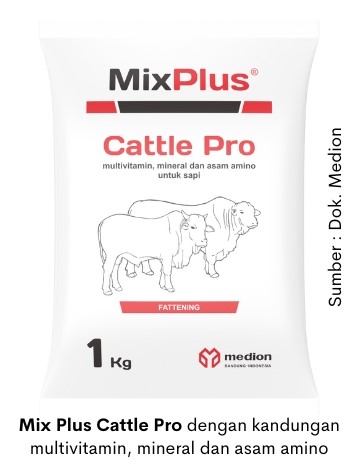
One example of supplements that can be given to fattening beef cattle is Mix Plus Cattle Pro. Mix Plus Cattle Pro it is a premix preparation with multivitamins, minerals and amino acids.
The content is useful as an antioxidant, helps the body's metabolic processes and biochemical systems and promotes growth. This supplement can be administered daily at a dose of 1-2 g/kg of feed mixed in concentrate.
Nutrients such as minerals, vitamins and amino acids are essential for the productivity and health of cows. When the maximum daily weight gain and the use of feed more efficiently it will provide greater benefits. Thus, supplementation can improve livestock performance so that farmers ' profits can increase.