How to improve the quality of egg shells?
Bapak Ahmad Fadilla – by email
How to fix the deteriorating quality of eggshells? Please explain, thank you.
Answer:
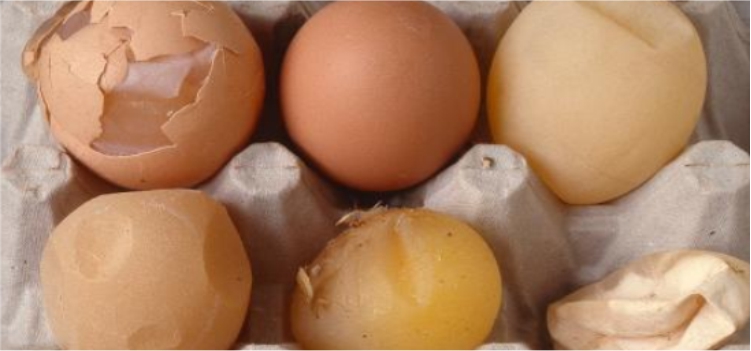
Thank You Ahmad for the question. Changes or abnormal eggshell conditions that often occur, such as thin or flabby eggshells until they turn white can be caused by various factors. In general, the poor quality of egg shells can be caused by 2 things, namely non-infectious and infectious factors.
1. Non-infectious factors
In non-infectious cases there are 3 causes, among others:
a. Pullet quality
Poor pullet quality is characterized by weight characteristics and low pullet uniformity. This low pullet uniformity can result in non-uniformity of the beginning of production and non-uniformity of the size of the eggs produced. The existence of a pullet that has a narrow pubic bone distance and shows skeletal problems is also a distinctive feature that results in the chicken has a smaller egg size.
b. Nutrition ration
Laying hens require a fairly high intake of calcium (Ca) in the production period. If the Ca preparation in the chicken's body is not sufficient, the amount of production will decrease and the formation of egg shells can be disrupted. As a result, egg shells are mushy. Ca intake also affects the color of eggshells.
If the Ca level is low or insufficient, the secretion of phorpyrin when painting eggshells will decrease as a result of which the color of the eggshell becomes whiter. What is also important to note in the administration of Ca and P is about the balance of their needs in the body. For laying hens starter to grower phase, the ratio of Ca : P of 2-2.5: 1. For the pre-layer phase the ratio is 5 : 1, and when the layer phase rises to 9-12: 1. If the Ca content in the ration exceeds the standard needs, it will affect the absorption of other minerals such as Mg, Mn, and Zn as the transport of eggshell color pigments to be not optimal.
c. Maintenance management
The failure of the management of the rearing of laying hens inevitably also leads to a decrease in the amount of production and quality of eggs. The discomfort felt by chickens can cause stress which can cause the process of egg shell formation does not take place perfectly. When the weather is hot, the chicken will panting (gasping) so that it emits a lot of carbon dioxide (CO₂). At the formation of eggs, CO₂ is needed to form calcium carbonate (Caco₂) which is useful for arranging egg shells. As a result, the shellfish will be thinner and easier to crack.
2. Infectious factors
Decreased eggshell quality can also be caused by infectious factors, namely infection. Penyakit yang menampakkan gejala klinis penurunan kualitas kerabang antara lain Infectious Bronchitis (IB), Newcastle disease (ND), dan egg drop syndrome (EDS).
a. IB infection
IB virus attacks cause changes in egg quality that show a very varied egg color. The decrease in egg production can reach 70% with changes in asymmetric, rough, thin and pale eggshells. When broken, the consistency or viscosity of the egg white becomes thinner and sometimes blood spots are found on the yolk. When the chicken production phase will be dissected anatomical pathology changes that are typical of abnormal or undeveloped ovarian shape, edemaoviduk and the presence of oviduct cysts in the form of fluid sacs.
b. Nd infection
ND can lead to a decrease in egg production and quality. The decrease in egg quality that occurs is pale colored egg shells, but not until white as occurs in the case of IB. Nd Virus also attacks the nerves that can cause the chicken's head to be twisted (torticollis). In addition to the decrease in quality, the decrease in the amount of egg production that occurs due to ND attacks is quite high.
c. Eds infection
EDS generally attacks chickens near the peak of production around the age of 25-26 weeks. Usually chickens do not show special clinical symptoms, it's just that they are often characterized by a very drastic decrease in production accompanied by a decrease in egg quality. The eggshell becomes paler, sometimes without a shell, flabby, or rough and the egg is deformed or shrinks. A decrease in egg production can reach 20-40% Within 2 weeks. Production will drop for 4-10 weeks. The results of carcass surgery revealed the oviduct (reproductive tract) is loose and there is a buildup of fluid.
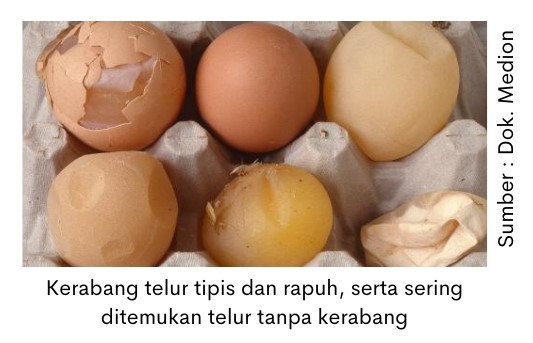
So, if there are changes in the quality of shellfish apart from observing the quality of eggs also need to be explored about the condition of the chicken. Of clinical symptoms that appear as well as surgical observation of the carcass if necessary (if it leads to infectious disease) as well as evaluation of non-infectious terms. So that it will be a cornerstone in the treatment or treatment that is done to be more effective.
If the cause is from non-infectious factors, make improvements to the factors that cause a decrease in egg production, such as body weight control and pullet uniformity, improved management and improved ration quality. Create a comfortable cage with even air circulation and not too dense capacity. Set the lighting program. Laying hens that have entered the egg production period, need 16 hours of lighting to maintain the optimal amount of egg production. Provide feed sources that contain high Ca and P such as bone meal or rock meal. In addition, it can provide supplementation containing multivitamins, minerals, and amino acids such as Top Mix as much as 2-4 grams per as much as 2-4 grams per kg of feed or Mix Plus LLM3A with a dose of 15 kg per ton of feed (can be given every day since the age of 16 weeks).
While in terms of infectious factors, the diseases mentioned above are diseases caused by viruses. The most appropriate way is to prevent with the implementation of 3 aspects, namely the implementation of strict biosecurity, the implementation of good maintenance management, and proper vaccination. When the disease has attacked, which can be done, among others :
- Selection and isolation of sick chickens based on the severity of the disease. Separate sick chickens into separate battery cages for handling.
- Give vitamins to increase stamina by using Vita Stress or Fortevit.
- Disinfection of cages and equipment using Medisep or Zaldes.
- Administration of antibiotics to prevent secondary infection. Examples of antibiotics that can be given are Rofotyl, Lincomed-LA, or Remisin.
- If the case refers to ND infection, what can be done is revaccination with Medivac ND Clone 45. Revaccination can bully high antibody formation quickly. Emergency vaccination using Medivac ND Clone 45 in the production phase it can be done through drinking water or injections. Revaccination can be done if the attack is not severe and the condition of the chicken is still healthy. The results of revaccination depend on the degree of malignancy of the invading virus, morbidity and mortality. The success of emergency vaccination is determined by the type of ND virus that attacked, the severity of the disease, the speed and accuracy of diagnosing the disease, which determine the speed of revaccination. If revaccination is late, the field virus will grow more and more.
- Do monitor antibody titer ND, IB, and EDS routinely at least once every 1 month to see antibody titer status and determine the next vaccination schedule.