Pertanyaan dari Bapak Jito – by email
My cow's udder and nipples are swollen and reddish. How to handle it?
Answer
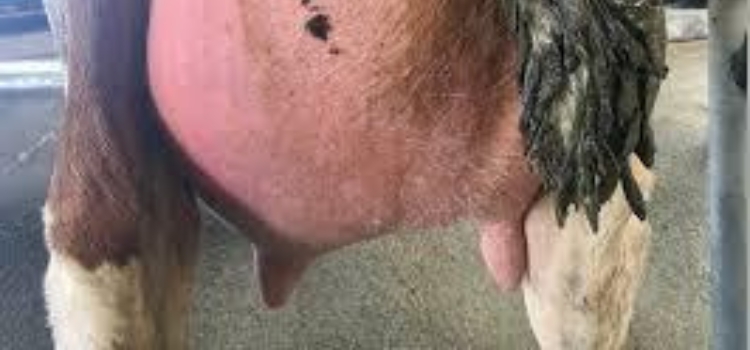
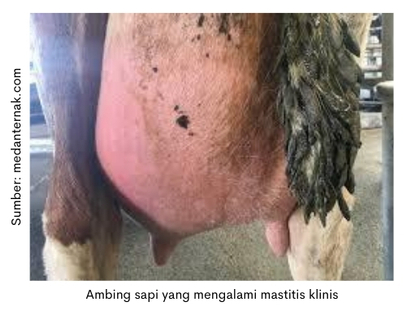
Swollen udders and nipples accompanied by redness can indicate that there is inflammation of the internal tissues of the mammary glands or so-called mastitis. Mastitis can be caused due to various factors, one of which is a bacterial infection.
These bacteria can enter and infect the udder during the milking process or while in the cage due to poor hygiene. In addition, mastitis can also be transmitted from sick cows to other cows during the milking process.
Mastitis can occur in 2 types, namely clinical and subclinical mastitis. Clinical Mastitis is characterized by physical changes in the udder such as swelling, redness and pain response and feels hot when the udder is touched or pressed.
The milk produced can also occur physical changes such as thicker or liquid with a change in color to more yellow or accompanied by blood. As for subclinical mastitis, the cow will look healthy without any physical changes in the udder and milk.
However, when checking the quality of milk, the number of somatic cells will be found above the normal limit (>400,000 cells/ml). The high number of somatic cells indicates that an infection is occurring.
Treatment and Prevention of Mastitis
Here are some measures for the treatment of cows with mastitis :
- Give antibiotics such as Medoxy-LA or Neo Meditril-LA intramuscularly. Pay attention to the time when you will give antibiotics. It is better to give antibiotics when the cow is in a dry period of the stall. However, if the administration of antibiotics is necessary in the lactation period, such as when there are cases of clinical mastitis, it is necessary to consider the downtime of the drug.
- Give me a break (Medipiron Injection) especially in cases of clinical mastitis.
- MultivitaminsInjekvit B-Plex) can be given to help the healing process by increasing the endurance of livestock.
- Give supplements that can help overcome cases of mastitis. Mastigrin as an herbal supplement it can be given to reduce the number of somatic cells especially in cases of subclinical mastitis. Mastigrin it is safe to be given during the lactation period because it will not produce residues so that the milk remains safe for human consumption.
Prevention that can be done to minimize cases of mastitis is:
- Pay attention to the cleanliness of the cage and also the cage attendant who will do the milking.
- The equipment used must be clean and distinguish between equipment for sick cows and healthy cows.
- Apply good milking management from before, during and after milking.
- Milking starts from healthy cows and ends with sick cows
- Do the nipple dip (teat dipping) with Antisep after milking to minimize the risk of bacteria getting into the udder from the still open nipple.
- Give herbal supplements (Mastigrin) to help reduce the incidence of mastitis. Mastigrin it can also be given to increase milk production.
- Apply good Cage dry period management. In this period, milking is not done so that the udder can rest so that milk production during the next lactation period can be optimal. During the dry period of the cage can still be carried out nipple dip with Antisep.