Bapak Aris
Email: arissukamdani19@gmail.com
I would like to ask you about a laying hen whose body condition is hot and the next day dies. What is the cause and how is the solution?
Answer:
Dear. Mr. Aris, thank you for the question. The heat of the fire, the heat of the fire, the heat of the fire, the heat of the fire, the heat of the fire, the heat of the fire (heat stress). Heat stress is a stress disorder that occurs due to environmental air temperature conditions exceeding normal temperature (>28°C) so that the chicken is unable to balance between the production and disposal of body heat. Please note that the comfort zone (comfort zone) chickens are in the temperature range of 25-28°C with a humidity of 60-70%.
When the chicken is hot (heat stress, red), the chicken will try to lower its body temperature through the release of body heat. However, because chickens do not have sweat glands, the response seen from the behavior of chickens when experiencing heat stress among others:
- Chickens stretch, hang, or spread their wings. However, this effort is less than optimal because the temperature of the cage environment is not significantly different from the heat of his body.
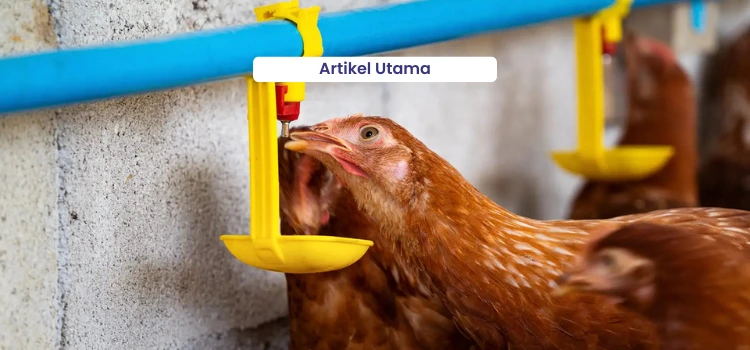
- Chickens attach the body to the walls of a cooler cage or immerse the body inside litter. Sometimes chickens also do “bathing " in drinkers.
- Do peripheral vasodilatation or increase peripheral blood flow (edges), especially in the combs, Wattles, and feet so that the color becomes more red and hot.
- Chicken do panting, that is, breathing through the throat or increasing evaporation (evaporation). The cock will open its mouth and move its throat as a place for air to enter and exit. The chicken that did panting but his body temperature does not decrease will experience weakness, fainting, then can die suddenly. Death from heat stress this will especially begin to happen when the chicken's body temperature reaches 42°C or more.
In addition, other impacts that can interfere with the survival and production of chickens from the event heat stress :
- Weakens the immune system, so chickens are susceptible to disease
- Causes wet feces, so the fly population multiplies, ammonia increases, as a result of which chickens are more susceptible to respiratory diseases
- Decrease the quality and quantity of eggs
Ways that can be done as an effort to overcome heat stress in order not to happen protracted and detrimental to farmers are among others:
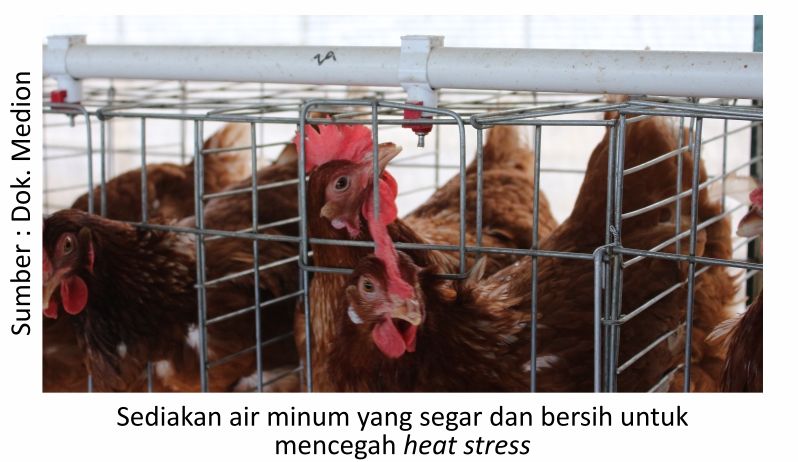
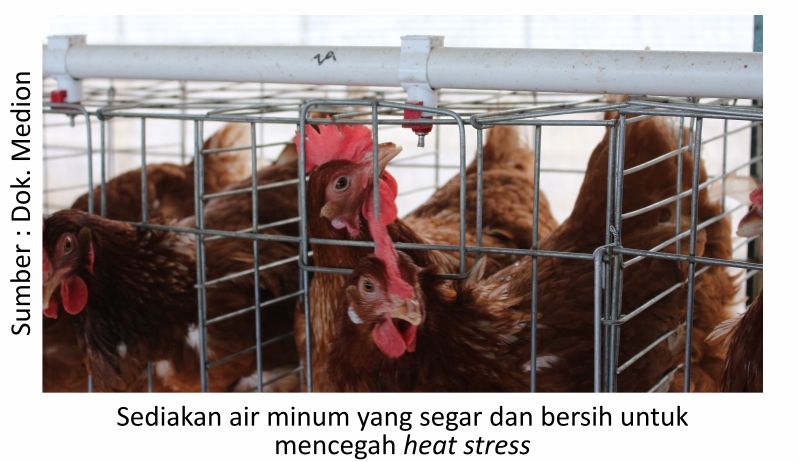
- Provide cold water temperature 20-24°C good quality. Cold water can be used to help chickens stabilize the body temperature of chickens when the air environment is high and adjust the distribution of drinking water so that it is evenly distributed
- Do chicken thinning. Thinning in one cage aims to reduce density so that chickens feel more comfortable
- Adjust the treatment to environmental conditions, for example, do not vaccinate, cut the beak (debeaking) or other treatment when the ambient temperature is high, as this can further aggravate the condition heat stress
- It is best not to give rations during the day when the temperature conditions are high, because it can cause death due to the high activity of digestive metabolism and the generation of a lot of body heat. For that, the management that can be done is to give 1/3 ration in the morning, then 2/3 ration in the late afternoon, and provide additional rations containing calcium supplements or other minerals needed by chickens at night
- Give vitamins and electrolytes such as Vita Stress or Kumavit to increase endurance and prevent stress..
- Perform regulation of air circulation and temperature of the cage as with the addition blower or artificial rain in hot weather
- Tightens biosecurity because heat stress suppresses the immune system making it easier for chickens to develop infectious diseases.