Bpk Rismono
Rismono@gmail.com
I want to ask, chicken broiler I was at the age of 20 days sick with the characteristics that the liver shrinks and the spleen swells. What is the cause of the feed and how is it handled?
Answer:
Thank you Mr. Rismono for the question. If only based on these 2 changes it is rather difficult for us to determine the cause of the problem. In general, a swollen spleen indicates that there is an infection in the chicken, because the spleen is one of the body's defense organs in chickens. Before determining the diagnosis, it is necessary to trace the changes in other organs and also the clinical symptoms.
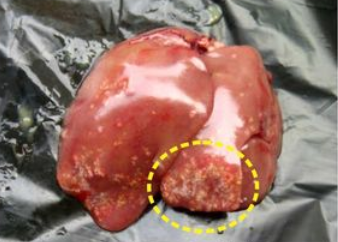
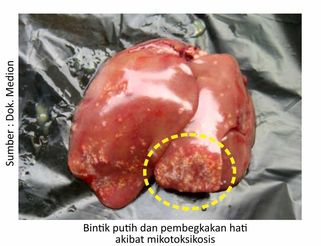
An atrophied/shrinking liver is likely caused by mycotoxins contained in the ration. Mycotoxins are secondary metabolite products produced by fungi growing on organic substrates. This product is not necessary for the growth of the organism itself and negatively affects those who consume it. Diseases caused by mycotoxins or mycotoxicosis can be acute or chronic, depending on the amount of toxin, duration of contact, and age of the chicken. Acute poisoning is usually found in young chickens that get high doses of aflatoxin, while chronic poisoning can be found in older chickens (more than 5 Weeks) who consume these toxic substances with low levels for several weeks. Young chickens are more sensitive to attacks in this case. These mycotoxins can attack almost all body systems including lymphoid organs, giving rise to immunosuppressive effects (weakening of the immune system). Anatomical features of pathology (changes in organs) due to mycotoxicosis include :
- Enlargement of the liver accompanied by white necrotic nodules (white spots), when it progresses chronically the liver will atrophy( shrink), pale yellowish and hardened
- Accumulation of fat in the ventricles and body fat
- Erosion of the ventricular mucosa
- Bursa fabricius and thymus shrink
- The kidneys and gall bladder are usually enlarged
- Hemorrhage in the line-shaped muscle
Specific treatment for aflatoxin-afflicted chickens does not yet exist. Feed containing aflatoxins should be discarded and replaced with Feed free of mycotoxins. Chickens usually recover from most cases of mycotoxicosis within a short period of time after feedings containing the ingredient are stopped. If there are indications of a mixed infection with bacteria or parasites, it is necessary to carry out appropriate treatment. The levels of vitamins, microminerals (especially selenium), proteins and fats in the feed need to be increased or can be given additionally in drinking water. Increased levels of crude protein and vitamins in feed can inhibit the effects of aflatoxins. The presence of cases of mycotoxicosis is necessary to consider in the selection of ration material.
Apabilla needs to be given toxin which is mixed on the feed. In order for the use of toxin the exact dosage, then need to test mycotoxin levels. Products toxin what Medion produces is Freetox-L and Freetox-M. Preparations Freetox in the form of a powder containing Hydrated sodium calcium aluminosilicate (HSCAS) which has the activity of binding mycotoxins (fungal toxins), especially aflatoxins strongly. Its use is homogeneously mixed into the ration. Usage Freetox-L used when mycotoxin levels in the ration of less than 50 ppb, while Freetox-M used when mycotoxin levels are more than 50 ppb. In addition Freetox M it can be given when chickens have been diagnosed with mycotoxicosis. Vitamin supplementation, especially fat soluble vitamins (A, D, E, K), amino acids (methionine and penilalanin) and increase the levels of protein and fat in the ration is also able to suppress losses due to mycotoxins. High-dose multivitamins such as Fortevit could be a solution.
Administration of Heprofit can also be done, considering that there have been organ changes in chicken liver. Heprofit it is a liquid supplement that contains herbal extracts to protect the liver from damage (hepatoprotectors). Liver damage can lead to decreased ration consumption, decreased production, organ damage, decreased immune system and even death. The giving Heprofit this is done so that the liver is not damaged and the performance of the chicken remains optimal.
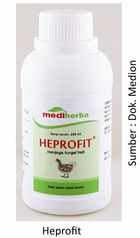
In addition, Heprofit it does not cause side effects and residues because it is made from herbal ingredients. Awarding Heprofit treatment is carried out by mixing 0.5 ml per 2 liters of drinking water and given 3 days in a row.