Mr Pijafiza
Email: pijafiza@yahoo.com
I have a 15 day old broiler farm. Should curtains be opened or closed at night? When opened, will the chicken get cold and sick easily?
Answer:
Dear. Mr. Pijafiza, thank you for the question. First we will explain the purpose of setting open close curtain cage. Good air circulation will help increase oxygen levels and reduce the smell of ammonia and other harmful gases from the cage. The regulation of air circulation is first done through the open and close arrangement of the cage curtain. Setting open and close the curtain is very important, especially during the brooding period,, to optimize the heating temperature at brooder as a replacement temperature because the thermoregulation system (body temperature regulation) chicks are not yet functioning properly.
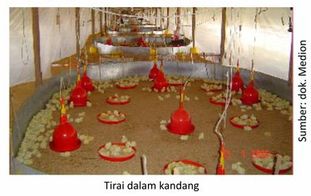
Time period brooding period,, especially farms with large populations (spacious enclosures) or farm in areas with cold temperatures/high wind flow, usually use two curtain systems, namely the outer curtain that closes the entire scope of the cage and the inner curtain/inner cotton contained in the cage and cover chick guard.
- Inner curtain
The use of curtains in or inner cotton aim to optimize the heat from brooder especially in the mornings and evenings so that the chicks always get a comfortable temperature for their growth. On the 1st to the 3rd day always use the inner curtain. Then at the age of 4 days the inner curtain began to open and at the age of 7 days it was removed. Its function is replaced by outer curtains and the regulation of chicken density.
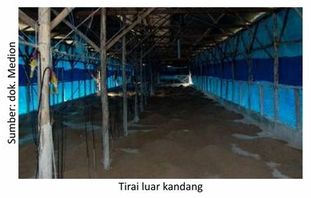
- Outdoor curtain
The use of outdoor curtains aims to maintain or control the temperature and humidity of the cage and wind flow. In general, the outer curtain will be used according to the temperature conditions in the respective area.

Based on the information that the current Father's chicken is 15 days old, the possibility of the chicken has occupied the entire cage (chick guard) it is removable, so there is no need for an inner curtain. It is also seen from the age, the father's chicken can regulate changes in body temperature with ambient temperature.
Regarding the arrangement of the outer curtain, it will usually be adjusted to the age of the chicken and the surrounding environmental conditions (temperature and wind flow). At the age of 0-1 weeks the curtain is fully closed with the aim that the heat from brooder focused so that not much heat is lost. With a note, still given a ventilation gap in the upper cage wall with a width of 20 cm so that there is still air circulation in the cage. If the curtain is fully closed without any ventilation gap, it will cause the content of O2 reduced, while ammonia and CO2 increased. This can disrupt the respiratory system of chickens. Do not leave the slightest gap at the bottom of the curtain to prevent the flow of cold air from entering from below and hitting the chicks directly. Then in the second week of keeping chickens, the curtain begins to open 1/3 of the way from above. In the third week the blinds are opened 2/3 of the way, as well as in the fourth week of maintenance, they can already be opened completely.
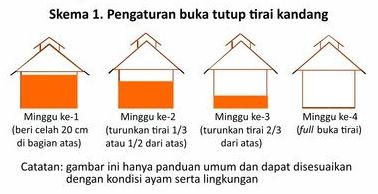
This curtain opening and closing activity still requires the instinct of farmers, of course, by looking at behaviour (behavior) chickens and environmental conditions. There are certain conditions that are taken into consideration such as rain and wind direction. For example, if the wind is blowing from the south, the South curtain must be closed higher than the North curtain to avoid the chicken being directly exposed to the wind and vice versa.
Regarding whether at night the curtain needs to be opened or closed, it is again adjusted to the conditions of the father's farm. If at night the temperature is cold and strong wind flow, we recommend partially closed curtains, especially on the side of the wind flow comes. So that the wind does not directly hit the chicks. This is because the stress of fluctuating temperatures (heat to cold) can trigger stress which can cause immunosuppressants (suppress the immune system) which results in the condition of the chicken's body becomes weak and easily infected with disease.