Various types of drugs are commonly used in the poultry world to overcome diseases that attack chickens. Outstanding trademarks are also diverse. The problem is that some farmers are still public in knowing the right treatment practices in the field. As a result, the disease does not go away and the productivity of chickens is disrupted. Another effect occurs antibiotic resistance of certain groups. Then, what is the use of wise and proper medicine like?
Principles Of Treatment
In the world of Medicine, the principles of treatment are the basis for achieving the goals of treatment. The principles of treatment are clearly translated in the veterinary drug product information both on the label / label and the leaflet on the drug packaging. In it are listed some of the things that are signs for us in doing treatment. When one is not met, treatment is often not optimal.
The art of treating the right and safe to meet the goals of treatment we will describe as follows:
- Indications of the drug in accordance with the diagnosis of the disease that struck
Indications will lead us to diseases that can be cured on the drug so that proper diagnosis is needed. To confirm the diagnosis can be done by collecting as complete information as possible from the case of the disease that occurs. Supported by information from breeder information( Anamnesis), clinical symptoms, observation of changes during carcass surgery (anatomical pathology), to laboratory tests.
After getting a diagnosis, then look for a suitable drug for the indication. Each drug has a different and specific effect on a particular disease. For example, to treat CRD, it is necessary to know that also Mycoplasma can not be killed with antibiotics that work to damage or inhibit the formation of cell walls, because also Mycoplasma it has no cell walls on its surface. Therefore, it can provide antibiotics that act on the membranes and nucleus of cells, especially those that actively inhibit the formation of folic acid and bacterial proteins Mycoplasma. Examples of Medion products that can be used such as Neo Meditril, Proxan–S, Therapy, or Doxytin. - Proper dosage and timing of Drug Administration
When the drug reaches the target organ, its amount should be sufficient. If less, the seeds of the disease are not completely eradicated. This is usually already taken into account by the drug manufacturer in the dosage form of each administration. This is the reason why the dose to be administered must be according to the rules listed.
The dose of the drug will be adjusted to the amount of drinking water or chicken weight. Here is an example of calculating the dose of the drug based on drinking water. For example, a chicken population of 1000 chickens with an average body weight of 1.5 kg chickens. Then the need Trimezyn-S per day is:
BB X population x duration of Administration x dose
= 1000 ekor x 1,5 kg x 0,1 gram tiap kg BB
= 150 grams/day
Then the need for 3 days of treatment is 3 x 150 grams = 450 grams.
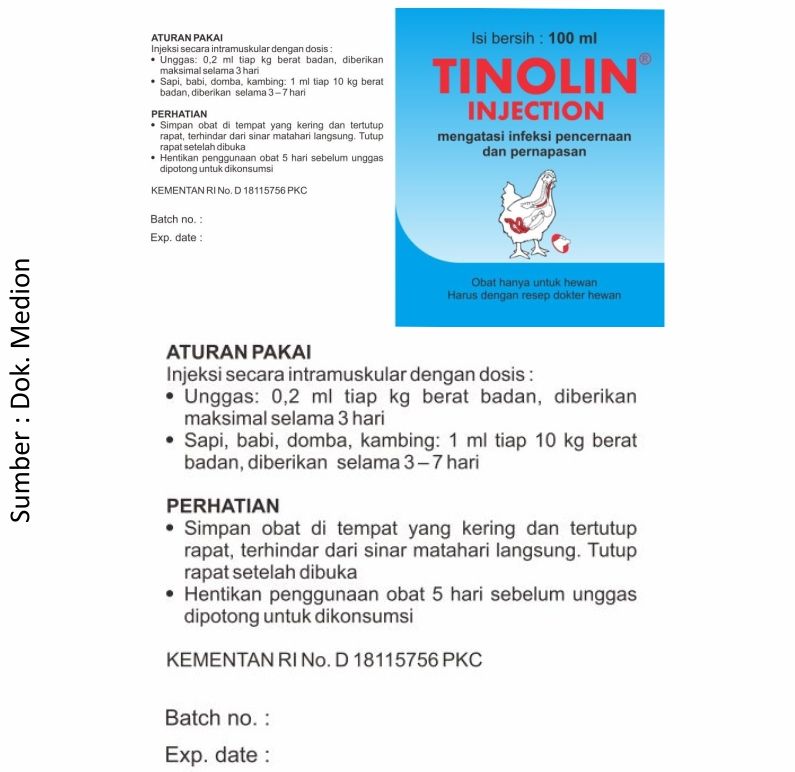
Trimezyn-S then given during the morning to noon (hours 07.00-13.00) as much as 75 grams dissolved in drinking water needs for 6 hours, and the next 75 grams given during the afternoon to afternoon (hours 13.00-19.00). At night, you can drink only water or you can supplement it with vitamins. Whereas if the administration of drugs by injection as an example Tinolin Injection, it is administered according to the rules of use, namely intramuscular injection at a dose of 0.2 ml per kg of body weight for 3 consecutive days.
The rules of use also contain the recommendation “given to chickens for 3 days in a row”. The sentence means that farmers must provide treatment for 3 consecutive days so that the seeds of the disease can be eradicated completely. Sufficient dosage and the right treatment time are important principles in treatment. The drug needs to be in a sufficient period of time to be able to eradicate the seeds of the disease. If it is less than that, it is feared that there is resistance (immunity) of bacteria to antibiotics.
- Appropriate treatment applications
The drug given must be able to reach the target organ, work site or diseased organ so that the drug can work precisely and optimally. It is associated with the choice of such routes of Drug Administration as oral, parenteral and topical. The choice of treatment route is important to ensure that the drug can reach the desired organ or site of action.
The oral route can pass drinking water, feed, and bite. Parenteral routes include subcutaneous (under the skin), intramuscular (through the muscle) and intravenous (directly into a vein) injections. The topical route is carried out by applying the drug to the area of the diseased organ or wound. Choosing the right route will minimize the drug is damaged and eliminated before it reaches the organ that is the target of treatment.
If you want an immediate treatment effect in treating severe respiratory infectious diseases, the parenteral route (injection or injection) is the main choice. However, if parenteral preparations are not available, then oral preparations through cekok or drinking water containing drugs that have systemic effects can be an alternative choice.
If the rules of use are written instructions for dissolving the drug with drinking water then use drinking water media to give the drug to livestock. If using it together with the ration, the conversion calculation must be ensured so that the dosage is appropriate and the treatment goals can be achieved.
In addition to the explanation of treatment techniques above, here are some things that need to be considered also in Wise and proper treatment:
- Maintenance management improvements
One of the important predisposing factors (triggers) of the disease is poor maintenance management. Take for example colibacillosis, the medium of transmission of this disease is feces, litter and drinking water. Farms that are not good at managing feces and litter usually susceptible to colibacillosis. It could also be due to contamination of drinking water and equipment, as well as an increase in the population of flies (vector E. Coli infection) so that the cases increase or the treatment remains unsuccessful.
It's good to always pay attention to maintenance management properly. Perform regular stool cleaning at least once a week. Use Ammotrol to help reduce ammonia levels in the cage as well as help with stool drying. - Appropriate storage of the drug
Store the drug in a dry place, tightly closed and away from direct sunlight. Like in a clean closet, not damp and shady. Use the drug in the order in which it is stored (first in first out or the first to enter is the first to use) - Rolling antibiotics
Purpose rolling antibiotics (substitution of antibiotic groups used) is to reduce the risk of resistance to disease. By changing the class of antibiotics, it is expected that the seeds of the disease will not have time to adapt to the antibiotics that have been used so as to prevent antibiotic resistance. Do it rolling or the alternation of selected antibiotics every 3-4 maintenance periods to prevent the occurrence of drug resistance. - Drinking water quality for drug solvent
Most of the drugs used, administered through drinking water. Therefore, the quality of drinking water is one of the things that should be considered. Water with low pH (acid) and high pH (alkaline) can precipitate several types of drug groups. If using hard water as a solvent will also bind the active compounds in antibiotic drugs Fluoroquinolon and tetracycline so it becomes ineffective again. And the high microbial contamination in drinking water will trigger the emergence of diseases such as colibacillosis and salmonellosis. - The presence of contraindications to the drug with chicken diseases
For example if there is an indication of a case of complication of a bacterial infection with a viral disease that causes kidney damage in the infection infectious bronchitis (IB) and Gumboro (IBD). It is highly recommended that the antibiotics given do not aggravate the work of the kidneys (which at that time were damaged, red) like Therapy, Doxytin, Amoxitin, or Ampicol.
In supporting the success of disease treatment, the use of appropriate drugs need to be supported by factors of cage management and application biosecurity that's good. It will be even better if on the eve of treatment, drink water mixed with multivitamins such as Vita Stress, Fortevit, or Strong n Fit to help reduce stress and speed up the healing of the disease. Greetings.