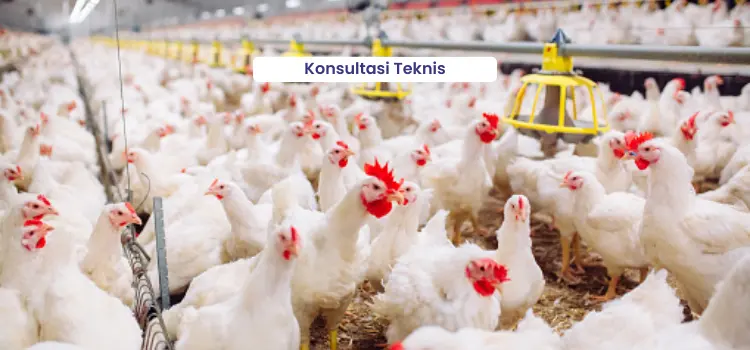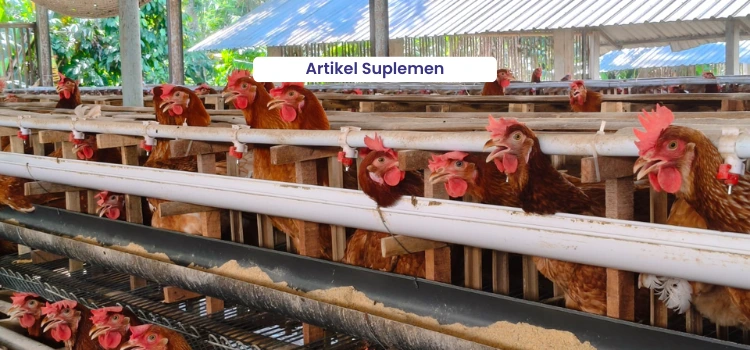
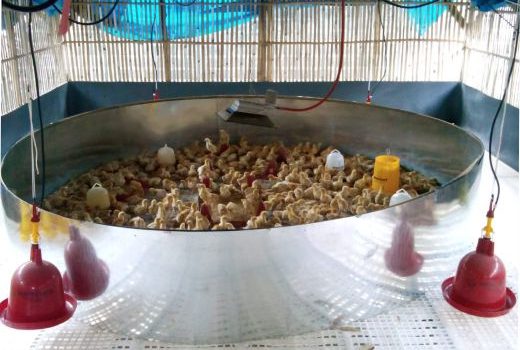
The first step in the process is to make sure that there is enough water in the tank and that it is safe to use (broiler). Brood period in chicks called the period brooding period, is the period when chicks need artificial heating until a certain age or until the chicks can adjust themselves to the temperature of their environment.
The heater becomes one of the components brooding period, which significantly affects the growth and development of DOC. Before talking about the importance of using the right heater, we briefly review the explanation of the period brooding period,.
Genetic development of chickens broiler this is in line with genetic quality improvements made by experts. The main purpose of raising chickens broiler is to produce meat. Therefore, experts also continue to develop chicken strains that result in the production of quality meat with a high level of feed efficiency.
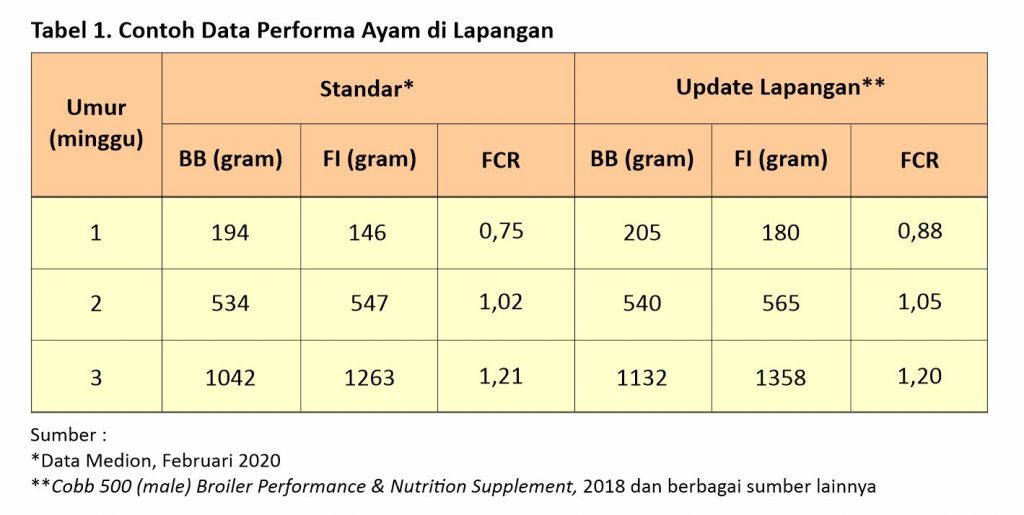
The faster and more efficient growth in converting feed into meat (FCR) certainly needs to be supported by the implementation of Excellent Maintenance Management.
Chickens are homoiterm (his body temperature is maintained at a stable level) so it requires a constant body temperature. Due to the extreme temperature of the environment will easily make the chicken suffer from stress, slow to grow, experience health problems, and even die.
On time brooding period,, chickens will experience very rapid growth. Almost all vital organs in the chicken's body are developed in this phase. In addition, modern commercial chickens are very sensitive to ambient temperature and chicks can only regulate their body temperature optimally at 2 weeks of age.
Thus, the chicks during the period brooding period, it is very important to always be in-monitor conditions at all times for optimal growth.
Temperature Brooding Optimal
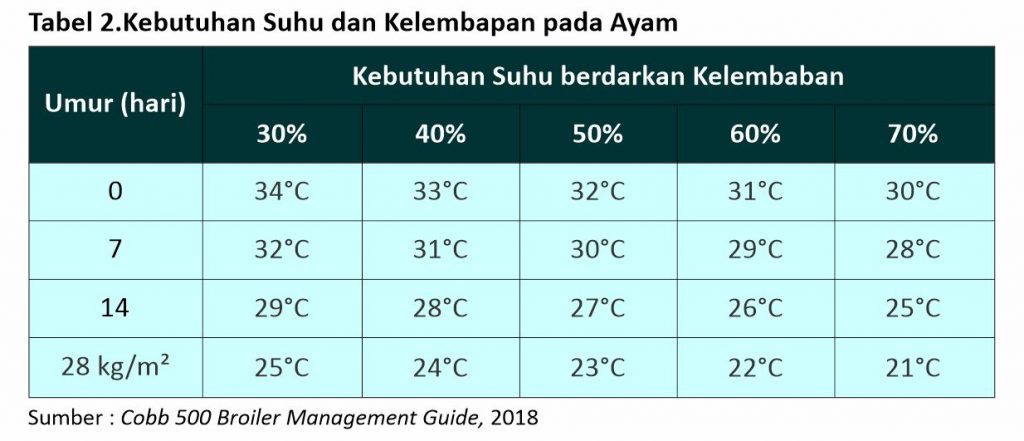
So that the chicks can grow well in the future brooding period, much depends on the provision of a comfortable temperature of the artificial heater. The comfort of the chicks can be described by activity and dispersal in the cage. The ideal temperature will make the chicks spread evenly and move normally.
Temperature control brooding period, it should be done periodically and as often as possible. Temperature measurement is usually only done to see the air temperature in the cage. It would be better, temperature measurements are also performed on litter.
Temperature control can be done once every 2-3 hours along with the provision of rations using a thermometer placed in the middle of the cage brooder. Place the thermometer at a height of 20-30 cm from litter. This is because the temperature litter inappropriate can also cause the chicken is not optimal growth.
In addition to using a thermometer, the state of the cage temperature is also described by looking at the condition of the chicken from the activity and spread. Suitable temperature and humidity conditions will be shown from the liveliness and even distribution of DOC throughout the cage brooding period,.
Current temperature brooder in accordance with the desired by DOC is about 30-34°C, then in less than 15 seconds after being stocked, DOC will immediately perform activities such as movement, drinking, and eating.
If there is DOC that accumulates on one side of the cage, it can be caused by uncomfortable temperature and humidity conditions. When the temperature of the cage is too cold, chickens will tend to swarm under heating, silent, curled up and wet feet conditions.
Whereas when the temperature is too hot, the chicken will stay away from the heater and look for a cooler place with more air flow. The chicken will also panting (panting), drink more, and reduce ration consumption.
Examination through the condition of the Chick's legs can also be done to determine his body temperature, characterized by a warm foot temperature but not cracked. Take the DOC and stick the DOC's feet on our cheeks or hands.
If it feels cold then the temperature of the cage, either air temperature or litter not suitable. Therefore, the role brooder (heater) it is very important to keep the temperature of the cage within the comfort zone of the chicken.
The role of the heater for the future Brooding Optimal
Comfortable temperature during the day brooding period, can be met from the use of heaters. The heating function for DOC (day old chicken) is very important, because it is not only a heater, but the heat produced also serves to stimulate various organ functions, including body temperature control organs. According to Tony Unandar (2008), inappropriate heating temperatures will increase the rate of Adenocorticotropic Hormone (ACTH) which is an indicator of stress in the DOC.
Higher than normal levels of ACTH will cause disruption of the absorption process of the remaining yolk. This means that the absorption of parent immune substances and other nutritional components contained in the yolk will also be hampered. In addition, excessive levels of ACTH will also have an effect lazy leucocytes syndrome, which is a condition in which white blood cells do not give an optimal response to foreign bodies or pathogens that will enter the chicken's body.
Furthermore, it will result in growth disorders with varying degrees of severity, such as slow-growing DOC, dwarfism, and weight inequality.
Heaters are usually used until the chicks are 2 weeks old. But this is not an absolute standard because the use of heating can be adjusted to weather conditions in farm. When the detected temperature is too hot or cold, the breeder must immediately lower or increase the heat intake of the heater used.
The heaters commonly used by farmers are gas, firewood, coal, and kerosene. But in the use of gas-fired heaters, temperature regulation is certainly easier and more practical to do than the use of other heaters such as wood or coal heaters. The use of other fuels has some drawbacks, such as unstable heat/difficult to regulate and smoke generated, then the use must be considered by farmers.
Currently, many types of gas heaters are sold on the market. Gas-fired heaters are more widely used by farmers because they are easy to install, durable and safe. The heat produced is stable, focused, does not cause noise or air pollution (smoke), and the temperature can be adjusted as needed. Efficient or not the use of gas heating, one of the things that affect is the installation of the right heater.
The biggest cost of using a gas heater certainly comes from the investment cost of purchasing and refilling its LPG gas cylinders. In an effort to reduce these costs, we must be able to save or efficient use of LPG gas during brooding period,. How, among others:
Regulating the use of heaters
The first way to save LPG gas is to regulate the use of heaters to produce temperatures according to the needs of chicks. To find out whether the heat generated is appropriate or not, temperature control should be done regularly. This temperature control can be started in 1-3 hours after chick in and continued every 2-3 hours at the same time with feeding.
Ideally, the temperature brooding period, we measure using a thermometer. But in addition to the thermometer, the suitability of temperature brooding period, it can also be determined by looking at the condition of the chicks, namely from the activity, distribution, and condition of the legs. If the temperature is too hot, the Chick's legs will be reddish and look cracked, especially on the nails and soles. Conversely, if the temperature is too cold, the Chick's feet will feel cold (compared to our body temperature).
In addition, to save the use of LPG gas, during brooding period, (③14 days) we don't need to turn on the gas heater for 24 hours. Turning on the heater 24 hours is mainly only done at the age of 1-2 days. This is because at that age the condition of the chicks are still vulnerable to cold temperatures and the body temperature regulation system is still completely dependent on the heater. But after the age of 3 days and so on, the use of heaters can be gradually reduced according to the conditions of the chicks and the weather in the local area.
Good condition of hose and gas cylinder
Another thing that can be done to save on the use of LPG gas is to make sure there is no gas leakage on the gas hose, hose clamps and LPG gas cylinders. If there is a pungent smell of gas, immediately check the origin of the source of the odor then immediately make repairs if there are damaged components.
Correct installation of the heater
In order to save on the use of LPG gas, the correct heating installation is also decisive. Because, if the installation is wrong, then the heat felt by the chicks is not maximum. As a result, in addition to the deterioration of the condition of the chicks, of course, as if the heat radiations given when brooding period, it should be larger and more gas is needed.
Since it will be used for the first time, the number of heaters installed in each cage brooding period, must be adjusted to the capacity of each type of heater. A firewood-fired heater, for example, can warm 500 chicks.
While the gas-fired heater is able to warm up to 1,000 chicks. One piece of gas-fired heaters such as IGM can be used to heat up to 1000 Doc tail in the area chick guard 4.5 m in diameter.
The heater is hung on the edge of the area chick guard (1/3 area of the edge) at a height of 100 cm from the surface of the cage floor with a slope angle of 15° towards 2/3 of the other cage area. This heater position can be moved whenever area chick guard expanded/widened.
The installation of the heater at an angle of 15° here serves to spread the heat evenly over a larger area so that the chicks are scattered and reduce the risk of death from overcrowding. In addition, the heat generated is focused on the heated area and is not dissipated into other areas.
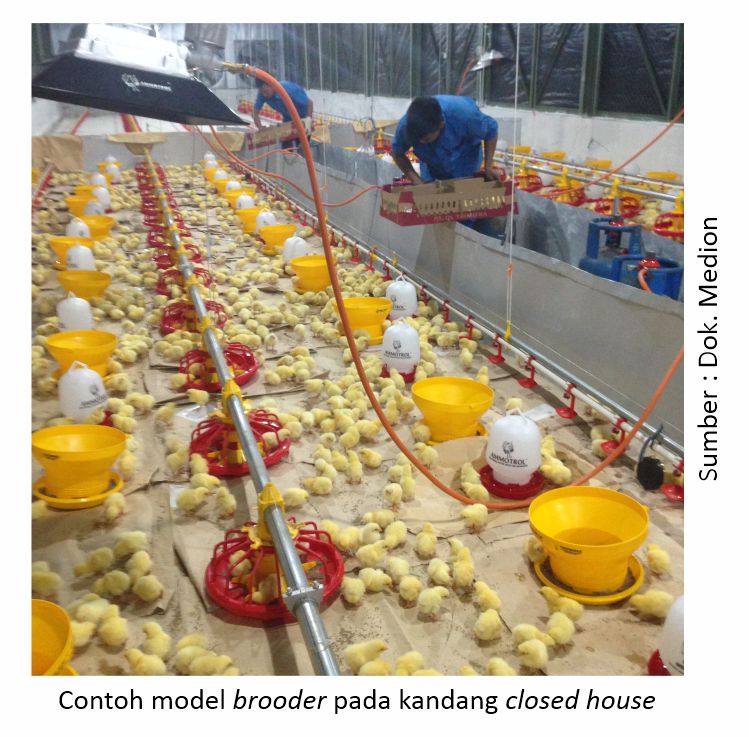
Selection of the right gas heater
Other factors that can also indirectly save the use of LPG gas during brooding period, namely by choosing an infrared gas heater. One example is IGM (Indukan Gas Medion). Usage IGM this is very profitable.
Why should an infrared Gas heater?
Infrared heater is a heater that emits infrared light waves from the combustion of ceramic components in it. So, the working principle of this heater is as follows: gas enters through safety device towards the venturi pipe.
Because there is a gas flow in the venturi pipe, the outside air will be sucked through the air filter. After that, a mixture of gas and air enters the combustion chamber, and this is where the combustion process occurs where then the ceramics heat up and infrared rays are produced.
Heat transmission by infrared heaters occurs radiatively, that is, directly about the chicks without going through the intermediary of air, so that the Heat received by the chicks is more optimal. While in convection heat delivery (such as gas heating system hood / canopy), heat transfer occurs through air intermediaries, where some of the heat will be carried and wasted into the air so that the Heat received by the chicks is less than optimal.
In contrast, in semawar heaters, coal furnaces, firewood, and sawdust, most of the heat is transferred through the convection process. With convection system heating, the heat generated will be channeled through the air. As a result, at high humidity, the heat perceived chicks will be much higher and the value heat index (HI) her too will exceed the threshold.
Meanwhile, if using infrared heaters, such as IGM (Indukan Gas Medion), the humidity value is not predominantly influential. So, regardless of the value of air humidity, most of the infrared heat will still be instantly transferred and easily adjusted to the temperature needs of the chicks.
Currently to make it easier for farmers to use infrared gas heaters, Medion has marketed IGM Starter Kit (IGM SK). With the purchase of 1 unit IGM SK, then the breeder will obtain 1 fruit IGM, 1 piece Gas Brooder Regulator, and gas hoses.
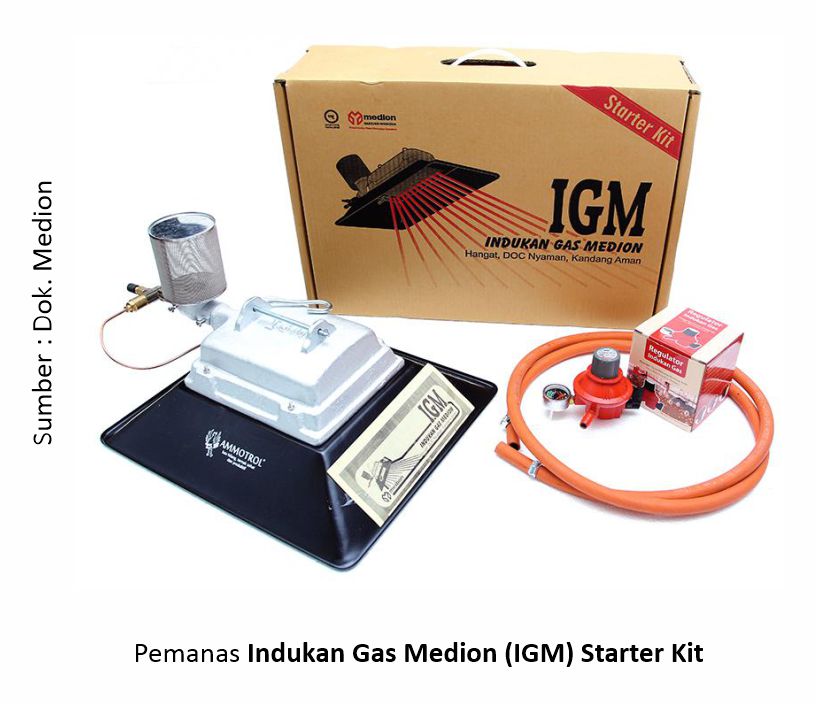
Regulator Indukan Gas (RIG) is a special regulator for gas heating. The Regulator is designed with a pressure of 50-165 mbar using a scale of 1 round so it is very safe and fitting to be used as a cage heating regulator.
From an operational point of view, with a relatively equal temperature output of the gas heater, if using RIG it is more efficient than using a regular regulator (high pressure). Even on infrared heaters IGM is equipped with a safety device to prevent cage fires and more economical in the use of gas fuel.
In addition to the temperature can be set as needed, a heater for chickens layer and broiler it is also stable and safe to use and does not cause noise and smoke. IGM also designed with selected materials so that it is durable and long lasting.
Added with services service free so as to provide convenience for farmers when facing problems on the heater.
Things to consider when using infrared heaters IGM, namely:
- Make sure the air filter is installed on the heater so that the air entering the heater is clean air. Clean air is important to create a perfect combustion process.
- Perform maintenance IGM routinely so that its durability lasts. The way with:
In addition, there is also a LPG heater type central heater or space heater which will heat the air in the whole cage (Super Saver). Working principle space heater similar to a hair dryer or hand. One space heater generally, it has a capacity of up to 10,000 DOC so that it offers practicality for cages that have a large population.
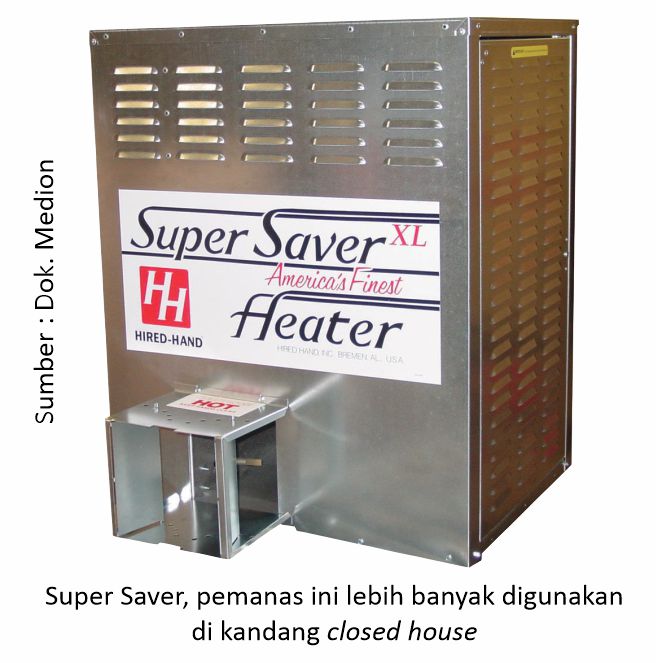
These two types of heaters can be used together to get the best results. Space heater will work to warm the room air while some spot heater like IGM work to warm certain areas of lower temperature.
Meeting The Needs Of The Future Brooding
In addition to controlling the temperature of the cage and conditioning the chicken is always comfortable with a heater, some management actions that can be done so that the future brooding period, the more optimal, among others:
- Prepare a comfortable and clean cage before implementation chick in. Cleaning the cage must be done thoroughly from washing the cage, equipment, spending litter and feces, up to liming and disinfection. Not only cleaning inside the cage, but it is also important to do on the outside and bottom of the cage. The rest period of the cage cannot be shortened and should be applied at least 2 weeks after the cage is clean.
- Ensuring conditions litter optimal with a thickness of 5-8 cm because litter or husk also functions to absorb heat so that the warmth felt by the chicken is more optimal. In addition, prevent the husk from getting wet so that the chicken does not get cold.
- Usage chick guard from zinc material to resist wind flow and as a heat reflector.
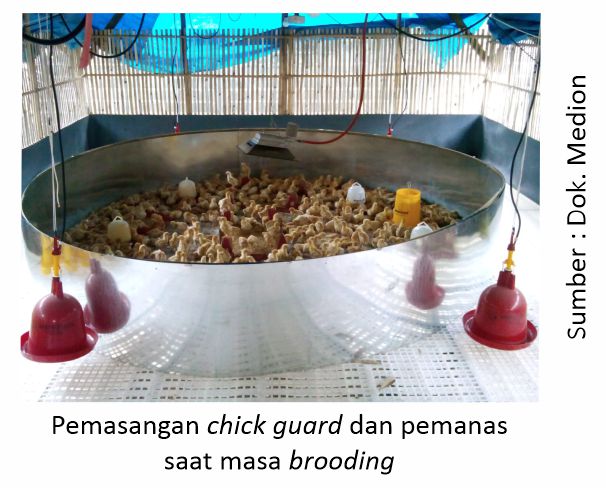
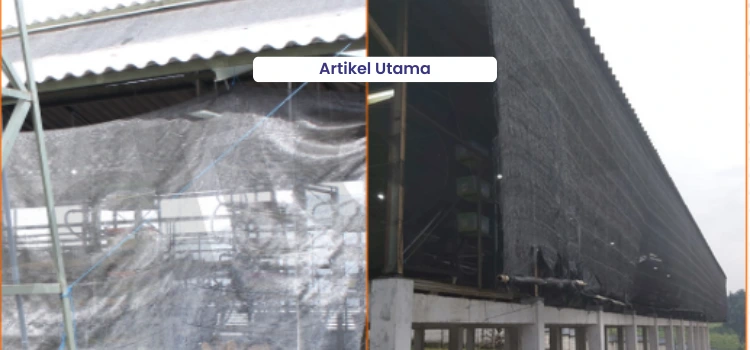
- Time period brooding period,, especially farms with large populations (spacious enclosures) or farm in areas with cold temperatures/high wind flow, usually use two curtain systems, namely the outer curtain that closes the entire scope of the cage and the inner curtain/inner cotton contained in the cage and cover chick guard. The use of curtains in aims to optimize the heat from brooder especially in the mornings and evenings so that the chicks always get a comfortable temperature for their growth. On the 1st to the 3rd day always use the inner curtain. Then at the age of 4 days the inner curtain began to open and at the age of 7 days it was removed.
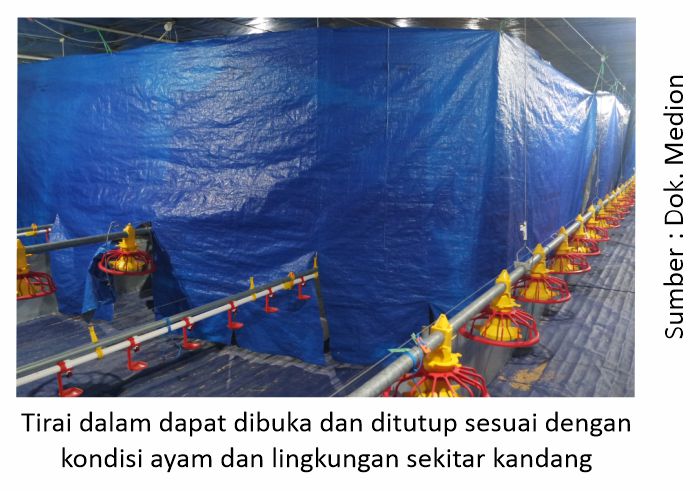
- While the use of outer curtains aims to maintain or control the temperature and humidity of the cage and wind flow.
- Sufficient clean air can also be created by adjusting the density of the cage.
- Rations and drinking water should be given as soon as the chicks arrive because it is beneficial in accelerating the absorption of the remaining yolk which is a temporary source of nutrition and a source of immunity (maternal antibodies) of chicks. In addition, the provision of rations at this time will be able to stimulate the development of the digestive organs through increased digestive capacity and intestinal absorption.
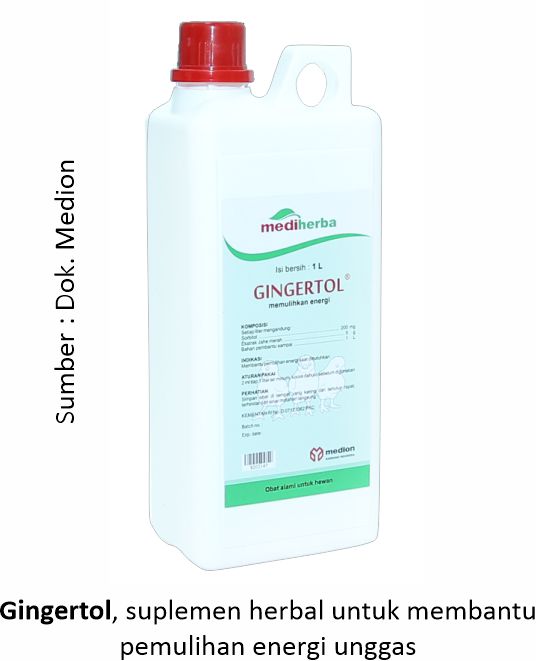
- To replace the energy lost during DOC's trip to farm, give 2-5% sugar water and Gingertol. Prepare immediately before chicks are stocked in chick guard. Give vitamins such as Vita Chicks to maintain the condition of the chicks when the temperature in the cage is uncomfortable. To help improve the functioning of the immune system chicks can be given immunostimulants such as Imustim three days before and after vaccination.
- In the second week, giving Kumavit is a good choice for the maintenance and natural improvement of chicken performance. Then Fithera given at this age as prevention given the high cases of bacterial diseases (Korisa, CRD, Colibacillosis (dyspnea, heart and liver covered by fibrin)) and protozoa (Coccidiosis) in chickens broiler still an enemy to the world of animal husbandry.

- Do the right vaccination program to bully the active immune system when maternal antibodies are not protective as you get older.
- Optimal lighting will encourage chicks to always consume rations and drinking water, and help in the secretion of the hormone thyroxine to speed up the metabolism of the Chick's body. Lighting needs in the future brooding period, is the maximum time for 20-24 hours/day with a light intensity of 1-20 lux. After that, it can be gradually reduced by 2 hours every week as the age of the chicken increases.
The heat (brooder) which plays a very important role at the beginning of chicken rearing in reducing the risk of death and optimizing growth performance. May be useful.