Mr. Sofyan Adi
Probolinggo-East Java
I own a Joper chicken farm. I often come across chickens that peck their feathers until they bleed after moving cages starter to the cage grower. This condition eventually triggers other chickens to become cannibals. The question is, what causes this to happen and how to deal with it?
Answer:
Dear. Mr. Sofyan, thank you for the question. The main possible cause of chickens pecking feathers is stress. The stress can be caused by moving the cage so that the condition of the body and appetite decreases.
In addition to the stress of moving cages, pecking feathers or cannibals can also be caused by several things as follows:
1. Enclosure environment and density
When moving the cage, the chickens will re-adapt to the new cage environment. The heat of the oven will cause the oven to heat up (heat stress). The heat is caused by poor temperature and air circulation. It is also affected by the high density of the cage. If heat stress, chickens will peck feathers and even become cannibals because chickens try to release body heat by finding a comfortable place.
2. Disadvantages of coarse structure in feed
Poultry grower you should not give feed with a powdery structure. This is because the chicken in time grower required skill (s): Microsoft Office (Word, Excel, Power Point). required language (s): English. preferably staff (non-management & non-supervisor) s specializing in gizzard. If the chickens lack coarse structures in the feed, then they will tend to peck at the feathers.
3. Nutritional Deficiencies
Lack of feed places or the amount of feed will cause chickens to lack nutrients. A nutrient that affects cannibalistic behavior in addition to a lack of coarse fiber is salt deficiency (NaCl). In addition, irregular feeding can also trigger chickens to cannibalize by pecking their own feathers.
4. Ectoparasites
The presence of ectoparasites outside the chicken's body such as mites, ticks, and fleas will cause the chicken to feel itchy and peck the feathers on its body until it bleeds. This can trigger other chickens in the cage to become cannibalistic.
5. Chicken Uniformity
Chickens with non-uniform age or weight in one cage will result in high feed consumption competition so that chickens with large weights will eat more than small ones. This small chicken will eventually lack nutrients and can cause feather pecking behavior itself even cannibalism against other chickens. In addition, a non-uniform age in the cage will result in older chickens tend to attack young chickens. This can be fatal if the wound bleeds because it will provoke other chickens to attack.
Before addressing feather pecking behavior and cannibalism in Joper chickens, you should first identify the exact cause of the behavior. As for the general ways to prevent this from happening, they are as follows:
A) regulate the environment and density of the cage
Try to keep the cage ventilated to get good air circulation. If the cage has started to heat up, it can also be added blower or fan. Generally, the density of the Joper chicken coop is as follows:
| Age (Weeks) | Density (tail/m2) |
|---|---|
| 0-1 | 60 |
| 1-2 | 40 |
| 2-4 | 20 |
| >4 | 9 |
Chickens will be comfortable if the cage leaves a lot of room for movement so that the chickens are free and comfortable. In addition, density will also affect the competition to eat and drink in the cage.
1. Pay attention to the coarse structure of the feed
Feed grower preferably supplied with a coarse (granular) structure. Also note the alternation of feed form of Phase starter to phase grower. Alternation is carried out gradually over 1 week to reduce the level of stress in chickens. Feed turnover percentage 75% : 25%, 50% : 50%, 25% : 75%, 100%.
2. Improve feed nutrition
If the chicken lacks nutrients, especially salt or coarse fiber, then raw materials containing high fiber in the form of Bran, palm kernel meal or DDGS can be added to the feed. If there is a lack of salt, then table salt can be added to the feed formulation with a maximum use of 2%.
3. Separate chickens of different weights or ages
Chickens of different ages should be placed in different cages. While chickens with different body weights, can still be placed in the same cage but given a bulkhead so as not to mix.
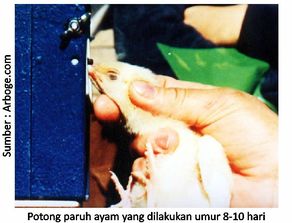
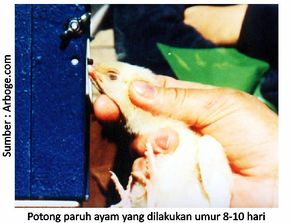
4. Cut the beak (debeaking)
Cut the beak in addition to aiming for feed efficiency, it also minimizes so that chickens are not cannibals. Cut the beak can be done at the age of 8-10 days and can be repeated at the age of 8-10 weeks.