Bapak Yudi Mardiana
Email: denmas.yudi77@yahoo.com
How to deal with flies on farms whose populations increase during the rainy season?
Answer:
Dear. Mr. Yudi, thank you for the question. During the rainy season, the humidity in the cage environment will increase so that the feces tend to be more moist and wet. We need to know that feces containing a moisture content of 75-80% will be an ideal place for breeding flies. In 0.45 kg of damp feces can be used as a breeding ground (survival)1,000 flies.
Adult flies will produce white and oval-shaped eggs. This egg then develops into a larva (brownish white) in a pile of wet feces and out into a relatively dry area to develop into a pupa (cocoon). From the pupa will turn into an adult fly. This is what causes an increase in the fly population.
The fly is not an infectious agent but its role is more likely as a vector or carrier agent of disease seeds. Not infrequently found also flies are perched on chicken rations damp (wet). This is allegedly a way for flies to transmit disease seeds so that they can infect chickens on farms.
Fly control requires proper technique. Fly control measures must be carried out thoroughly, including physical, biological, and chemical control, such as the following:
- Physical control
Try to keep the feces dry and clean the feces by dredging the feces under the stage cage every 3-4 times a day, so that it can break the breeding cycle of flies. Although the rainy season, it should be noted also about the air circulation system (ventilation). Keep providing ventilation gaps on the walls of the cage for air exchange and speed up the drying process of feces.
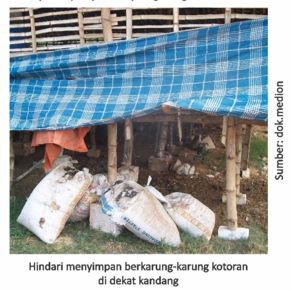
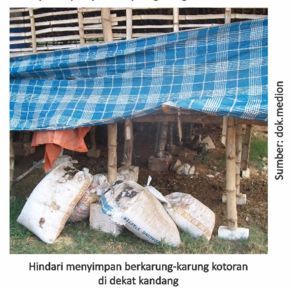
Avoid hasty work, especially in changing drinking water. Do not let water spill into litter or feces. Repairs to the roof of the enclosure and its installation nipple drinker the leak is also the right step in keeping the stool dry. In addition, do Cage sanitation such as immediately disposing of dead chicken carcasses and broken eggs, and waste management must be managed properly so as not to trigger flies to come.
- Biological control. This technique is done by utilizing natural enemies/parasitic flies such as beetles, ticks, and bees. Fly parasites usually kill flies during the larval and pupal phases. One example Spalangia nigroaenea, that is, a kind of WASP (Stinging Bee) that parasitizes or “opponents” for the fly pupa.
- Chemical control. This control technique by giving medicine flies when it has been seen an increase in the population of flies. Even so, the administration of fly medicine is not the core of fly control techniques, but rather a refinement of physical control. In addition, the administration of fly remedies must be carried out appropriately.
Fly repellent drugs can be divided into 2 groups based on how the drug works at the life cycle stages of flies, namely drugs that work to kill fly larvae and kill adult flies. To kill fly larvae, you can use Larvatox, and to kill adult flies, you can use Flytox and Delatrin. Flytox is an insecticide preparation that effectively controls flies in the farm area without causing resistance, works fast, and long-lasting power. Similarly, Delatrin has an effect knock down (kill flies instantly). Flytox is applied by sprinkling, while Delatrin is applied by spray. As a preventive measure, Ammotrol can be given to make the stool texture drier and reduce the smell of ammonia in the cage.