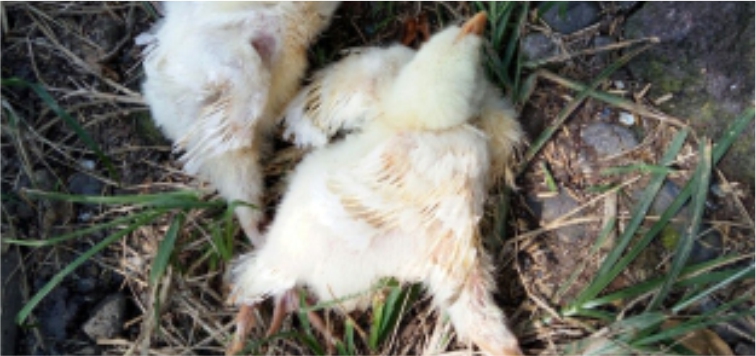
Paralysis in chickens is one of the serious problems that arise in chicken farms. Cases of paralysis are more common in broilers. However, in some cases it can also occur in laying hens. Although the percentage of cases of paralysis is quite small, it does not mean we should take this problem lightly.
Causes of paralysis in chickens
Some chicken farmers may have encountered cases of some chickens that are kept limping, difficult to walk, or experiencing paralysis so that they cannot walk at all. Such chickens will definitely not grow and develop optimally. Eventually will cause higher losses due to increasing numbers culling and increase feed convertion ratio The chickens that we have.
Paralysis in chickens has many causes. In general, the causes of paralysis in chickens can be divided into two factors, among others:
A. Non-infectious factors
Non-infectious factors that can cause paralysis in chickens include traumatic injuries to chicken legs due to Sharp Objects or pinched on the sidelines of the cage floor and nutritional deficiency factors.
Traumatic injuries can cause the chicken to limp even to paralysis. Cases of paralysis due to traumatic injuries are usually individual and are not transmitted from one chicken to another. It is necessary to consider the construction of the cage so that it does not become a predisposing factor for injuries to chicken legs.
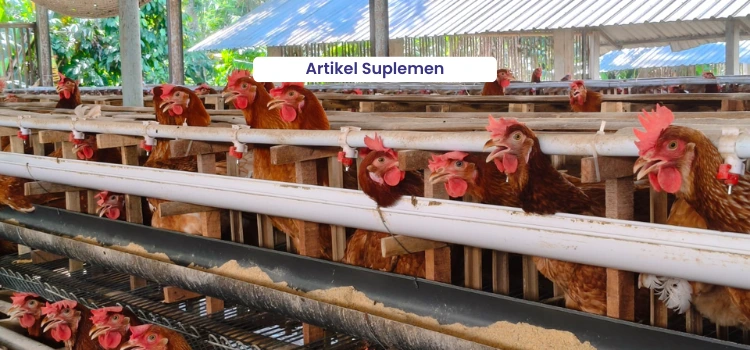
For example, avoid the sharp floor or wall of the cage, if using a stage cage floor with a wooden or bamboo floor, pay attention to the distance between the wood or bamboo. Make sure the distance is ideal and does not result in chicken legs easily mired and entered in the gap between the wood or bamboo.
Injuries due to rough physical treatment can also cause chickens to experience lameness and even paralysis. This rough treatment is common when catching chickens during vaccination, routine weighing, and at harvest time, especially in broilers. If not done properly and carefully can result in injury and even fracture of the foot bones. Chickens that have broken leg bones will show lameness and even paralysis.
Other non-infectious factors are related to nutritional deficiencies, such as calcium and phosphorus. Calcium (Ca) and phosphorus (P) is a mineral that serves as a constituent of the body skeleton (bone) and egg shells in chickens. Deficiency of these minerals can prevent chickens from reaching their full genetic potential.
In Phase laying hens pullet (starter and grower) the adequacy of Ca and P in the ration is very important because they are needed for the formation of the skeleton. Deficiency of Ca and P in chickens pullet it can cause abnormal bone growth. The need for minerals Ca and P in chickens can be seen in Table 1.
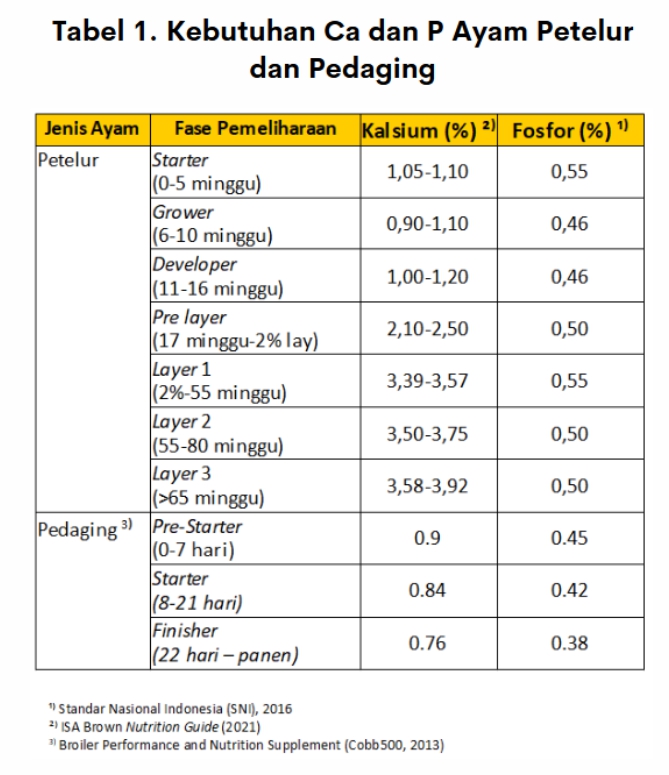
From the table it can be seen that the need for minerals Ca phase layer laying hens will be higher than the phase pullet. This is due to the high need for Ca in order to form eggshells. When it comes to the chicken phase layer if there is a shortage of water, then the water supply will be reduced (reabsorption) the mineral Ca present in the bones. As a result, bones become porous and break easily. Finally the chicken hard to stand and as if paralyzed (tired cage/cage layer fatigue).
In addition to Ca and P mineral deficiency, deficiency of vitamins B and D3, as well as manganese (Mn) minerals can also cause symptoms of paralysis if since DOC or young age chickens experience deficiencies in the intake of these micronutrients.
In laying hen farmers, some farmers use rations with self mixing. To ensure the adequacy of nutrients, especially the mineral content of Ca and P from the given ration. We can do ration nutrition testing through MediLab (Medion Laboratory). So that the occurrence of paralysis in chickens due to nutritional deficiencies can be prevented.
If after testing the ration found the mineral content of Ca and P below the standard, we can add minerals and vitamins such as Mineral Feed Supplement A a total of 1 kg per 50 kg of ration.
B. Infectious factors
Some examples of infectious diseases that can cause paralysis in chickens include:
1. Paralysis due to infection Reovirus
Reovirus viruses of the family reoviridae. Reovirus is a virus with genetic material composed of double stranded (ds) RNA, not amplified, diameter 75 nm, and resistant to heat. Infection Reovirus may cause economic losses in the poultry industry because it can lead to disruption of growth, disruption of achievement of target body weight, increased FCR, increased reject rate, and decreased carcass quality in broilers. Some forms of disease that can be caused by infection Reovirus namely viral arthtritis/tenosynovitis and runting & stunting syndrom.
Viral arthritis/tenosynovitis
The most frequent occurrence of cases of diseases caused by Reovirus the chicken is viral arthritis (VA). As the name implies, arthritis or arthritis it appears as the most characteristic symptom of VA cases because Reovirus. The incidence of VA cases is more common in broilers than in laying hens and usually attacks at the age of 28-49 days. Death rate (mortality) is usually low at less than 6%, while the morbidity rate (morbidity) is high enough to even reach 100%.
The most common symptoms are pain and swelling in the joints of the legs (articulatio tarsometatarsal) and on the soles of the feet. In some cases, a yellowish exudate (fluid) is found in the joint space of the foot.
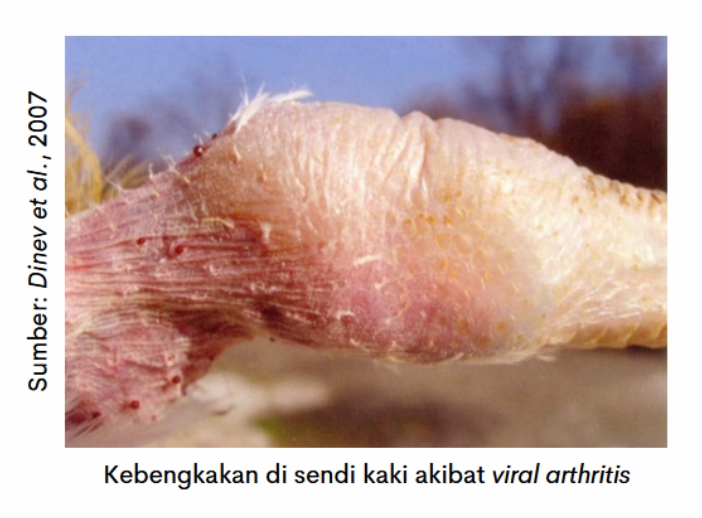
Viral arthritis result tenosynovitis (inflammation of the tendons and tendon sheaths). Tenosynovitis acute is usually characterized by the presence of paralysis in chickens. So when standing or walking the chicken will rest on the joints of the feet and difficult to move. While on tenosynovitis chronic paralysis symptoms will be more striking. When the connection between the muscles and the bones of the foot (tendon gastrocnemius) the chicken is cut off, then the chicken will experience permanent paralysis of the affected leg.
When chicken surgery is performed, fluid accumulation (edema), swelling and rupture of the gastrocnemius tendon, thickening of the leg bone (tibia bone) and the presence of yellow-brown exudate in the joints of the legs can be found. The skin in the area that is swollen is often found Reddish and when touched it will feel hard. The soles of the feet can also be seen swelling, although not often.
Runting & Stunting Syndrome
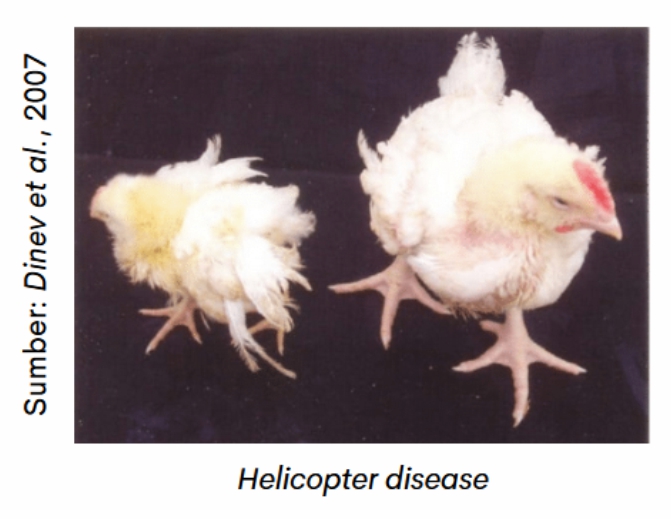
Disease of runting and stunting syndrome (RSS) also known as helicopter disease, malabsorption syndrome (MAS), runting and leag weakness, pale bird syndrome, diarrhea and stunting, brittle bone disease, infectious stunting syndrome.
The cause of this RSS is not yet known with certainty. A number of viruses can be isolated from the intestines or feces of chicks suffering from RSS. Such viruses include Reovirus, enteroviruses, parvovirus, calicivirus, rotavirus non-specific, similar particles togavirus, and coronavirus. However Reovirus is a virus that is often found when isolating the virus from this RSS case.
Called stunting syndrome in case of growth retardation or dwarfism since the chicken hatched. This is caused by vertical transmission from the hen. However, if growth is inhibited due to horizontal transmission (from chicken to chicken) it is called runting syndrome.
RSS disease due to Reovirus infection associated with cases malabsorption syndrome (MAS), which is a symptom that arises in the digestive tract resulting in impaired growth. The most common symptom of this RSS is non-uniform growth, which can be observed from the age of 4-6 days of chicks.
This growth disorder is mainly due to impaired absorption of nutrients or the process of digestion of food. In chicks aged 2-4 days appear to show mild pain symptoms such as lethargy, lazy to move, and hanging wings.
In chicken feces, an incompletely digested ration can be observed. It is also common to find feces covered with yellowish-brown exudate, as a result of which it is often confused with cases of coccidiosis. Other specific signs are abnormal feather growth on the primary wing feathers (which border the feather follicles). In addition, the growth of feathers is also irregular so that it looks like a helicopter propeller. This is what then causes this disease known as helicopter disease.
When necropsy is performed, there is often an enlargement of the proventriculus, which can be accompanied by bleeding or tissue death (necrosis) on the mucosa of the digestive tract. In the gut can be found catarrhal enteritis. In addition, it can also bring up the osteoporosis (bone loss), arthritis, atrophy of the bursa Fabricius and necrosis / death of liver cells. Because in this case RSS can also cause damage to bones and joints, such as osteoporosis and arthritis. So in the case of RSS, it can also show clinical symptoms that resemble VA cases, namely limping, difficulty walking, and even paralysis.
Infection Reovirus in chickens, both broilers and layers have a great impact on the achievement of chicken performance. Forms of infection ranging from viral arthritis and runting & stunting syndrome it can cause the chicken to limp and even paralysis. Chicken will be difficult to reach the place of ration so feed intake will go down and chickens that do not eat of course the growth will not be optimal.
Prevention efforts that we can do is to implement good maintenance management, as well as the implementation of strict biosecurity by cleaning, sanitation, and disinfection both for Cage personnel, vehicles in and out of the farm, and other livestock production facilities.
Characteristics Reovirus it has no envelope on its outer structure. So it is resistant to disinfectants ether, but slightly sensitive to chloroform. Reovirus resistant to pH 3, H₂O₂ at room temperature, 2% Lysol and 3% formalin solution. The Virus can be inactivated with a solution of 70% ethanol and a solution of 0.5% iodine.
Seeing the resistance of the virus to some of these disinfectant agents, we must be observant in choosing disinfectants to prevent Reovirus. We can spray the cage using iodine class disinfectants such as Antisep, Neo Antisep, or Neo Antisep New Formula.
Disease prevention can also be enhanced by vaccinating breeding chickens and laying hens using Medivac Reo at the age of 7-10 days and repeated at the age of 49-63 days at a dose of 0.2 ml by intramuscular injection (through muscle) or subcutaneous (under the skin). Then at the age of 98-105 days do repetition with Medivac Reo Emulsion at a dose of 0.5 ml by intramuscular or subcutaneous injection.
To date, there is no effective treatment for the disease due to infection Reovirus. Selection as well as
do it culling in seriously ill chickens. Antibiotics are usually given to treat secondary infections. Antibiotics that can be given such as Neo Meditril, Tinolin, and Tinolin Injection.
To help increase endurance we can also provide supportive treatment by giving Imustim as immunostimulants (immune system enhancers) or multivitamins such as Vitastress and Fortevit.
2. Paralysis due to infection Herpesvirus
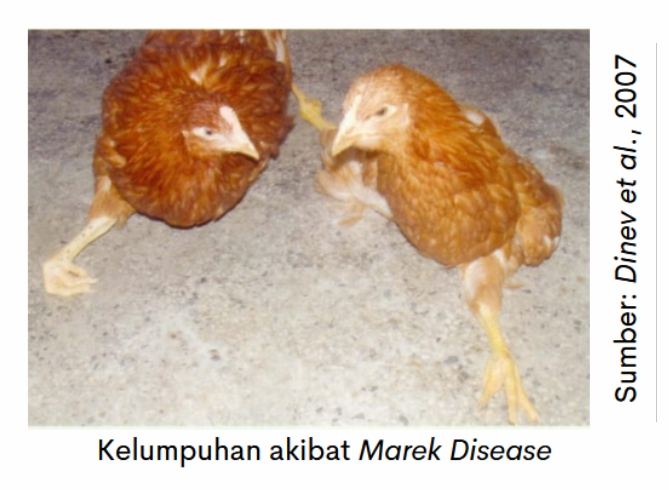
One more disease that can cause paralysis, namely infectious diseases by Herpesvirus or better known as the disease Marek Disease. The incubation period of the disease can last for 2 weeks. An infection that comes from the excretion of the virus from previously infected chickens with an incubation period of about 3-6 weeks.
In acute cases, chickens can die suddenly without showing previous clinical symptoms. While in chickens that can still survive will show symptoms of depression and lethargy, difficulty moving, and continues with paralysis of the limbs (legs and wings), both partial (or all of them).
Clinical symptoms in chronic cases, generally found damage to the peripheral nerves, namely the nerves ischiadicus which is swollen so that it causes paralysis in the legs, nerves brachialis which causes paralysis in the wings (drooping), as well as nerves vagus which leads to impaired breathing, as well as neck twisting or torticollis.
Pathological anatomical changes found when chicken surgery in cases Marek Disease that is, there is an enlargement of one or several peripheral nerves. In addition to enlargement, The Color of the peripheral nerves also turns yellow to gray, loss of latitude, and sometimes visible edema (swelling due to fluid).
Similarly, in the case of Reovirus infection, paralysis due to infection Marek Disease, then the chicken is already not treatable. Actions that can be taken are selection and culling chicken showing severe neurological symptoms. Administration of antibiotics such as Medoxy or Medoxy-LA to treat if a secondary infection appears. Preventive measures that can be done include by selecting DOC, namely choosing DOC from parents who have previously been vaccinated Marek Disease at the breeding farm.
3. Paralysis due to infection Staphylococcosis
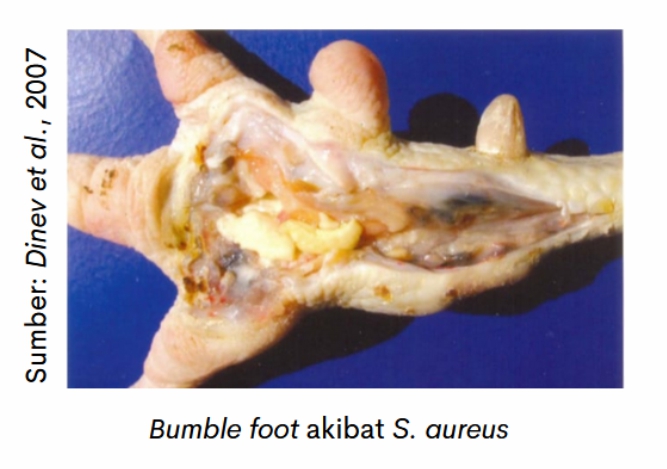
Paralysis caused by a bacterial infection Staphylococcus aureus it often happens to chickens. Poor quality of the cage is a predisposing factor for infection. The paralysis starts from the occurrence of torn or injured skin that is not treated immediately, then infected and swelling occurs. The skin of the feet is usually covered with a layer of skin (foot pads), such as being hit by a sharp wire or bamboo split. The incubation period of bacteria S. aureus lasts quite short about 2-3 days. In other words, when bacteria S. aureus enter through the wound, then 2-3 days later there will be swelling of the soles of the feet or so-called bumble foot.
Another name for this case is bubulan. Swelling occurs due to toxins / toxins released by S. aureus. In the tissues of the soles of the feet, bacteria S. aureus causes the formation of pus so that the soles of the feet swell over time containing perkejuan and chicken limp, weak and paralyzed. This swelling can even reach the knees of chicken legs. Initially case bumble foot this is only seen on one leg, but if it continues more severely, then it does not rule out being experienced by both legs.
When found a chicken that has paralysis or bumble foot, before treatment, select sick chickens in advance. Chicken with bumble foot severe should diafkir because it will be difficult to cure. While the swelling of the joint is not too large or still in the form of a wound, it can still be treated by applying CIL and given antibiotics via drinking water with Neo Meditril, or via injection with Neo Meditrile-I, Medoxy-LA, or Tinolin Injection. To speed up the healing process, after antibiotics can be given multivitamins Fortevit or Vita Stress.
4. Paralysis as a result Avian Mycoplasmosis
Mycoplasmosis caused by prokaryotic microorganisms such as bacteria called also Mycoplasma. One of the cases mycoplasmosis we have heard so much about CRD.)chronic respiratory disease) or cekrek. The causes of this cekrek are species Mycoplasma gallisepticum (MG). In addition to MG, there are species also Mycoplasma others are also known to attack commercial chickens, only more specifically
Mycoplasmosis caused by prokaryotic microorganisms such as bacteria called also Mycoplasma. One of the cases mycoplasmosis we have heard so much about CRD.)chronic respiratory disease) or cekrek. The causes of this cekrek are species Mycoplasma gallisepticum (MG). In addition to MG, there are species also Mycoplasma others are also known to attack commercial chickens, it's just more specifically attacking the joints of the legs so that arthritis arises and eventually paralysis or the case is better known as “infectious synovitis“. Species also Mycoplasma such are Mycoplasma synoviae (M. synoviae).
Mycoplasma synoviae usually infect broilers at the age of 4 weeks, but there are also chickens that are infected at the age of 1 Week. The incubation period varies between 2-21.
When the beginning of infection, in fact, these microorganisms enter through the respiratory system of chickens and directly inhabit the location of the mucous membrane of the respiratory tract. At this early stage, no clinical symptoms will appear, unless the infection M. synoviae this complicates the disease newcastle disease or infectious bronchitis, then new symptoms will appear snoring and inflammation of the air sacs.
Furthermore, when the infection M. synoviae being in the systemic stage / septicemia (which is acute or chronic), M. synoviae it will spread to other organs through the bloodstream. After that M. synoviae will nest in the joints of the legs and abdominal sacs (bursa sternalis) until swelling and symptoms of paralysis occur.
Usually chickens will look lethargic, decreased appetite, and look limp if walking. If the condition gets worse, there will be depression, anemia, paleness of the face and comb, emaciation, and death.
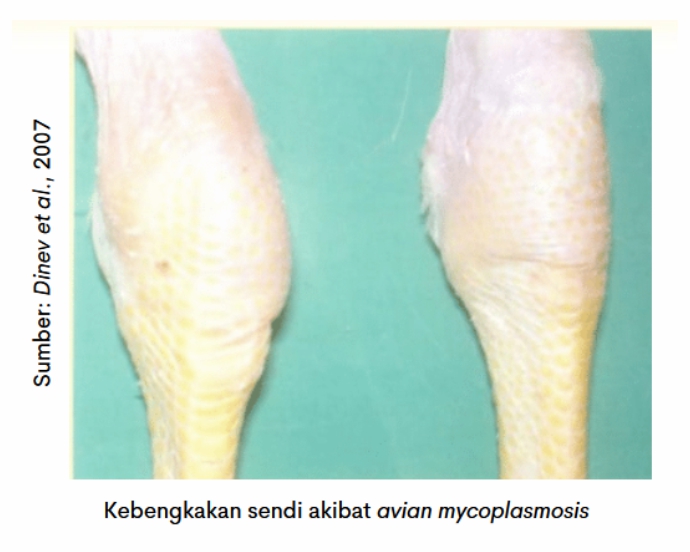
Morbidity from infection M. synoviae it can reach 90-100%, but those that show arthritis generally only range from 5-15% or sometimes it can reach 75% if the health management applied in livestock is not disciplined. While mortality is about 1-10%.
The same is the case with arthritis due to infection S. aureus, when on farms chickens were found with arthritis due to infection M. synoviae, before treatment, selection of sick chickens is carried out. Chickens with severe joint swelling should be immediately diafkir. While the swelling of the joints is not too large, it can still be treated with antibiotics. In choosing antibiotics for the treatment of cases of disease due to also Mycoplasma care must be taken not to choose antibiotics whose mode of action damages the cell wall. This is because also Mycoplasma it does not have a cell wall, so treatment becomes ineffective. Antibiotics that work by damaging cell walls and should be avoided in the treatment of diseases resulting from also Mycoplasma is an antibiotic from the group Penicillin. Therefore we can choose antibiotics from other groups such as Doctril, Neo Meditril, or Tinolin. Then to increase the endurance and stamina of chickens provide supportive treatment with multivitamins Vita Stress or Fortevit.
After we know some of the factors that can lead to paralysis in chickens, it is hoped that we can determine the right strategy to reduce losses due to the incidence of paralysis cases. The implementation of good maintenance management and strict biosecurity is one of the things we can do. Success is always Indonesian breeders.