Email : sapij0745@gmail.com
Are there any drugs to cure clubfoot and dry feet in chickens that are still in the brooding period?
Answer:
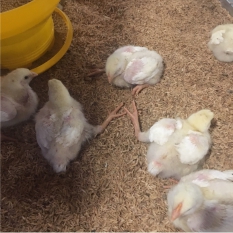
Thank you for the submitted question. Chickens that have symptoms of clubfoot are a sign of paralysis. Sometimes it is found that chickens limp, have difficulty walking, or cannot walk at all. In general, the causes of clubfoot in the brooding period are divided into 2 factors, among others:
- Non-infectious factors
Traumatic can occur in chicken legs due to Sharp Objects or pinched on the sidelines of the basket/crib DOC or brooder cage floor. If the wound is still mild, it can be treated by applying Antisep or Neo Antisep. Other non-infectious factors are related to nutritional deficiencies, such as calcium and phosphorus. Deficiency of vitamins B and D3, as well as the mineral manganese (Mn) can also cause symptoms of paralysis, since DOC or young age if the intake of micronutrients obtained is low. For this reason, giving supplements containing vitamins and minerals such as Mineral Feed Supplement A to newly grown chickens is very helpful to overcome cases of leg paralysis due to nutritional deficiencies.
- Infectious factors
Some examples of infectious diseases that can cause paralysis in chickens include :
a. Reovirus
Chickens aged 1 day (DOC) are usually more sensitive to reovirus infection through breathing (air, red) rather than through the digestive tract. Because of its spread, which can occur from the age of 1 day, the morbidity rate of Reovirus infection is relatively high. Arthritis due to also usually occurs at a young age, namely in the age range of 3-4 weeks. If the infection persists, due to its viral predilection in addition to wiping the tonsils also in the joints, then inflammation/swelling of the legs will appear. Such swelling of the foot usually occurs in the metatarsal tendons extensor and digital flexor. As a result, chicken legs are difficult to move. Other clinical symptoms generally lead to uneven growth, dwarfism, inverted feathers, and increased mortality. When chickens are already paralyzed due to Reovirus infection, then the chicken can not be treated because the cause is a virus. Handling actions that can be taken is to do culling and reject the chicken that has experienced paralysis, giving Vita Stress or Fortevit to help increase the endurance of chickens that still look healthy and speed up the recovery process. Meanwhile, measures to prevent Reovirus infection include buying DOC from chickens that have been vaccinated against Reovirus by breeding companies and optimizing future management brooding period,.
b. Marek diseases
This disease is caused by herpesvirus. In acute cases, chickens can die suddenly without showing clinical symptoms. While the surviving chickens will show symptoms of depression and lethargy, then experience movement disorders, and continue with paralysis of the locomotor apparatus (legs and wings), either partial (one side) or completely. Clinical symptoms in chronic cases, generally found damage to the peripheral nerves in the ischiadicus nerve that causes paralysis of the legs, nervus brachialis causes paralysis of the wings (drooping), nervus vagus which causes disturbances in breathing, as well as the neck becomes twisted (torticollis). It is the same in the case of Reovirus infection, culling and reject chickens that have experienced paralysis, giving high doses of multivitamins such as Fortevit to increase endurance for chickens that still look healthy and improve biosecurity strictly. Measures to prevent Marek infection include buying DOC who has been vaccinated by Marek's nursery company. Marek vaccination can be carried out on day-old chicks (DOC) or in ovo on 18-day-old embryos. Optimize cage and period preparation management brooding period,. Carry out sanitation and disinfection of the cage and the eradication and Prevention of the entry of virus-carrying insects into the cage.
As for dry feet, then the thing that needs to be done is:
- Give 2-5% sugar water and Gingertol to replace the energy lost from the chicken's body as soon as DOC stocked up.
- Along with the provision of drinking water, give rations immediately little by little because it is useful in accelerating the absorption of the remaining yolk which is a temporary source of nutrients and a source of immunity (maternal antibodies) chicks. As well as being able to stimulate the development of the digestive organs through an increase in the digestive and absorption capacity of the intestine.
- The number and distribution of rations and drinking places must also be in accordance with the population and evenly so that chickens can eat at the same time. The place where the ration is used should be specially designed for chicks such as Take care of the DOC or DOC's ration place.
- Check the consumption of rations and drinking water, 2-3 hours after the first ration through tactile cache. Consumption of rations is said to be good when at least 75% of the sample DOC palpable chewy and soft which indicates that the chicken has consumed enough rations and drinking water.
- When the temperature brooding period, detected overheating, then the farmer must regulate the use of heaters by lowering the temperature according to the needs of the chicks.